What Is Egocentric Data Collection?

Leela Yanamaddi
September 14, 2026
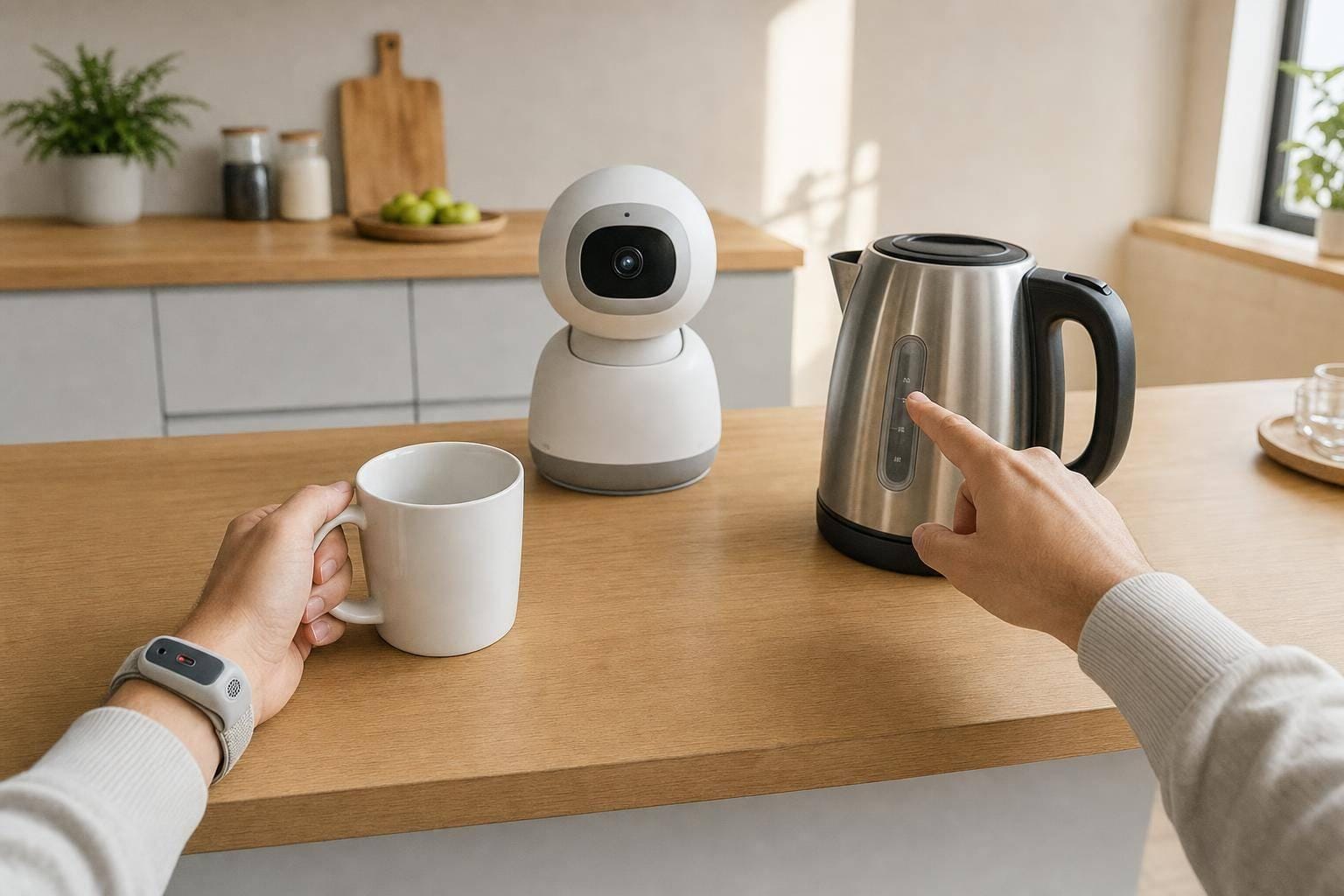
Egocentric data collection means recording work from a person’s own point of view so robots can learn from the same kind of view they will have when deployed.
I’d sum it up like this: it combines first-person video with sensor data like IMU, depth, gaze, hand pose, audio, and task labels. The goal is to turn human task demos into training data for robots, manipulation systems, and VLA models. And the process only works well if the data is synced, labeled, checked, and handled with clear privacy rules.
Here’s the short version:
- Egocentric = first-person view
- Exocentric = outside view, like a wall or ceiling camera
- Teams often collect 30–60 FPS video and 200–400 Hz IMU
- Extra signals like depth, gaze, and hand pose help with fine motor tasks
- Data must be time-aligned, labeled by task step, and checked before training
- Use cases include warehouse work, assembly, maintenance, and human demos for robot learning
- Privacy rules, consent, redaction, and access control are part of the pipeline
- Large projects have shown gains, including 54% higher robot manipulation success after pretraining on large first-person human video sets
If you want the simple answer: this is how teams turn human work into robot-ready training data from the human’s own view, not from a room camera.
That viewpoint match is the whole point. It helps close the gap between what a person sees during a task and what a robot sees when it tries to do that same task.
Robot Learning by Understanding Egocentric Videos
What Data Is Collected in Egocentric Recording Programs
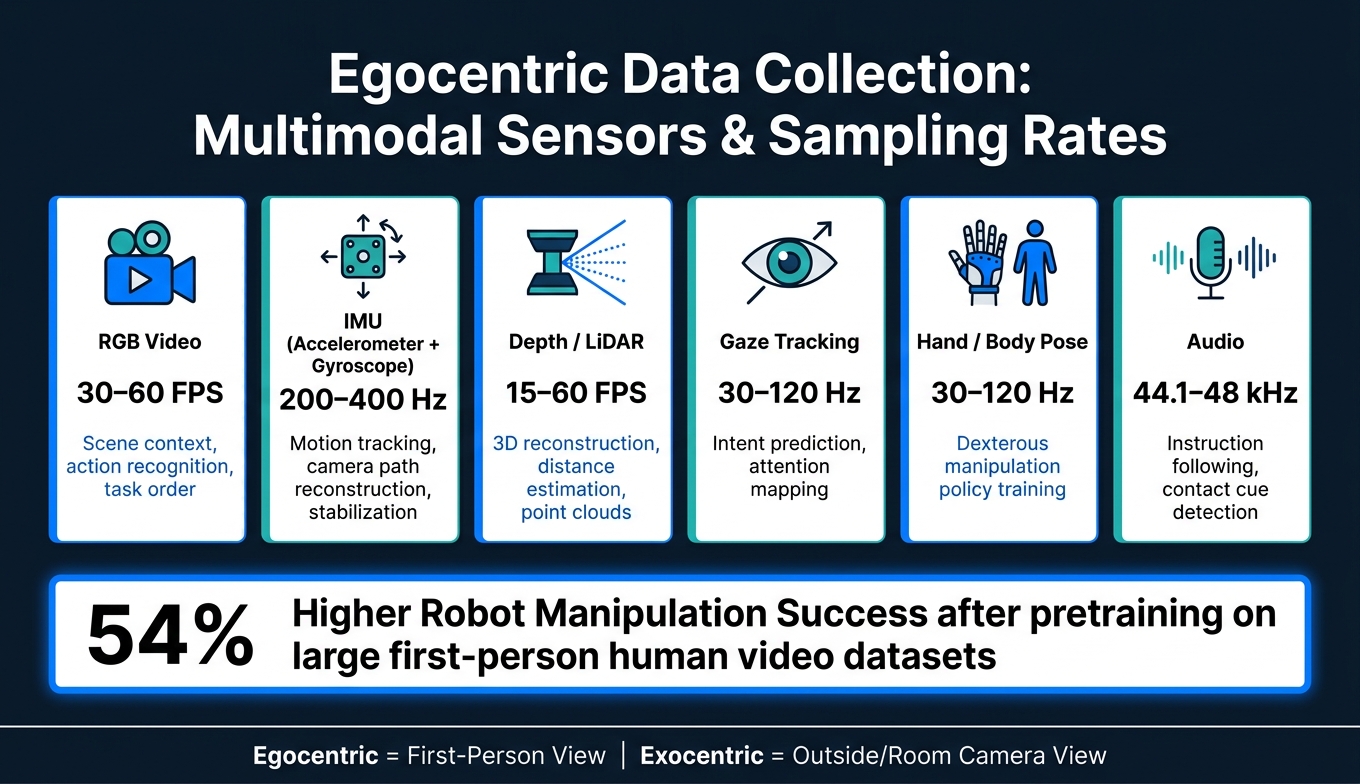
Egocentric Data Collection: Multimodal Sensors & Sampling Rates
Primary Visual and Motion Streams
Most programs begin with head-mounted RGB video at 30–60 FPS. That stream gives you the scene, the order of actions, and the flow of the task from the wearer’s point of view.
Many setups also record wrist-mounted video to match the robot end-effector view. That extra angle helps when the hand is doing the part that matters most.
IMU data - accelerometer and gyroscope readings at 200–400 Hz - fills in motion details that video alone can miss. It helps track movement, rebuild camera paths, and steady footage when parts of the scene get blocked.
Multimodal Signals That Improve Training
RGB and IMU cover the core inputs. But for harder tasks, extra signals can make a big difference.
Depth sensors and LiDAR add 3D structure for navigation and manipulation. Instead of just seeing a surface, the system can estimate shape, distance, and layout.
Some programs also collect gaze data to show where a person is looking during a task. That can help models learn attention patterns tied to intent.
Hand and body pose data matter a lot for fine motor work, especially per-joint tracking of fingers and wrists. EgoDex pairs 829 hours of video with 3D hand and finger tracking across 194 tabletop tasks. Audio adds another layer by picking up spoken instructions and contact sounds that can signal when one step ends and another begins.
Of course, raw signals alone don’t do much. They need to be labeled and lined up in time.
Common modalities and rates are below.
| Modality | Typical Sampling Rate | Key Contribution |
|---|---|---|
| RGB Video | 30–60 FPS | Scene context, action recognition, task order |
| IMU | 200–400 Hz | Motion tracking, camera path reconstruction, stabilization |
| Depth/LiDAR | 15–60 FPS | 3D reconstruction, distance estimation, point clouds |
| Gaze | 30–120 Hz | Intent prediction, attention mapping |
| Hand/Body Pose | 30–120 Hz | Dexterous manipulation policy training |
| Audio | 44.1–48 kHz | Instruction following, contact cue detection |
Task Metadata and Outcome Labels
Task IDs, success labels, and temporal segments make recordings searchable and trainable. In practice, these fields let training pipelines filter examples, split sequences, and assign the right weight to each clip.
Governance fields matter too. Track consent and redaction status, and keep raw footage locked down until review clears it for annotation.
At scale, annotation is what turns raw recordings into training data. EgoLive shows what that looks like: 1,680 hours of stereo video at 60 FPS across 346 tasks, with automated annotations for 6D motion tracking, 3D hand keypoints, and sub-task segmentations. Without that annotation layer, the footage is much less useful for training.
The next step is turning these streams into synchronized, quality-checked datasets.
How Egocentric Data Collection Works in Practice
Designing Collection Programs for Specific Tasks
Start by mapping the robot task step by step. Lay out the objects involved, the hand actions, the ways things can go wrong, and how the setting may change. In warehouse picking, that usually means navigation, grasping, and barcode scanning. In factory assembly, it includes routine work like fastening bolts and less predictable moments like rework and tool changes.
Before a team scales anything, pilot runs matter. A small set of workers records a sample of the target tasks, then the team reviews the footage closely. They check whether hands and objects stay in frame during key actions, whether labels and screens can be read, and whether motion blur or blocked views get in the way. Pilots also surface workflow gaps, like moments when a worker turns away or the camera gets covered. That gives the team a chance to change mounting positions, add secondary sensors, or tighten contributor instructions before large-scale collection starts.
A task matrix helps keep this organized. It lists each task step, the camera angles needed, the variations the team expects to see, and the metadata fields tied to each clip. That way, the program records both normal behavior and edge cases. The goal isn't just to document a process. It's to define what the robot needs to learn.
Those task maps also shape the rest of the pipeline. They tell annotators what to label and tell QA what to check.
Annotation, Synchronization, and Quality Checks
Annotation is the step that turns recordings into clips a policy can train on for manipulation, navigation, and error recovery. Teams split long recordings into smaller segments such as "approach shelf", "reach and grasp", and "scan barcode." Those segments line up with decision points in robot control policies. Annotators then add action labels, object labels, and hand interaction details like grasp type and contact points.
Synchronization starts during capture, not after. Every device in a session needs a shared time reference. That may come from NTP-synchronized clocks, hardware timecodes, or plain calibration events like a clap or an LED flash that shows up across sensors. Over long sessions, timestamp drift can throw sensors out of sync. So data pipelines flag sessions when drift passes the allowed threshold, then either correct the timestamps or remove the affected segments.
Quality checks usually cover four areas:
- Structural: file integrity, resolution, and duration
- Temporal: timestamp consistency and episode boundaries
- Sensor alignment: sync across RGB, depth, IMU, and audio
- Semantic: label consistency and annotator agreement
These checks decide whether a recording remains raw source material or moves into the training dataset.
Ego4D shows what this looks like at scale. Across 1,074 labeled videos, annotators rejected 18,839 interaction labels during QA to keep noisy labels and corrupted segments out of training.
That process is what turns footage into data a robot team can actually use.
Raw Recordings vs. Training-Ready Datasets
Raw recordings are just the starting point. Training-ready datasets have been labeled, synchronized, and cleared through QA. The aim of QA is simple: make the dataset ready for training, evaluation, and benchmarking so model teams don't have to do one-off cleanup every time they use it.
Once a dataset passes QA, it is ready for robotics training and evaluation.
Where Egocentric Data Is Used in Robotics and Industrial Settings
Warehouse and Logistics Workflows
Once recordings are synced and labeled, the next step is using them for specific shop-floor tasks. Warehouses are a strong match for egocentric capture because the work is repetitive, highly visual, and centered on objects.
First-person footage shows the exact signals workers use in the moment: how they scan a shelf to find an item, how they grip and place objects of different shapes and sizes, and how they deal with a misplaced or damaged product. That kind of footage gives robotics teams training data from actual fulfillment work, not polished lab demos.
A large warehouse dataset can show these patterns across many tasks while still keeping the small details that matter.
Factory Assembly and Maintenance Work
Factory work also fits egocentric recording well because many tasks are step-by-step, precise, and tied to safety. Things like component alignment, fastening, cable routing, torque application, and routine inspection depend on exact hand position and tool use. First-person video is often the best way to capture that.
IndustReal shows this clearly - 84 egocentric video sequences from 27 participants performing standardized assembly and maintenance procedures, paired with 3D models of the assembled parts. These recordings matter because they show how workers move through each step, use tools, and deal with exceptions under actual production conditions.
Human Demonstrations for Embodied AI and VLA Models
Human demonstrations connect raw egocentric footage to robot behavior. When a person carries out a task - picking the right-size box, routing a cable, replacing a filter - that recording becomes a training example linking visual context, hand movement, and the end result.
For embodied AI and vision-language-action (VLA) models, the aim is not just to teach a system what a scene looks like. It is to teach how actions tie to language goals and physical outcomes. Human egocentric recordings supply the demonstration data used to train manipulation policies, workflow automation, and VLA models on actual operational tasks.
That also means annotation, synchronization, and workplace governance belong inside the data pipeline from the start, not as something added later.
What Organizations Need to Get Right
Privacy, Consent, and Workplace Data Governance
Once recordings are in hand, the next issue is simple: who gets to use them, and under what rules? After capture and QA, governance is the last checkpoint before data can be used for robot training, manipulation policies, or VLA model development.
Put three rules in writing:
- allowed uses
- data owners
- pre-launch risk review
Access controls do two jobs at once. They protect worker privacy, and they help keep training data clean and trustworthy. Consent language should spell out what is being recorded, how long it will be kept, who can see it, and whether faces or screens will be redacted. Bystanders should get notice too. In some cases, that also means face blur or no-recording zones before footage leaves the site.
Raw footage should be kept for a short window for QA and annotation. Redacted datasets can stay longer, but under tighter controls.
With access rules in place, dataset design becomes the next quality check.
Dataset Usability Requirements for Enterprise Teams
Governance makes data usable. Structure makes it reusable.
The most reusable egocentric datasets use a standard record format for each task episode. That means storing start and end conditions, success or failure flags, object and tool IDs, task labels, and environment context.
Teams also need to track balance across task types, success and failure cases, and sites. Otherwise, models may work well in one facility and fall apart somewhere else. Clear licensing and access terms should be written into contracts with annotation vendors and AI partners, including data rights, confidentiality, and limits on derived models.
Conclusion: Why Egocentric Data Collection Matters for Physical AI
Egocentric data collection records first-person human work in a form robots can learn from. First-person video, paired with motion, depth, and task metadata, gives robotics teams training signal tied to how people actually see, move, and finish tasks in the physical world.
Multimodal capture, annotation, quality control, privacy, and dataset structure turn raw footage into durable Physical AI infrastructure. When those parts line up, egocentric data becomes a reusable training asset instead of a one-off pilot.
FAQs
Why is first-person data better for robot training?
First-person data matters for robot training because it shows tasks from the human point of view. That includes how people look at a scene, move through it, and handle objects during day-to-day work. Egocentric video and demonstrations give models a practical starting point for actions that are tough to spell out with rules or sensor logs alone.
Just as important, this kind of data shows human judgment in messy, imperfect settings. It reflects physical interaction as it happens, not in a neat lab script. That helps AI learn what successful task execution actually looks like when the environment is cluttered, variable, or a bit unpredictable.
Teleoperation interventions add another layer. They provide high-quality labeled examples that can sharpen performance and help systems deal with edge cases that don’t show up often but matter a lot when they do.
What makes egocentric data training-ready?
Egocentric data becomes training-ready when raw multimodal captures are turned into structured, context-rich records. In plain English: the system needs to line everything up so it can be used later without guesswork.
That usually means synchronized timestamps and standardized asset IDs that tie video and sensor streams to specific tasks, worker IDs, and machine states.
Quality depends on more than clean formatting, though. You also need automated checks for missing data and drift, expert review to confirm demonstration accuracy, and clear reason codes or escalation paths for interventions, overrides, and failures.
How do teams protect privacy during recording?
The available information does not spell out privacy protection protocols or consent management practices for egocentric data collection.
Put simply, this source does not explain how teams protect privacy during recording.