The Hidden Fuel Behind Every AI Robot: High-Quality Human Data

Leela Yanamaddi
August 13, 2026
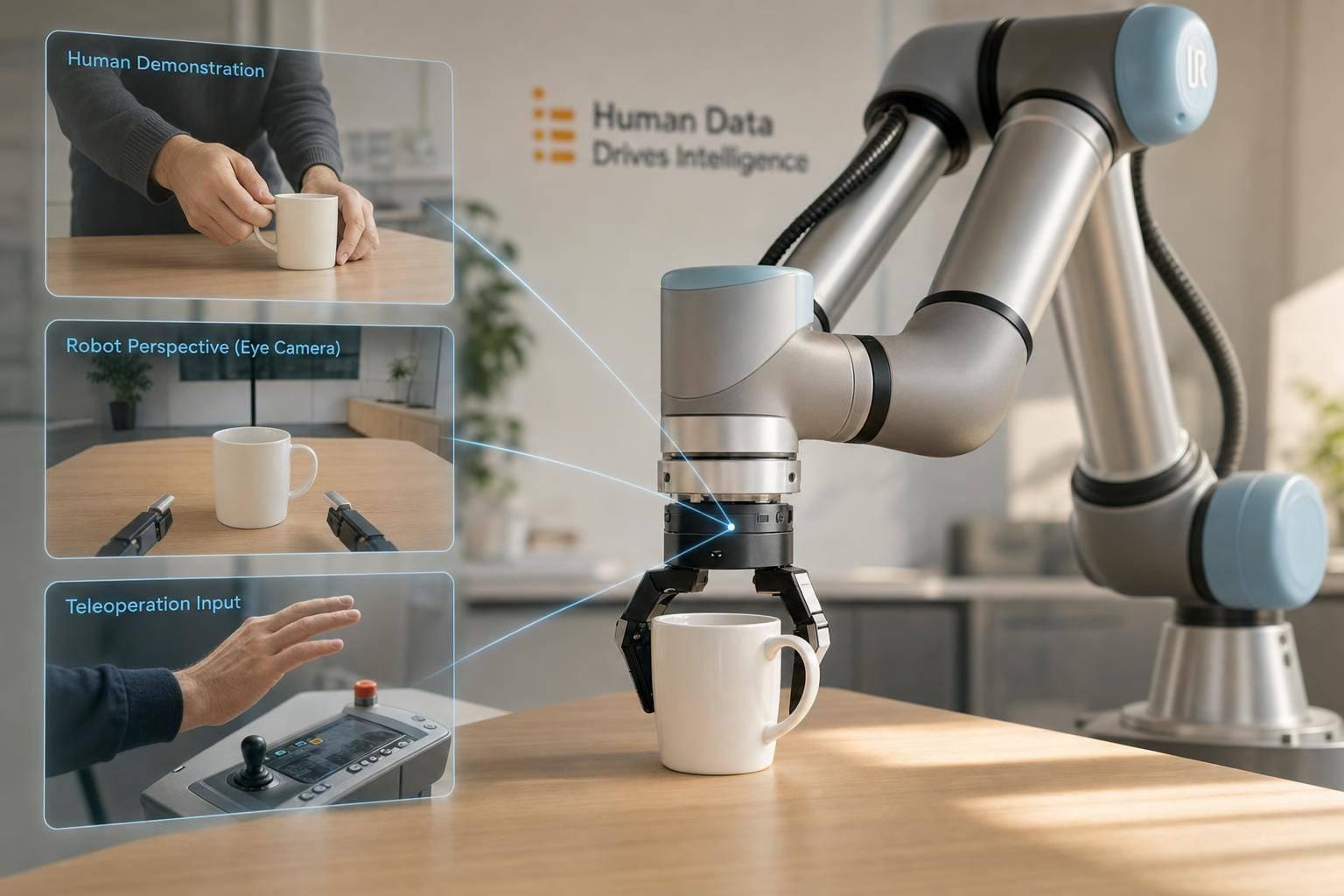
Most robot failures start with bad training data, not bad hardware. If I had to sum up the article in one line, it would be this: robots get better when teams collect cleaner human data, label it well, and feed field mistakes back into training.
Here’s the short version:
- Physical AI runs on human data. Unlike language models, robots can’t learn their jobs from internet-scale text. They need people to show tasks, record actions, and mark what happened.
- The data bar is high. Many Vision-Language-Action models need 10,000 to 20,000 hours of labeled trajectories, and companies are already spending more than $100 million a year to get that data.
- Weak data breaks robots in the field. Common issues include missing recovery examples, camera-view mismatch, poor labels, and timing drift.
- Viewpoint matters. Research cited in the article says 1 hour of high-quality egocentric human video can add more to policy performance than 1 extra hour of robot teleoperation data.
- Small errors can wreck training. A 10 ms timing mismatch on a 30 Hz stream can corrupt the learning signal, and 3–5 mm of calibration drift can damage precision task data.
- More data isn’t always better. Filtering out low-score episodes can improve success rates more than adding large amounts of unfiltered data.
- The best pipelines keep learning after deployment. When teams log human fixes, tag failures, and send those records back into training, robots stop repeating the same mistakes.
If I were reducing the full article to its core message, it would be this:
Better robot performance comes from four things:
- Collect data from the same settings the robot will face on the job
- Use the right data types - demonstrations, egocentric video, teleoperation traces, and feedback
- Check timing, calibration, labels, and trace quality before training
- Turn field failures into new training data
In other words, data quality matters more than raw volume. That’s the main point of the piece.
Good vs Bad Robot Demonstrations: Developer's Guide to Collecting Data for GR00T
The Problem: How Weak Human Data Causes Robots to Fail
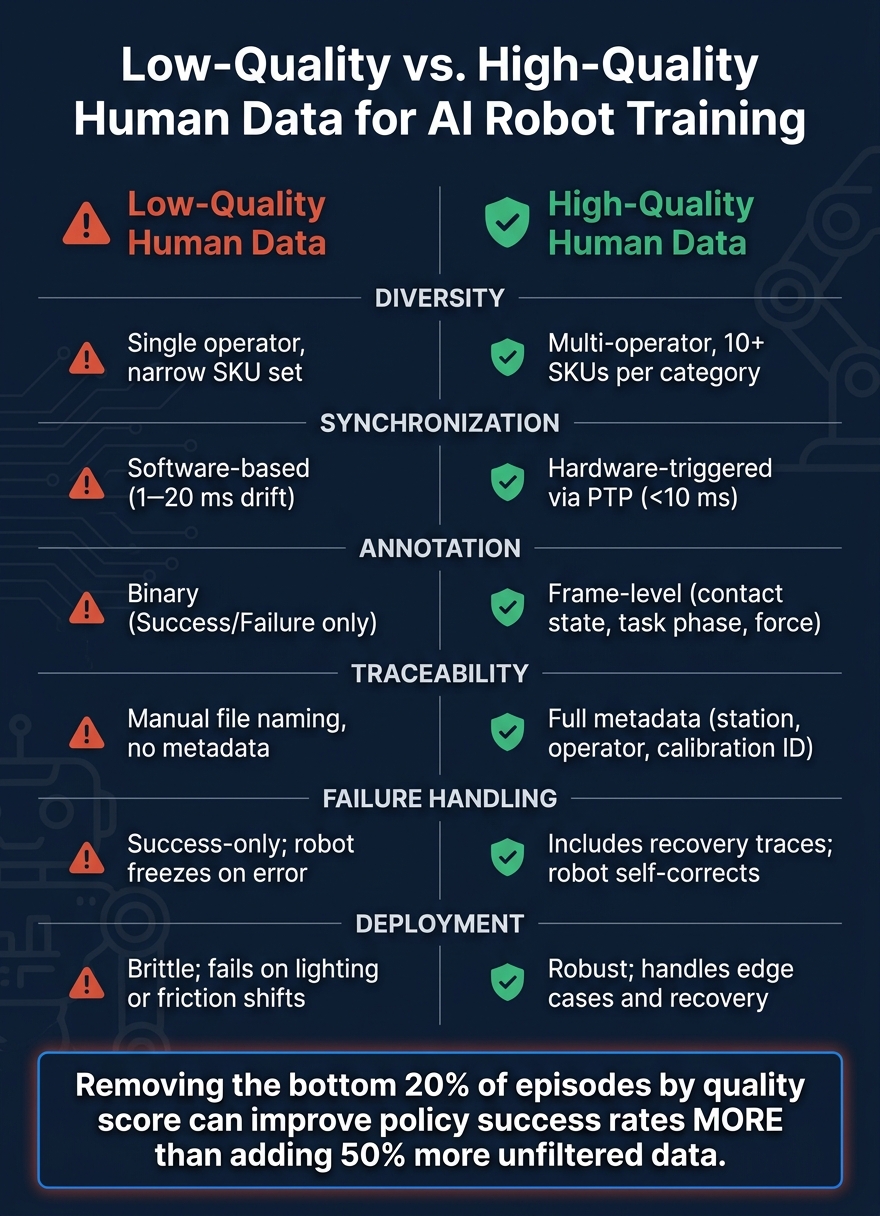
Low-Quality vs High-Quality Human Data for AI Robot Training
Weak human data makes robots brittle. A system may look solid in the lab, then fall apart once conditions shift on the factory floor. The biggest reasons are pretty plain: missing recovery examples, viewpoint mismatch, and noisy labels.
Robots Without Enough Real Demonstrations Are Unprepared
Physical work in the world is messy. Objects slide, surfaces change, and tasks don't always happen in a neat sequence. But many datasets leave out recovery traces. So when a grasp slips or an object rolls away, the robot has no learned response, even though those events show up in 5% to 15% of real-world operations.
There's another problem people run into during collection: fatigue. Without a structured process, operators tend to fall into repetitive motion after 60 to 90 minutes, which shrinks task coverage.
And even when a dataset includes full demonstrations, things can still go wrong if the robot learns from the wrong point of view.
Third-Person Video Misses What the Robot Actually Sees
Camera mismatch is a common failure mode. A wrist-mounted robot camera sees the scene from a very different angle than a fixed camera in the room. Fixed-camera footage often misses the hand-object interaction zone and gets blocked by occlusions. That leaves the robot trying to learn from a view it won't have at inference time.
Egocentric video helps because it keeps the hand-object interaction front and center. Research from the EgoMimic project (Georgia Tech and Stanford, 2024) found that 1 hour of high-quality human egocentric data, captured with Meta Project Aria glasses, added more to robot policy performance than 1 additional hour of direct robot teleoperation data.
That result matters because policies trained on the wrong viewpoint tend to overfit to background cues that vanish later. And the margin for error isn't huge. Even a 15° mismatch in camera field of view can make a robot miss a grasp.
Even then, the right viewpoint won't save a model if the labels are bad.
Poor Labels and Feedback Make Model Training Noisy
Bad annotations can quietly poison training. If someone marks a grasp as successful because it looks okay on video, but the grasp slips under real load, the model learns the wrong lesson. In plain English: wrong labels teach robots to accept unstable behavior.
"An annotator who cannot distinguish a stable grasp from a marginal one will label marginal grasps as successful, introducing systematic failures into the training set." - Digital Divide Data
Timing errors add another layer of noise. On a 30 Hz image stream, a mismatch of only 10 ms between sensor data and recorded actions is enough to corrupt the training signal. Software timestamps drift more easily than hardware-triggered sync, which makes this a data collection issue, not just a model issue.
Here’s how the gap looks across the areas that matter most in deployment:
| Feature | Low-Quality Human Data | High-Quality Human Data |
|---|---|---|
| Diversity | Single operator, narrow SKU set | Multi-operator, 10+ SKUs per category |
| Synchronization | Software-based (1–20 ms drift) | Hardware-triggered via PTP (<10 ms) |
| Annotation | Binary (Success/Failure only) | Frame-level (contact state, task phase, force) |
| Traceability | Manual file naming, no metadata | Full metadata (station, operator, calibration ID) |
| Failure Handling | Success-only; robot freezes on error | Includes recovery traces; robot self-corrects |
| Deployment | Brittle; fails on lighting or friction shifts | Robust; handles edge cases and recovery |
So the issue isn't just getting more raw data. It's building a cleaner pipeline to collect it, check it, and feed it into training.
What High-Quality Human Data Looks Like in Physical AI
Weak data usually comes from a simple problem: the data doesn’t match the robot’s job.
For Physical AI, good human data is multimodal, synchronized, and tied to task results. Different data types do different jobs. Demonstrations show task flow. Egocentric video fixes viewpoint mismatch. Teleoperation records robot-native control. Feedback data shows how recovery happens. Each one helps with a different failure mode, whether that’s missing recovery behavior, bad viewpoint alignment, or noisy labels.
Demonstrations, Egocentric Video, and Teleoperation Traces
Each data type adds a different signal. None can fully stand in for the others.
Human demonstrations show how a person completes a task in the physical world. That makes them useful for teaching task structure. But there’s a catch: the robot still needs that behavior translated into robot motion before policy training can start.
Egocentric video fills the gap that third-person cameras often leave behind. A wrist-mounted or head-mounted camera keeps the view close to what the robot needs to “see” during task phases and object handling. That matters a lot when small hand movements change the outcome. The downside is pretty clear: egocentric video is only visual data, so it still needs action labels or some mapping into robot motion before training.
Teleoperation traces are the closest thing to ground truth. The operator controls the robot directly, so the recording already lives in the robot’s control space. Every joint state, gripper command, and force-torque signal is captured inside the robot’s native control loop. That makes teleoperation highly faithful. It also makes it expensive. Every recorded minute needs a robot, an operator, and a live setup. Industry estimates put high-quality teleoperation data at $30 to $120 per minute of usable recording.
Put simply, teleoperation is the most faithful but the hardest to scale. Egocentric video scales the best. Demonstrations land somewhere in the middle. Feedback data becomes especially useful when deployment correction matters.
Raw traces, though, aren’t enough on their own. Before a model can learn from them, they need labels.
Task Annotations and Human Feedback That Improve Reliability
Metadata is what turns a recording into training data.
Phase labels like approach, grasp, insert, and release teach the model task structure, not just motion. That helps the robot choose the right action at the right moment during an actual task. Object references and natural language instructions matter even more for vision-language-action (VLA) models, because those models need text-grounded descriptions to generalize across tasks. Success and failure flags, along with termination reasons, tell the model which behaviors to copy and which ones to avoid.
Feedback data matters after deployment, when the robot starts making mistakes in the wild. Operators correct failures during live use, and those corrections feed a learning loop that narrows the gap between early training and production reliability. In plain English, this is how a robot stops making the same mistake over and over.
Intentional failure and recovery demonstrations should make up 5% to 30% of a production training set, depending on how high-stakes the task is.
Quality Standards That Make Data Usable at Scale
Even with strong data sources, collection falls apart fast if the standards are loose. Three thresholds matter most.
- Timestamp alignment: For manipulation tasks, action-observation timestamps need to line up within 10 ms. Software-only logging often adds 10–50 ms of jitter, and that’s enough to corrupt action labels in behavior cloning. A practical fix is hardware synchronization with Precision Time Protocol (IEEE 1588).
- Extrinsic calibration: The spatial relationship between cameras, sensors, and the robot base needs daily checks. A drift of just 3–5 mm can ruin precision assembly data.
- Label consistency: Professional annotation programs should target inter-annotator agreement of κ ≥ 0.8 using Cohen’s kappa. Without clear protocols, disagreement on multi-step tasks runs 12–18%.
As tasks get harder, training data needs climb fast, which makes filtering even more important. In teleoperation datasets, keeping only the top 25% of demonstrations by quality score has been shown to improve imitation learning success rates by 30–50% on contact-rich tasks.
Those rules only help if the collection pipeline enforces them day after day. The next step is turning these data types into a repeatable collection and quality-check process.
How to Build a Human Data Pipeline That Improves Robot Performance
Once you know which data types matter and where the quality bar sits, the next job is building a pipeline that enforces those rules in practice.
Scope Data Collection Around Real Tasks, Environments, and Failure Modes
One of the most common mistakes is simple: teams train in one setting, then deploy in a different one. That gap can wreck performance. If a robot will work under certain lighting, on certain surfaces, around a certain object mix, and with shifting friction, then training data should come from those same conditions.
It also helps to push variation on purpose. Aggressive pose randomization matters here. In one case, using ±10 cm of XY position variation and ±45° of yaw variation improved zero-shot transfer from 34% to 73%. That’s a big jump, and it shows why controlled variation beats narrow data collection.
Failure cases shouldn’t be left to chance either. Script them ahead of time instead of waiting for edge cases to show up on their own. If a robot is likely to miss grasps, collide lightly, slip on certain surfaces, or face cluttered layouts, build those situations into collection from day one.
Operator fatigue matters too. Keep sessions tight: 90-minute blocks with 15-minute breaks. Action jitter rises by 18% in the final 20 minutes of a 2-hour session. In plain terms, tired operators make messier data.
Scoping the right task is only half the battle. The capture process also needs to protect that task fidelity.
Check Data Quality Before It Reaches Model Training
Bad data has a way of sneaking in quietly. That’s why quality checks need to happen before anything reaches training.
Use one PTP-synchronized clock with hardware triggers so sensor streams stay aligned within <1 ms to 5 ms. If timing drifts, labels and observations stop lining up, and that can poison a dataset fast.
Camera calibration needs daily checks too. A drift of just 3–5 mm can silently corrupt point cloud registration and grasp labels during multi-week campaigns. It sounds small, but in robotics, a few millimeters can be the whole game.
A few filters usually pay off right away:
- Remove high-jerk trajectories that point to hesitation or operator uncertainty
- Flag duration outliers, since they often signal incomplete tasks or hidden recovery attempts
- Review episodes that look clean on the surface but break timing, calibration, or task-flow rules
In production, pipelines often reject 20–40% of raw episodes through automated filters and manual QA. That may sound harsh, but it’s often the right call. In fact, removing the bottom 20% of episodes by quality score often improves policy success rates more than adding 50% more unfiltered data.
Turn Robot Operations Into a Continuous Learning Loop
Some of the best training data shows up after deployment, when people step in to fix failures the model didn’t see coming.
That’s why every intervention should be logged as training data. Include the task variant, environment state, operator ID, and calibration status. More specifically, tag records with UUID, operator ID, robot ID, task variant, lighting, and calibration state. That level of tracking creates a feedback loop between early training and what happens in production.
"Human behavior is not just a bootstrap tool. It is often one of the richest signals available for understanding task intent, failure boundaries, and recovery strategy." - Robotics Center of Silicon Valley
A managed collection and teleoperation layer can send field failures back into training without launching a separate data campaign. When that pipeline is tied to live operations, each deployment cycle feeds the next round of model improvement. That’s how day-to-day robot use starts producing better robot performance.
Conclusion: Better Human Data Builds Better Robots
Every capable AI robot depends on human data. Demonstrations, egocentric video, teleoperation traces, annotations, and feedback each shape reliability in their own way. Put them together, and they decide whether a robot holds up in deployment.
When robots are trained without enough real demonstrations, they go into the field unready for actual conditions. Third-person video can introduce distribution gaps that quietly break policies. Poor labels and noisy feedback weaken the models built on top of them. In plain terms, data quality is often the line between lab success and field failure. These are data problems, not hardware problems.
One point stands out: quality at collection matters more than volume at training. A curated 25,000-episode dataset can beat an unfiltered 100,000-episode dataset.
So it helps to treat human data like core infrastructure, not a side task. That means:
- Scoping collection around real deployment settings
- Enforcing quality gates before data reaches training
- Feeding field failures back into training
Teams that work this way don't just get better early results. They build systems that get stronger with each deployment cycle. The pipeline behind the data is what shapes robot performance in production.
FAQs
Why is human data so important for AI robots?
Human data matters for AI robots because robots operate in the physical world. And that world is messy.
You can’t train a robot to handle physical tasks with internet-scraped text alone. A robot needs to learn from data that shows how people see, move, decide, and respond in real situations.
That’s where high-quality, multimodal data comes in. Data like egocentric video, teleoperation traces, and task annotations helps robots learn how to perceive, reason, and act.
Put simply: the data teaches the robot what’s happening, what matters, and what to do next.
And the quality and range of that data have a direct effect on how well the robot works in new settings. Better data can lead to better reliability, safer behavior, and stronger performance when the environment changes.
What makes robot training data high quality?
Robot training data is high quality when it’s accurate, physically grounded, consistent across sensor views, properly synchronized, and broad enough to reflect variation in the world.
It also needs detailed frame-level annotation and human-in-the-loop quality control to catch marginal or mislabeled episodes. Data quality can fall off fast when you have sensor dropout, label drift, distribution collapse, or cross-view inconsistency.
How can teams turn robot failures into better training data?
Use a continuous data flywheel: record every autonomous failure with full sensor logs and action traces, tag outcomes with the same metadata each time, and keep the raw episodes.
Then dig into the failure modes. Gather targeted demonstrations from the exact conditions that led to the miss, run QA checks for timing drift, dropped frames, calibration problems, and weak “success” labels, retrain on the combined dataset, and redeploy.