Text-Linked Data for VLA Models

Leela Yanamaddi
September 7, 2026
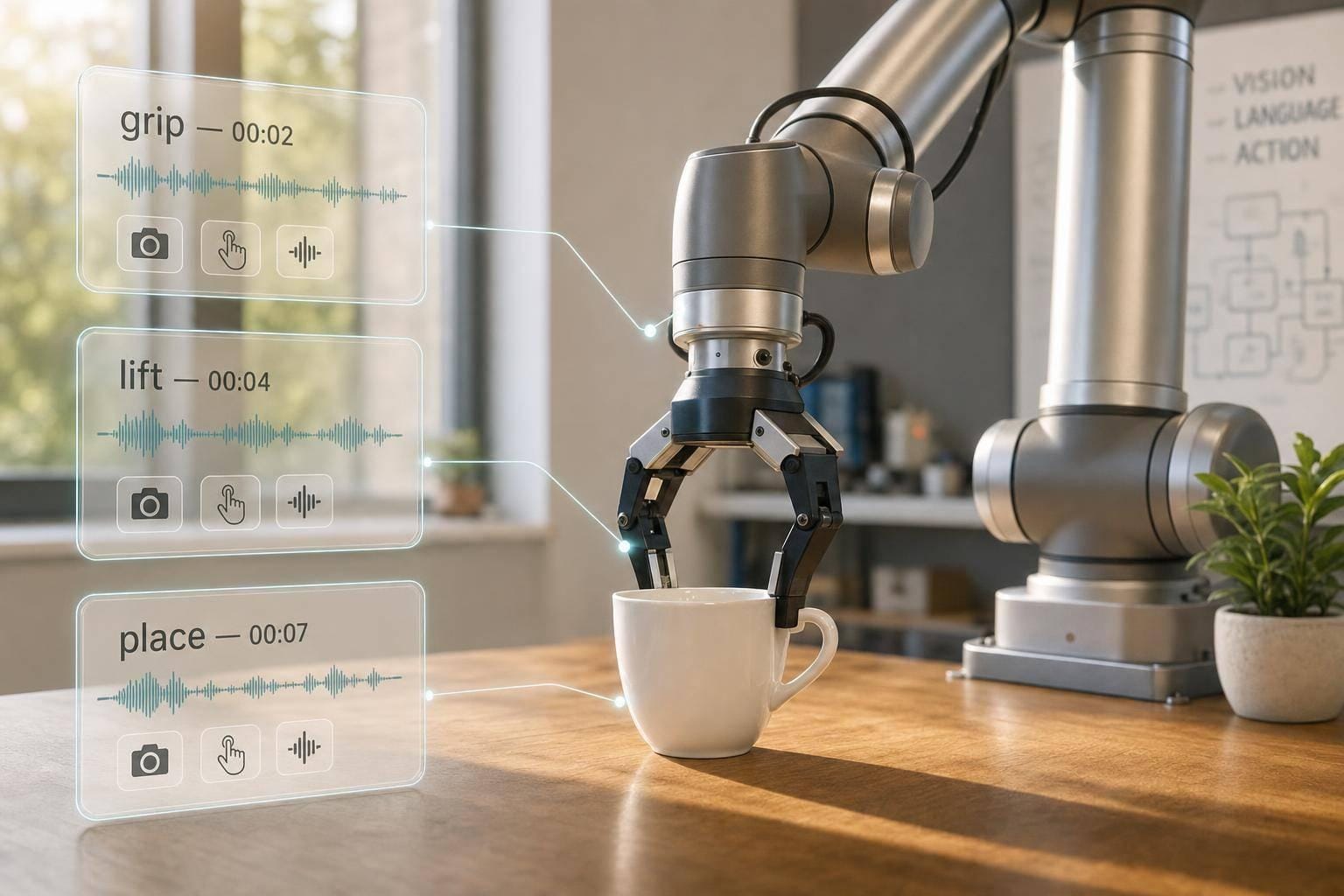
If text is not tied to the exact moment in robot data, a VLA model will miss intent, miss task state, and fail more often when the scene changes.
I’d sum it up like this: text-linked data gives a robot the why, not just the what. To train VLA models well, I need five things working together: language grounding, action labels, scene context, step order, and failure data. The article points to hard gaps too: language-conditioned robotics work has shown 25%+ better results on new instructions, RT-1 used about 130,000 episodes across 700+ tasks, and tactile datasets are still tiny by comparison, with FoTa at about 3 million data points.
If I were reducing the whole piece to a short checklist, it would be this:
- Match text to timestamps so instructions line up with video, sensors, and actions
- Ground words in the scene with object traits, spatial terms, and safety limits
- Store both low-level controls and skill labels so the model learns motions and phases
- Keep full step sequences so the model does not lose track in long tasks
- Log failures, retries, and human takeovers so recovery becomes part of training
- Add scene and contact context like blockages, slips, collisions, and clearance rules
- Fix missing modalities because vision alone often misses contact, force, and hidden state
A simple way to think about it: good VLA data is synced, labeled, step-based, and honest about failure. That is what helps turn robot logs into training data a model can use on the floor.
Data Foundations for Vision-Language-Action Models
Language Grounding: Connecting Instructions to Physical Actions
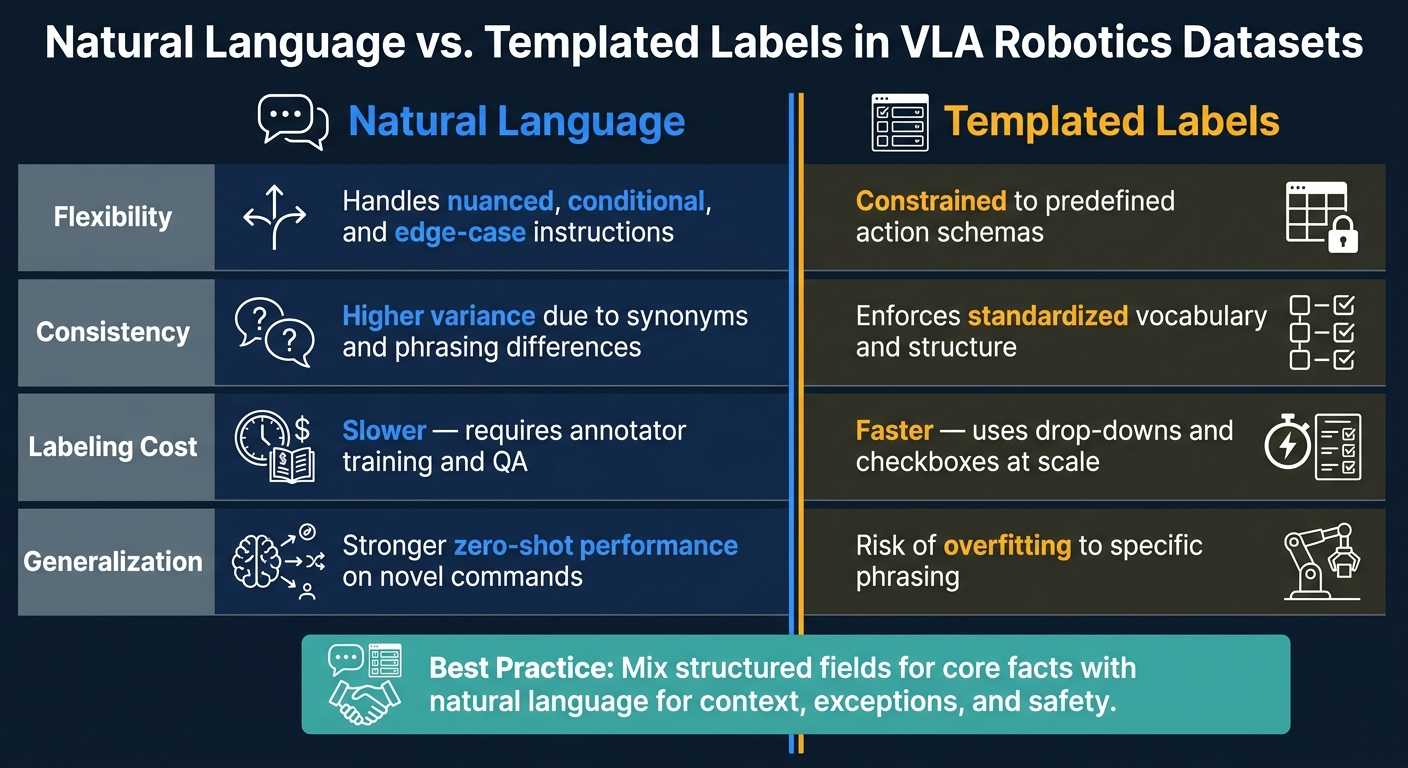
Natural Language vs. Templated Labels in VLA Robotics Datasets
Language grounding links words to objects, places, limits, and movements in the scene, a core component of Physical AI. In text-linked datasets, each instruction needs to match the exact sensor frames and robot state it refers to.
That link starts with object traits, spatial references, and constraints.
Task Instructions, Object Attributes, and Spatial Terms
Good datasets connect action verbs like pick, place, open, navigate, and inspect to detailed descriptions of the objects and space around them. Objects should be annotated with category, color, size, shape, and surface traits so the model can predict the right grasp and force before contact.
Spatial phrases like "top rack", "nearest pallet", and "behind the conveyor" tie the instruction to a place. Constraint language is just as important. Phrases like "grasp by the handle", "do not tilt", "avoid the marked safety zone", and "stay at least 6 feet from the yellow line" tell the model both what to do and what to avoid. By contrast, vague instructions like "put it over there" tend to increase localization errors. More specific referents - color + type + relative position - help cut down the gap between language and action trajectories.
Natural Language vs. Templated Labels
Early robotics datasets often used rigid templates like pick(object_id, location_id). Newer corpora such as DROID and CALVIN use free-form language that sounds more like the way operators speak.
| Dimension | Natural Language | Templated Labels |
|---|---|---|
| Flexibility | Handles nuanced, conditional, edge-case instructions | Constrained to predefined action schemas |
| Consistency | Higher variance due to synonyms and phrasing differences | Enforces standardized vocabulary and structure |
| Labeling Cost | Slower; requires annotator training and QA | Faster; uses drop-downs and checkboxes at scale |
| Generalization | Stronger zero-shot performance on novel commands | Risk of overfitting to specific phrasing |
The strongest pipelines mix structured fields for core facts with natural language for context, exceptions, and safety. That setup gives you the clean labels of a form and the nuance of how people talk on the floor.
Multimodal Signals That Support Grounding
Language by itself isn't enough. The model also needs aligned sensor signals to figure out what the words mean in the scene.
RGB gives color and texture. Depth gives geometry. LiDAR helps with obstacle detection. IMU tracks orientation. Force-torque data shows contact and resistance. RH20T puts this stack into practice: it combines RGB, depth, IR, joint states, pose, force-torque, audio, and tactile data. When those signals are aligned with language, models can handle instructions that depend on both visual and non-visual cues - such as "push until the panel clicks into place and stop if you feel abnormal resistance" - which vision alone can't resolve.
Once language is grounded, the next step is teaching the model what action to take and in what order.
Action Labels and Step Sequences: Teaching Models What to Do Next
Once language is grounded, the dataset still has to teach execution. Grounding tells the model what the user means. Action labels tell it how to carry that out. A model might understand “grasp the red box” and still fail if it doesn’t have action labels it can execute.
Low-Level Controls and High-Level Skill Labels
VLA datasets need two kinds of action data, and they have to work together. Low-level controls are the raw numeric commands the robot runs: joint positions, end-effector pose, gripper state, and base velocity commands for mobile robots. One common setup uses a 7D end-effector delta plus gripper open/close, bucketed into 256 bins per dimension. Google’s RT-1 dataset used this schema across about 130,000 demonstrated episodes covering 700+ language-conditioned tasks, recorded at 3 Hz.
That kind of detail matters. If units, ordering, and dimensions stay the same, data can move across robots more easily. But numbers alone aren’t enough. They become much more useful when they’re grouped into named skills.
High-level skill labels mark each phase in the motion stream. Labels like approach, grasp, lift, place, and verify break a continuous stream of control into named phases. That turns motion into skill units the model can reuse. It also makes datasets easier to share across robot setups.
Step-by-Step Task Structure Over Time
Short tasks are one thing. Long-horizon workflows are another.
For longer tasks, a dataset has to show the full sequence, not just isolated actions. Otherwise, the model may know how to do each step and still lose track of where it is. That’s a big problem in multi-step procedures where the next move depends on what already happened.
The standard setup is an episode-to-step hierarchy: each episode is split into time-ordered steps, and each step records observations, the action taken, a timestamp, a phase label, and a success or failure flag. Long-horizon datasets need to keep step order, timestamps, and success flags intact so the model can track progress. In practice, clear segmentation is the thing that keeps the model from drifting mid-task. Still, clean success traces only show one side of the story.
Failure Recovery and Human Intervention Data
Recovery data extends step labels into failure states. Success-only demonstrations show what a good run looks like. They don’t show what to do when a grasp slips, an object moves, or a route gets blocked.
That’s where teleoperation data helps. Sessions that record retries, re-grasps, operator pauses, and escalation events give the model examples of fallback behavior that’s safe and usable. Each recovery segment should be tagged with the failure type, the recovery strategy used, and the outcome. Targeted recovery collection can produce 10× more usable recovery data per hour than unconstrained teleoperation. Evlo.ai is building teleoperation infrastructure that captures these interventions with the context needed to feed them back into retraining.
Without that data, models can stall as soon as conditions shift outside the training distribution. With it, they can treat failure as something to work through, not a stop sign. Action labels get even more useful when the surrounding scene is recorded alongside them too.
Scene Context and the Data Gaps That Hurt VLA Learning
After language grounding and action labels, a dataset still needs the physical context that decides whether a motion will work. Action labels tell the model what to do. Scene context tells it whether it can do it, where it should do it, and under what conditions.
What Scene Context Should Capture
Scene context includes object layout, robot and camera pose, nearby agents, and constraints in the space, like restricted zones, low-clearance areas, and slippery floors.
Text-linked annotations make those signals usable. A label like "the red bin behind the blue pallet is blocked by a forklift" gives the model a way to reason about a hidden object instead of treating the scene like a flat 2D image. Annotations such as "maintain at least 3 ft of clearance from human workers" teach the model to account for safety rules that may not show up in raw pixels.
Contact events matter here too. When a connector clicks into place, when a grasp starts slipping, or when the robot bumps a fixture by accident, those moments need labels like "successful insertion," "slip during grasp," or "collision with fixture." Otherwise, the model can't tell the difference between a clean action and a near miss.
When datasets leave out these signals, they teach motion without situation.
The Most Common Dataset Gaps
Most VLA datasets still miss the same basics. Annotations are often thin and templated - labels like "pick object" or "place object" that don't say which object, where it sits, what blocks access, or what contact state marks success.
A review of 123 VLA papers found that none focused on tactile sensing, and only three used audio. FoTa, the largest tactile dataset, contains about 3 million data points - around 1,000× fewer than large-scale vision corpora. And it doesn't stop there. Most datasets cover isolated, single-skill actions instead of full workflows, so models never learn how an early choice affects what comes next. On top of that, many environments are controlled lab setups that look nothing like an actual distribution center or automotive plant.
How Data Gaps Cause Failures in Real Operations
These missing pieces show up fast in deployment. A model trained on thin, templated labels can misread operator intent when instructions need nuance, especially without verified human expertise to guide the training data. A model trained only on short episodes can lose track of task state in the middle of a workflow, unsure which bins were already picked or which steps are done.
The same problem shows up in fine manipulation. Without force or tactile data, a model struggles with precise insertions. It can't tell whether a connector is fully seated or only looks aligned from the camera angle.
In live facilities, mixed pallets, odd packaging, and shifting lighting can push lab-trained models out of distribution. That's when small accuracy gaps turn into stalled robots, mis-picks, and safety incidents.
Building Better Text-Linked Data Pipelines for Physical AI
Those failures usually come from the pipeline. To fix them, you need synchronized capture, clean schemas, and feedback from deployment.
What a Strong Data Pipeline Includes
A production-ready pipeline keeps RGB video, depth, audio, joint states, force, and other streams synced to one clock. That way, each text label lines up with the exact moment it describes. The point isn't to store raw logs for the sake of it. The point is to produce training-ready data for grounding, sequencing, and recovery.
Sync alone isn't enough. The pipeline also needs structured action schemas that separate low-level controls from high-level skill labels. Low-level controls can include joint angles, gripper state, or end-effector position. High-level skills describe actions like "scan barcode", "place in bin", or "clear fault." Each task should include preconditions, postconditions, and failure codes so the model learns when a skill should be used and how success is checked. Long-horizon recordings matter too. Full workflows, not just isolated clips, teach models to follow state across many steps instead of acting like every move happens in a vacuum.
Quality control sits right in the middle of all this. Automated alignment checks, annotator calibration sessions, and schema governance across sites all matter. It also helps to standardize formats, units, and versioned train/validation/test splits so the same data can be used again across teams and locations.
This is the infrastructure layer that makes VLA training usable at scale.
How evlo.ai Fits This Stack
Evlo.ai is building the physical AI infrastructure layer for multimodal human data collection and teleoperation. Its workflow captures egocentric video, audio, sensor streams, text annotations, and human demonstrations. It then logs robot takeovers, corrections, and outcomes as structured training episodes. Each intervention turns into new training data.
Key Takeaways
The pattern is pretty simple:
- Language grounding links instructions to physical actions.
- Step-level annotations teach long-horizon execution, so models can track task state across a full workflow.
- Scene context - object layout, spatial relations, and contact events - helps support safer decisions when conditions change.
When one of these layers is missing, the problems show up fast: stalled robots, wrong actions, and safety issues in live facilities.
FAQs
Why does timestamped text matter for VLA training?
Text-linked datasets matter for VLA training because they tie what a model sees to what it should do. When language is grounded in video, the model can connect instructions with action labels, scene context, and the sequence of steps inside a task.
Training starts to break down when the data leaves out messy real-world conditions, rare edge cases, or the context behind human interventions. Evlo.ai helps fill those gaps by collecting multimodal, expert-verified data and turning teleoperation feedback into structured input for model improvement.
What should a text-linked robotics dataset include?
Text-linked data helps Vision-Language-Action (VLA) models learn by tying language to actual scenes and connecting instruction steps to visible action labels and ordered sequences.
The most useful datasets include:
- Scene context
- Verified action labels
- Multi-step tasks
When that context is missing, labels are guessed, or examples are poorly tagged and never checked, model quality and reliability can drop.
Why are failure and recovery examples so important?
They help VLA models learn what to do when tasks go off track, not just when everything goes as planned.
With text-linked data, that means tying language to scene context, action labels, and step-by-step sequences so the model can spot mistakes and recover the right way.
Without those examples, common data gaps like weak context, missing steps, or noisy supervision can drag down training and hurt generalization.