Cross-Embodiment Imitation for Humanoid Teleoperation

Leela Yanamaddi
September 1, 2026
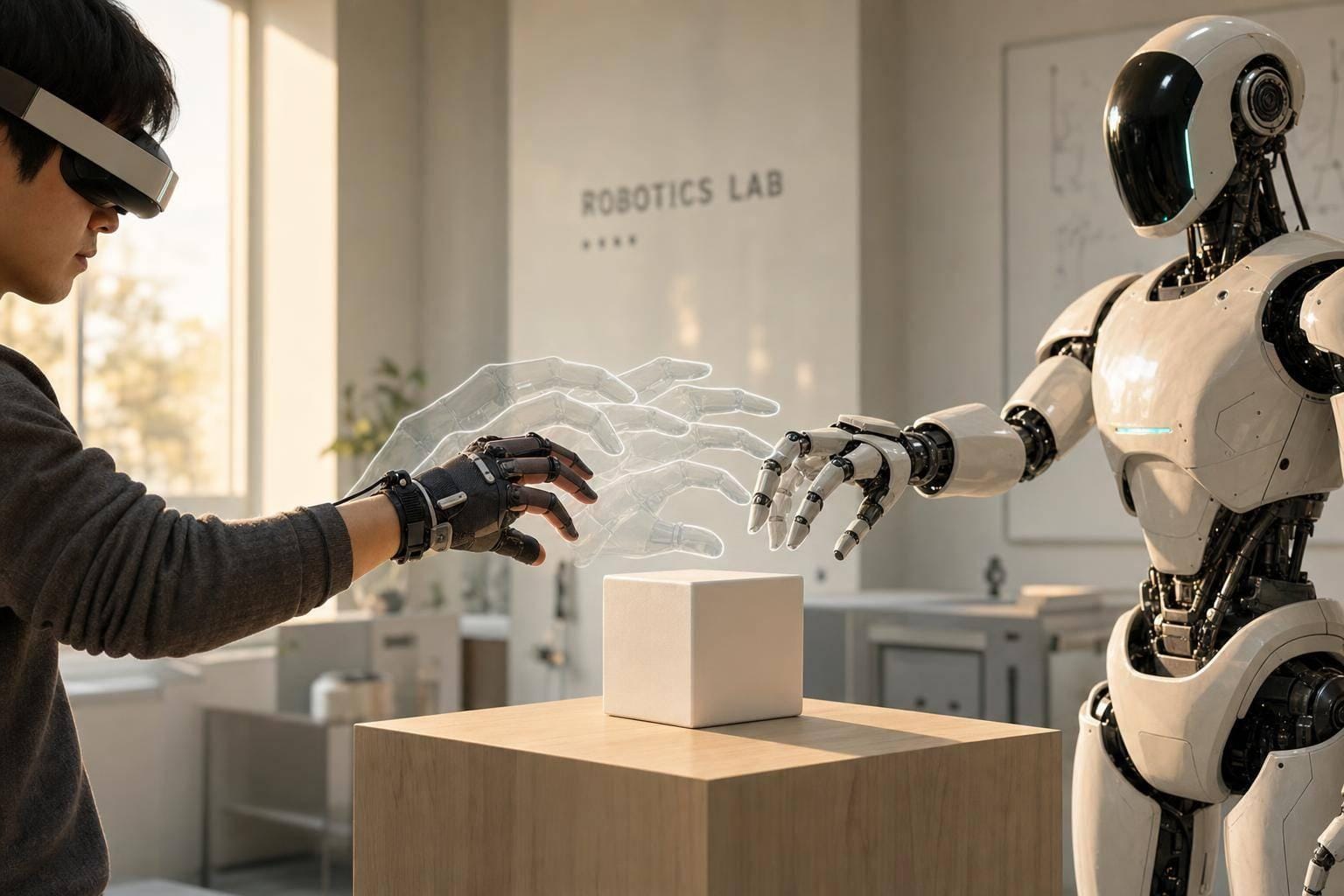
If you want humanoid robots to learn from people, teleoperation data matters more than video alone. I’d boil the whole topic down to this: a usable training set needs verified human expertise in operator demos, takeover logs, replay records, and retargeted robot-ready motion.
Here’s the short version:
- Cross-embodiment imitation means moving human task skill into a humanoid with a different body.
- Teleoperation gives you state, action, timing, and correction data that video does not.
- Good demos depend on operator skill, low delay, repeat runs, and body mismatch handling.
- Intervention logs show where autonomy failed and how a person fixed it.
- Replay data helps with retraining, review, and test runs.
- Motion retargeting maps human motion into robot joint space, then filters out motions the robot cannot do.
- Video datasets help perception, but not closed-loop control on their own.
A simple way to think about it: video tells you what happened; teleop data tells you what the human told the robot to do, what the robot did, and what had to be fixed. That difference is a big deal for policy training.
A few facts stand out from the article:
- The training signal is not just success cases. Recovery behavior matters too.
- Delay can hurt demo quality because corrections become less precise.
- Whole-body tasks are harder than arm-only tasks because timing and balance have to line up across many joints.
- Filtering bad retargeted trajectories before training cuts down unusable data.
Deep Imitation Learning for Humanoid Loco-manipulation through Human Teleoperation
Quick Comparison
| Item | What it gives you | Main limit |
|---|---|---|
| Passive video | Visual scene and human motion cues | No robot actions, no joint state, no correction loop |
| Teleoperated demos | State-action pairs for imitation learning | Data quality depends on operator and system delay |
| Intervention logs | Human fixes during failure points | Weak if logs miss context or reason for takeover |
| Replay data | Session review, retraining, and checks | Less useful if streams and timestamps are incomplete |
| Retargeted trajectories | Robot-ready motion for training | Needs filtering for balance, limits, and contact issues |
My takeaway: if I were building a humanoid learning stack, I would treat teleoperation as a data system first, not just a control tool. The best setup is one pipeline where demos, interventions, replay, and retargeted motion all feed the same training loop.
That’s the core idea of the article, in plain English.
Operator demonstrations as the core training signal
Cross-embodiment imitation starts with operator demonstrations. If those demonstrations are messy or inconsistent, everything that comes after gets weaker. So the first job isn't just to collect data. It's to collect the right data.
That means being selective about what goes into the training set. Clean, repeatable demonstrations give downstream learning something solid to build on.
How teleoperated demonstrations are captured
A useful teleop record captures control, not just motion. In a teleoperation session, an operator controls a humanoid robot in real time through an interface that maps human intent or motion into robot commands. Common setups include VR control, motion-capture retargeting, exoskeletons, and shared autonomy.
Good logs record robot commands, state, timestamps, and operator corrections. In plain terms, they keep the full trail of what the operator tried, what the robot did, and what had to be fixed along the way.
That matters because the best episodes don't just show success. They also preserve recovery behavior. If a robot slips, drifts, or starts the wrong motion, the correction is often as useful as the final action.
What determines demonstration quality and transferability
Clean demonstrations become reusable only when they are repeatable, low-latency, and compatible with the robot's body. A few factors shape whether a demonstration transfers well across embodiments.
Operator skill is the clearest one. An experienced teleoperator usually produces smoother, more consistent trajectories with fewer extra corrections. One successful run doesn't mean much on its own. What matters is whether the same result can be produced again and again.
Latency matters too. When delay goes up, corrections get less precise. That weakens imitation quality and can make the recorded behavior look shakier than the operator intended.
Embodiment mismatch shows up when human motion doesn't map cleanly to the robot's joint limits or workspace. In that case, the motion has to be retargeted or constrained before training. Otherwise, the data may look fine on the human side but fail on the robot side.
Whole-body coordination is the last big factor. Whole-body tasks are tougher to record cleanly than arm-only tasks. The teleop system has to preserve timing and coordination across the full body, not just one limb at a time.
Comparison of demonstration types
| Demonstration Type | Capture method | Primary Use |
|---|---|---|
| Direct robot teleoperation | Human operator drives the robot in real time | Imitation learning and policy training |
| Shared autonomy | Human corrections are layered on top of partial autonomy | Learning interventions, edge cases, and recovery behavior |
These demonstrations are the raw material for retargeting, replay, and continuous learning. The dataset is just the first layer. Once it's recorded, the next step is looking at what operators fix, reject, and replay.
Intervention logs and replay data for continuous learning
Even strong demos leave blind spots. Intervention logs catch the exact moments when autonomy slips and a human steps in. That handoff isn't just a sign that something went wrong. It's a learning signal.
Why intervention logs matter more than simple failure counts
A failure count tells you autonomy broke. An intervention log tells you what broke, how the operator fixed it, and what result the robot needed to get back on track.
That difference matters. When a human teleoperator takes over in the middle of a task, the intervention becomes a labeled correction example. In plain English, you can see where human input makes up for embodiment mismatch, instead of treating the event like a generic failure.
Useful logs should record:
- the operator's correction
- the robot state
- the task context
- the reason for takeover
- the target outcome
Without that detail, you're left with a number. And a number alone won't tell your team what to retrain.
How replay data supports retraining and evaluation
Replay data becomes far more useful when it keeps the full trail: commands, robot state, timestamps, sensor streams, and intervention markers. That way, teams can review correction points in context instead of guessing what happened.
For teleoperation, this makes a big difference. A team can watch the session, inspect the takeover moment, and decide whether the run should be relabeled or used to tune a policy across embodiments. That supports offline retraining, evaluation, and safety checks.
Put together, intervention logs and replay data form a retraining loop.
Once those interventions are on record, the next step is turning human motion into actions a humanoid robot can carry out.
Motion retargeting: turning human motion into humanoid actions
Motion retargeting takes captured demonstrations and maps them into the robot's coordinate frame and joint space. The main goal isn't to copy human joint angles one by one. It's to preserve what the person was trying to do.
From human pose to robot-compatible action space
Retargeting converts human motion into something a robot can execute in its own coordinate frame and joint space. In many setups, this depends on inverse kinematics (IK) to find joint configurations that match the operator's intended hand or foot placement as closely as possible.
Simple pose transfer focuses on matching posture. That sounds fine at first, but it skips a big part of the problem: robots have execution limits. A humanoid can't just mimic a person frame by frame and hope for the best. Stable whole-body retargeting handles the harder stuff, like balance, contact constraints, joint limits, and hand-object interactions.
Why feasibility filtering matters before policy training
Not every retargeted trajectory should make it into training. Some are unstable. Some break contact constraints. Some ask the robot to move in ways it can't.
That's where feasibility filtering comes in. It removes or fixes bad trajectories before policy training, keeping only the ones that are fit for imitation learning.
Comparison of retargeting methods
| Method | Typical emphasis |
|---|---|
| Simple pose transfer | Direct pose matching |
| Stable whole-body retargeting | Balance, contact constraints, joint limits, and hand-object interactions |
This filtered, retargeted data gives the policy a control signal that passive video alone can't provide.
Teleop data vs. passive video datasets: strengths, limits, and takeaways
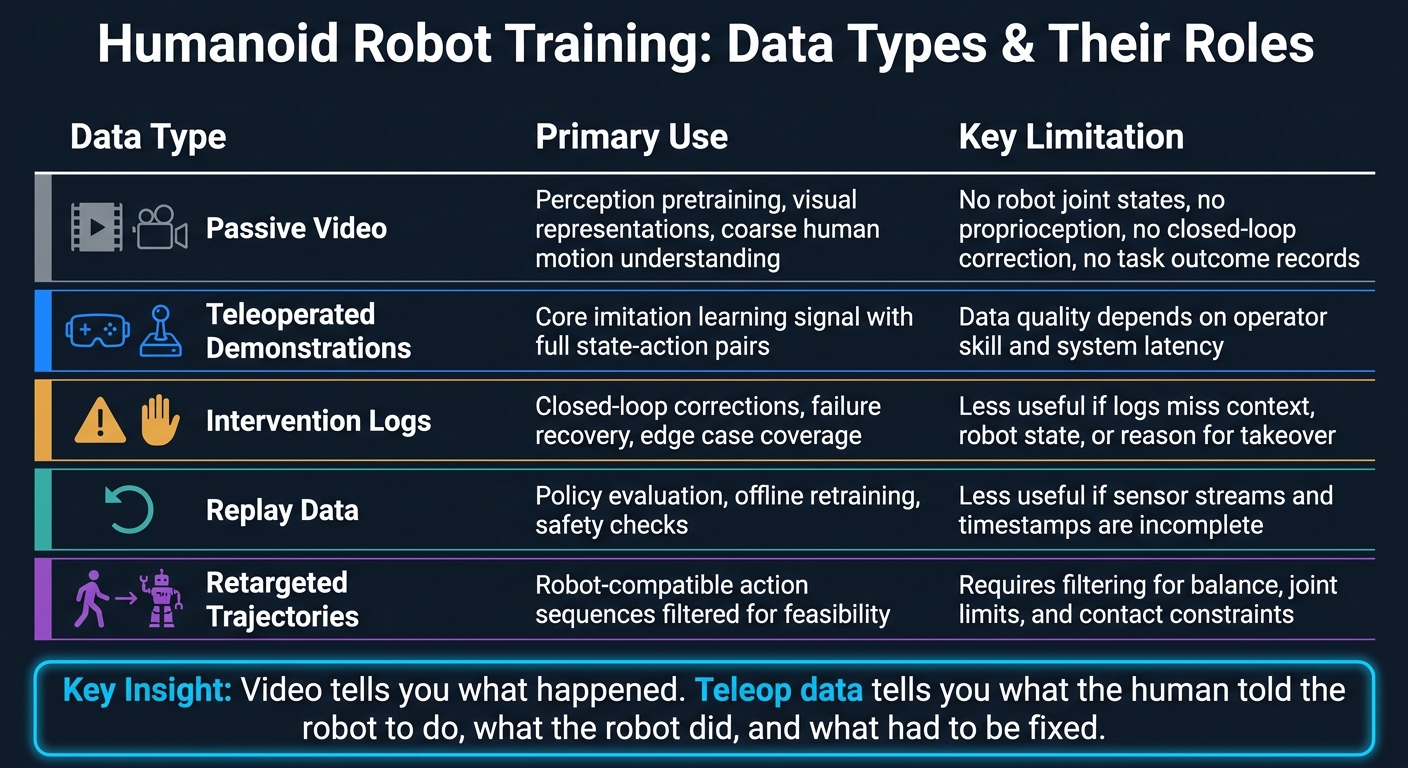
Teleop Data vs. Passive Video: What Each Data Type Gives You for Humanoid Robot Training
What passive video lacks for control learning
After retargeting, the next step is simple: what does teleop data give you that video does not?
Passive video is useful for perception, not control. It can help pretrain visual perception, object shape understanding, and coarse human motion across different robot bodies. That makes it a strong starting point for perception pretraining.
But video alone misses the signals a control policy needs. It does not include robot joint states, proprioception, force or contact data, or task outcome records. It also lacks closed-loop correction. If a task starts to drift, there is no operator stepping in to fix it. And without those signals, a policy trained on video by itself has a thin base for error recovery.
Where teleoperation infrastructure fits into Physical AI
That missing layer is why teleoperation belongs in the Physical AI stack, not only in robot control.
Teleoperation adds the state, action, and correction signals that passive video cannot provide. Those signals matter because they keep the control context, not just the final task result. In practice, the value comes from turning raw sessions into structured training data. That means logging intervention timing, task outcomes, and operator corrections, then feeding those records back into retraining pipelines.
The result is a continuous learning loop: each deployment creates data for the next policy update.
Key points for research and deployment teams
The main takeaway is to build one data pipeline, not a pile of disconnected datasets. Demonstrations, intervention logs, replay data, and retargeted trajectories work better when they are planned together from the start. Better data quality and shared standards make policy transfer across embodiments easier and cut down future human intervention.
Here’s the role each data type plays:
| Data type | Use |
|---|---|
| Passive video | Perception pretraining, visual representations |
| Teleoperated demonstrations | Core imitation learning signal with full state-action pairs |
| Intervention logs | Closed-loop corrections, failure recovery, edge case coverage |
| Replay data | Policy evaluation and retraining |
| Retargeted trajectories | Robot-compatible action sequences filtered for feasibility |
FAQs
Why is teleoperation better than video for imitation learning?
Teleoperation works better because it gives robots direct control data.
With teleoperation, the operator supplies precise, intent-driven state-action pairs and intervention data that a robot can use for control right away. That matters a lot. The robot doesn't just see what happened. It also gets the exact actions that produced the result.
Passive video is different. It shows the outcome, but it leaves out the control signals behind it. So you can watch the motion, but you can't see the operator's actual commands.
Motion retargeting helps bridge that gap. It maps human movements onto different robot bodies, which lets learned policies stay usable even when the robot's kinematics change.
What makes teleoperation data high quality?
High-quality teleoperation data pairs operator demonstrations with motion retargeting, which maps human movement onto robot kinematics. That mapping matters because human bodies and humanoid robots don't move the same way, and teleoperation helps close that gap.
This kind of data goes far beyond passive video. It includes state-action data the robot can use, such as intervention logs, replay data, and sensor streams. In practice, that gives robots the inputs they need to learn precise motor skills, recovery behaviors, and steadier task execution.
How does motion retargeting help humanoid robots learn human tasks?
The sources you provided don’t include the article itself or any details about how it handles motion retargeting, operator demonstrations, intervention logs, replay data, or the difference between teleoperation data and passive video datasets.
The only nearby reference is evlo.ai, which is mentioned as a teleoperation and data infrastructure platform. But that mention doesn’t explain the cross-embodiment imitation methods discussed here.