Humans in the Loop: The Untold Story Behind "Autonomous" Robots

Leela Yanamaddi
August 25, 2026
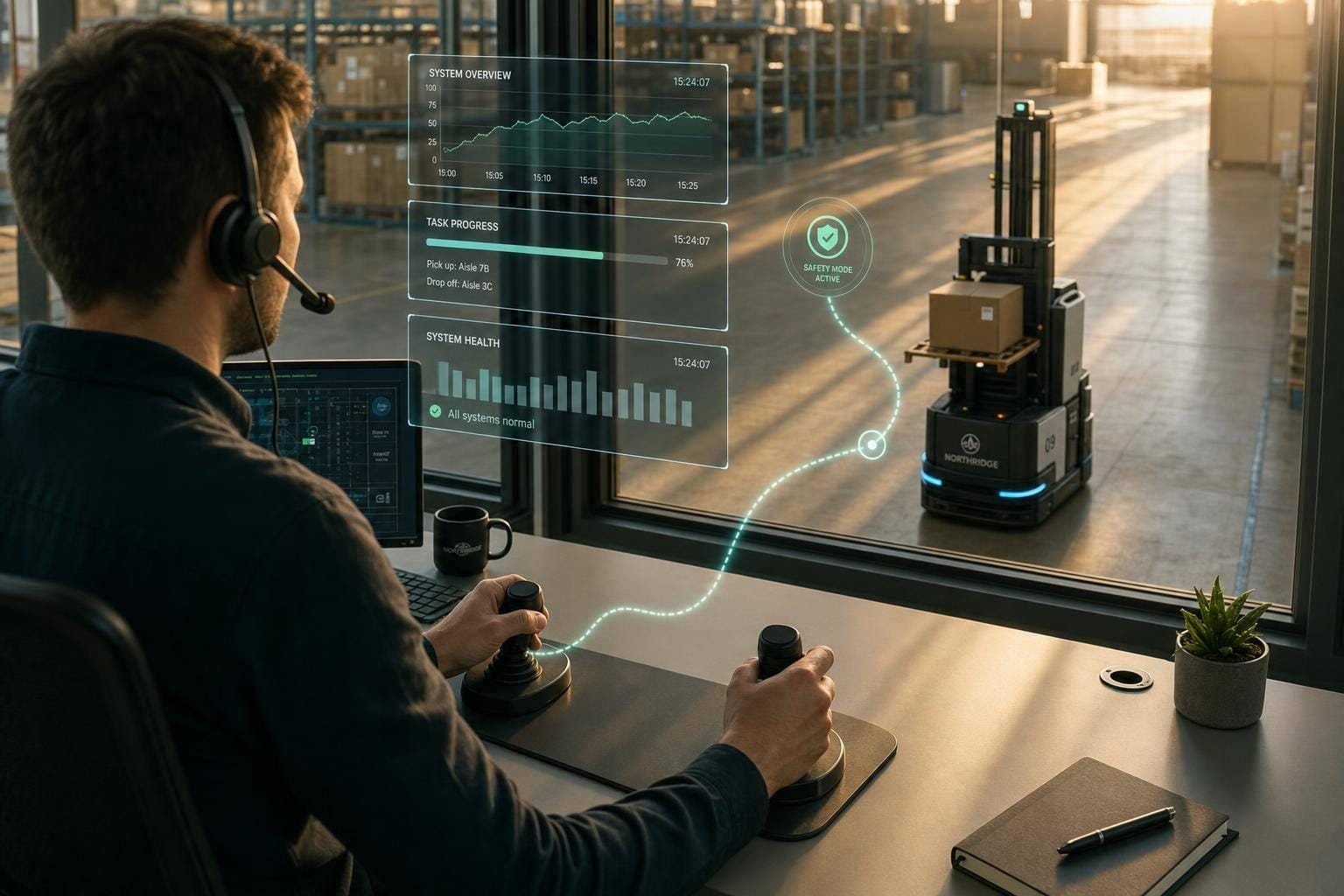
Most "autonomous" robots still depend on people to keep work moving. In many facilities, robots handle the normal 80% to 95% of tasks, but the last 5% to 20% - stops, odd cases, safety checks, and recoveries - is where human support does the heavy lifting.
If I had to sum up the article in one line, it would be this: robots scale better when teams treat human intervention as part of the system, not as a side task. That means logging each handoff, routing each issue, reviewing each fix, and turning those fixes into training data.
Here’s the article in plain English:
- "Autonomous" does not mean unattended forever.
- Facilities change all the time - lighting, layout, inventory, traffic, and floor conditions all shift.
- Robots fail most often on repeat tasks under changed conditions.
- People step in for safety, recovery, and judgment calls when confidence drops.
- Remote support matters through teleoperation and telesupervision.
- Issue queues, dashboards, and escalation paths keep failures from piling up.
- Every intervention should be logged and labeled so the same problem happens less often next time.
- Data from human fixes helps train future robot behavior.
- evlo.ai fits into this layer by supporting data work, teleoperation, and facility-level monitoring.
A simple way to think about it: the robot does the routine work, and the human layer handles what the robot misses. That human layer is not extra. <u>It is part of how dependable robot systems run in production.</u>
One useful contrast from the article is this: an autonomy-only setup tends to stall when a new failure appears, while a human-backed setup can keep work moving through remote recovery, human review, and model updates. That difference affects uptime, safety, staffing, and learning speed.
So if you’re looking at robot deployments in 2026, the big lesson is clear: the story is not just about robot software. It’s also about the people, workflows, and data loop behind it.
Problem: Where Autonomy Fails in Real Facilities
Real facilities don’t sit still. Lighting shifts. Layouts change. Inventory moves. Traffic patterns come and go. Weather can even affect what happens inside the building. That constant drift is what throws off robot autonomy and keeps human operators in the loop.
Perception and Task Failures That Trigger Human Intervention
The most common reason people step in is repeatability failure: a robot completes a task once, then struggles when it has to do that same task again under changed conditions. That’s the gap. The task looks similar on paper, but the setting is no longer the same.
When that happens, a human operator has to step in to recover the situation, escalate the issue, or review what went wrong.
Safety, Compliance, and the Need for Human Judgment
Robots working near people still need human judgment for safety and compliance. If system confidence drops, the right move is to stop and escalate, not guess. A person then has to decide when to pause, verify, and resume before work continues.
Those escalations don’t just slow things down. They create a steady flow of cases that the next layer of robotics operations has to route, track, and resolve.
Why Static Models Break Down After Deployment
A model trained on one facility state is already behind once that environment changes. It may have worked at launch, but deployment isn’t the finish line. The floor keeps moving.
Without human review and updates over time, performance drifts. More interventions follow, and day-to-day operations get less predictable. The robot isn’t broken; the world around it changed.
Solution: The Human Workflows and Systems Behind Reliable Robot Operations
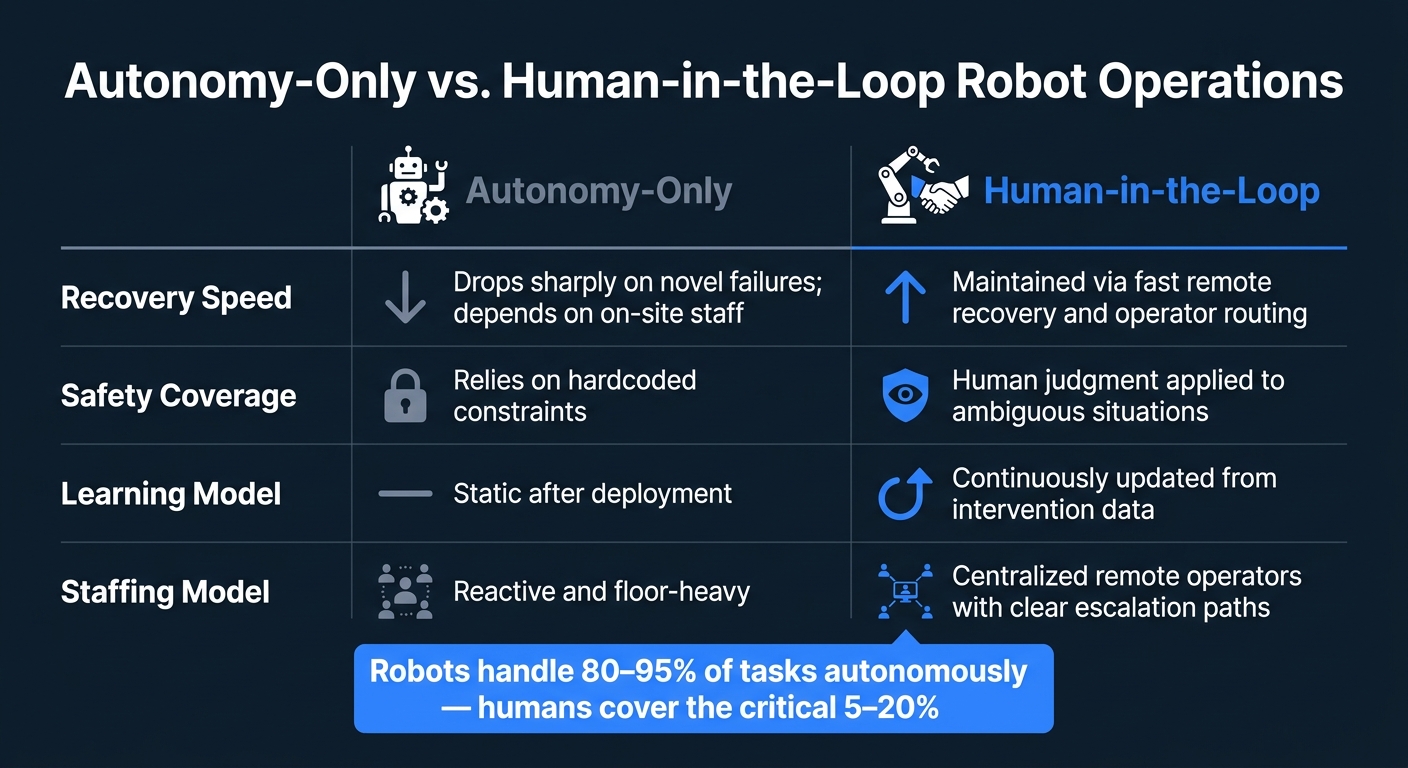
Autonomy-Only vs Human-in-the-Loop Robot Operations
Closing the autonomy gap takes more than better models. It takes human workflows built into the autonomy stack from day one. These workflows aren't a backup plan. They're part of how production works.
The first layer is remote recovery.
Teleoperation and Telesupervision for Recovery and Continuity
Most robot deployments follow the same pattern. The robot runs on its own by default. When something goes wrong, a remote operator steps in, handles the issue, and the robot starts moving again.
That sounds simple, but there's a catch: the handoff only works if every exception is tracked. If a robot flags a problem and no one logs, routes, and resolves it, the whole system starts to fray.
Telesupervision is a bit different. Instead of grabbing the controls, a supervisor watches telemetry and intervention queues. The goal is to spot warning signs before the robot comes to a stop. It's an early-watch layer. In practice, it works a lot like systems that send high-risk or unclear tasks to safer protocols or human supervisors before things go sideways.
Exception Pipelines, Fleet Dashboards, and Escalation Paths
A teleoperation session is only one part of the picture. Around it, you need a system that routes, tracks, and closes out each intervention. That usually includes alert logic, incident queues, saved task context, and escalation paths for cases where remote recovery isn't enough and an on-site team has to step in.
That setup shapes five core parts of robot operations:
| Metric | Autonomy-Only Operations | Human-in-the-Loop Operations |
|---|---|---|
| Recovery speed | Drops sharply when novel failures occur; dependent on on-site staff availability | Maintained through fast remote recovery and reduced by remote operator queues and routing |
| Safety Coverage | Relies on hardcoded constraints | Human judgment applied to ambiguous situations |
| Learning Model | Static after deployment | Continuously updated from intervention data |
| Staffing Model | Reactive and floor-heavy | Centralized remote operators with clearer escalation paths |
Those records don't just help teams fix today's issue. They also become the raw material for labeling and review.
Labeling, Review, and Continuous Learning from Interventions
This is where the compounding value shows up.
A teleoperation session isn't only a rescue action. It's also a live example of how a skilled operator handles a situation the robot couldn't solve on its own. That's gold - if you keep it.
Captured sessions should be labeled, reviewed, and fed back into training so the next robot can handle the same case without help. The discipline that matters here is repeatability, not one-off saves. A clean recovery may feel like a win in the moment, but if no one documents it and saves it as a training reference, the team has to learn the same lesson again later.
Every intervention should become a labeled reference for the next training cycle.
How evlo.ai Supports Human-in-the-Loop Physical AI

evlo.ai turns that operating layer into a working system. It connects those pieces into one Physical AI infrastructure stack.
Physical AI Data Infrastructure for Robot Training
Robots need data from the places and tasks they’ll face on the job. evlo.ai builds a scalable human data network for embodied AI and robotics teams. It supports first-person video, audio, images, text annotations, sensor streams, task demonstrations, and enterprise datasets. It also supports managed data collection and custom dataset creation for specialized workflows.
Human interventions add the judgment and correction that models need to get better. When an operator steps in to fix a failure, that moment becomes a training example. Over time, those examples help shape future performance.
That same data layer also supports live operations.
Teleoperation Software and Managed Operator Workflows
evlo.ai also moves into active robot operations through proprietary teleoperation software and managed teleoperation services. The platform links remote operators with robots in industrial settings.
When a robot runs into something unfamiliar, hits a safety issue, or faces a task outside its autonomous limits, a human operator can step in and keep work moving. Those interventions are logged for review and model improvement.
From Robot Operations to Facility-Wide Intelligence
As more operating data comes in, evlo.ai's manufacturing intelligence layer can turn factory data into intelligence by bringing together information from robots, machines, teleoperators, workers, and production systems. That layer supports factory monitoring, robot health, predictive maintenance, workflow optimization, escalation, and decision support.
That’s the operating base behind reliable autonomy.
Conclusion: Autonomy Scales Faster When Humans Stay in the Loop
Here’s the part people often miss about autonomous robots: humans are the reason they keep working. Robots don’t scale just because the software gets better. They scale when the human side of the operation keeps performance steady and keeps failures from piling up.
That’s why the best teams don’t treat intervention data like leftover admin work. They treat it as part of the product itself. If operators step in, escalate issues, or correct edge cases, that information matters. It shows where the system bends, where it breaks, and what needs to improve.
The teams you can count on tend to build the human workflow first. They put clear escalation paths in place. They set up operator workflows that people can actually use under pressure. They collect labeled intervention data in a way that feeds back into deployment. Then autonomy grows on top of that base.
None of this runs on autopilot. And that’s the point. The aim isn’t to remove people just to say there are fewer people involved. The aim is to build a smarter system, one that keeps human judgment in the loop during deployment. Human-in-the-loop infrastructure is what turns fragile autonomy into dependable operations.
FAQs
What tasks still need humans?
Humans still matter for judgment, context, and decision-making in ways algorithms can’t fully match. In high-impact situations, people provide accountability and check models before they go into production.
People also build the datasets, benchmarks, and evaluations that help AI learn and get better. And when uncertainty or hallucinations show up, humans serve as the final call.
How does teleoperation improve uptime?
Teleoperation helps keep uptime high because a human operator can jump in the moment an autonomous system runs into an edge case or an unexpected error.
Instead of letting the robot sit idle, a remote operator can guide it, clear the problem, or check safety conditions in real time. That cuts downtime and keeps workflows moving with less disruption.
How do human interventions train robots?
Human interventions help train robots by adding context, nuance, and judgment that datasets alone can't provide. Through feedback loops, experts guide model updates, benchmarks, and data labeling.
These human-in-the-loop workflows help check systems for real-world reliability and safety. Instead of being replaced, professionals use their expertise to shape how systems learn and change.