Data Quality in Robot Imitation Learning

Leela Yanamaddi
August 27, 2026
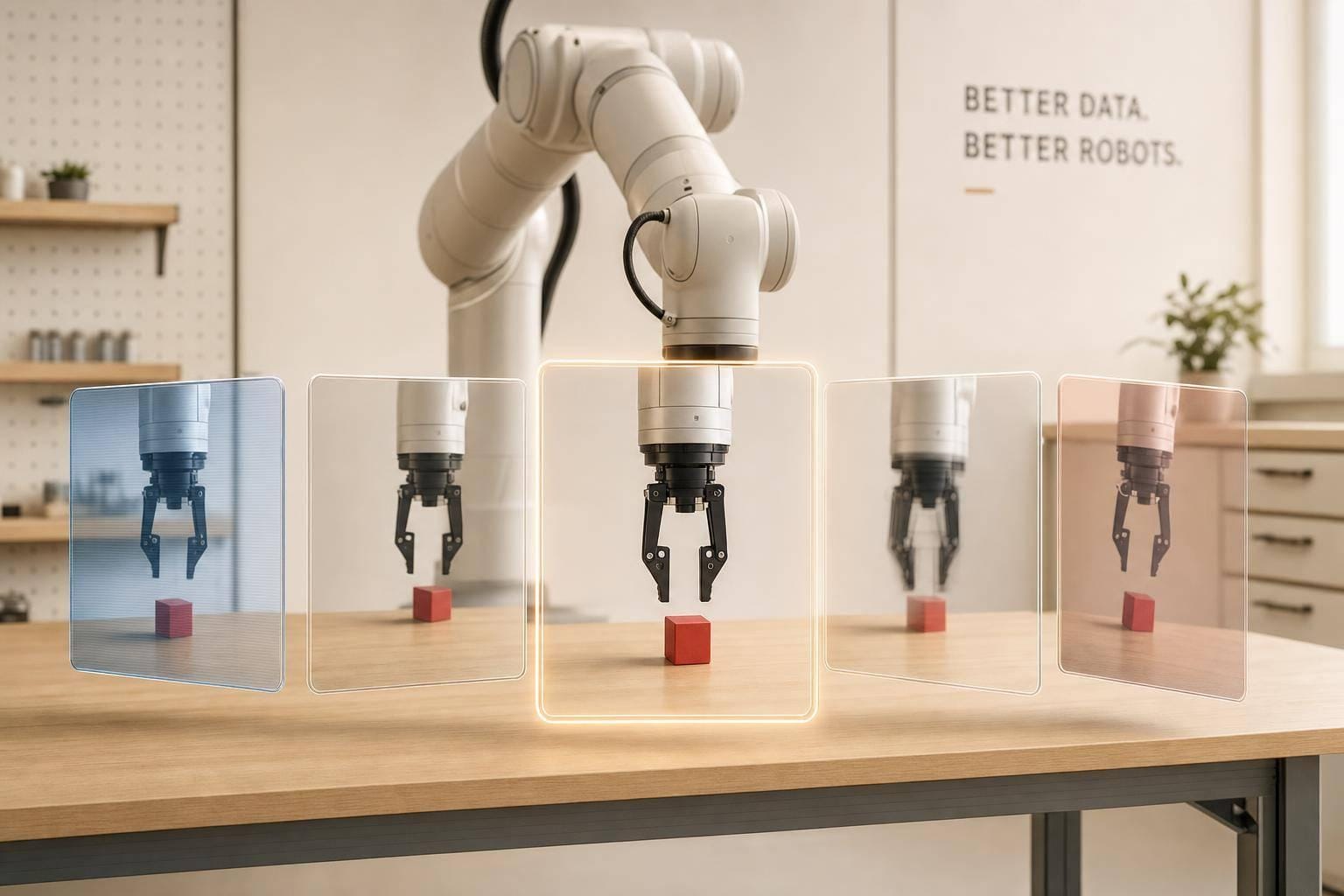
Bad demo data teaches bad robot behavior. If I had to sum up the article in one line, that’s it.
When I look at robot imitation learning, I don’t see a “more data is better” problem. This challenge is central to the evolution of Physical AI in manufacturing, where precision is non-negotiable. I see a data quality problem. Even a small amount of label noise, missing steps, or out-of-sync video and actions can push a policy toward unstable behavior. And in many cases, a smaller, cleaned dataset can beat a larger noisy one.
Here’s the short version:
- Robots learn patterns in demonstrations, not just task goals
- Wrong labels can teach the wrong action for the same state
- Missing transitions can break long task sequences
- Camera and timing errors can weaken the link between what the robot sees and what it does
- More low-quality data does not fix low-quality supervision
- Pre-training checks, human review, and teleoperation can help close data gaps before training starts
I’d treat this as a simple rule: if the data is messy, the policy will be messy too. A quality-first pipeline means checking labels, full trajectories, sync, and repeatability before a single training run begins.
| Issue | What it does to training | What I’d check first |
|---|---|---|
| Label noise | Teaches wrong action mappings | Annotation rules and spot checks |
| Missing steps | Breaks task flow | Full episode review |
| Sync gaps | Weakens observation-action links | Timestamp alignment |
| Camera inconsistency | Changes how the same action looks | Fixed setup, lighting, and angle |
| Repeated bad data | Scales the same errors | Filtering before training |
One practical takeaway stands out: volume is not a stand-in for clean supervision. If I want better robot policies, I have to fix the data pipeline first.
Good vs Bad Robot Demonstrations: Developer's Guide to Collecting Data for GR00T
The Most Common Data Quality Problems That Weaken Policies
Data quality problems often look minor at first glance - a mislabeled action, a missing step, or two streams that don’t line up. But small errors can throw off what a policy learns. And once that happens, the damage spreads through the whole dataset. Here are the three failure modes that tend to hurt the most.
Label Noise and Inconsistent Annotations
Labels tell the policy which action goes with which observation. If those labels are wrong, the policy may learn the wrong observation-action link instead of the right one.
Things get worse when annotators apply different standards to the same action. In that case, the policy gets mixed supervision for situations that are almost identical. Without verified human expertise to set a shared labeling standard, it ends up learning clashing action targets for the same state.
And even when labels are correct, demonstrations can still fall short if they skip key transitions.
Missed Steps and Incomplete Task Trajectories
Long-horizon tasks rely on a clean sequence of transitions. Skip a recovery move or leave a trajectory unfinished, and that sequence falls apart.
Recovery actions matter because they show the robot what to do when execution stops going as planned. A dataset packed with neat, ideal runs might look good on paper, but it gives the robot little help in the moments that matter most.
Camera Problems, Synchronization Errors, and Timing Gaps
A robot policy learns by matching what it sees with what it does. If those two streams are out of sync, the observation-action link starts to break. And if camera angle, frame rate, or operator pace changes, the same action can look different from one demonstration to the next.
That weakens observation-action alignment and can make control less stable.
These failures also get worse as the dataset grows. In practice, more low-quality data often makes the policy worse, not better.
Why Adding More Low-Quality Data Usually Does Not Fix the Problem
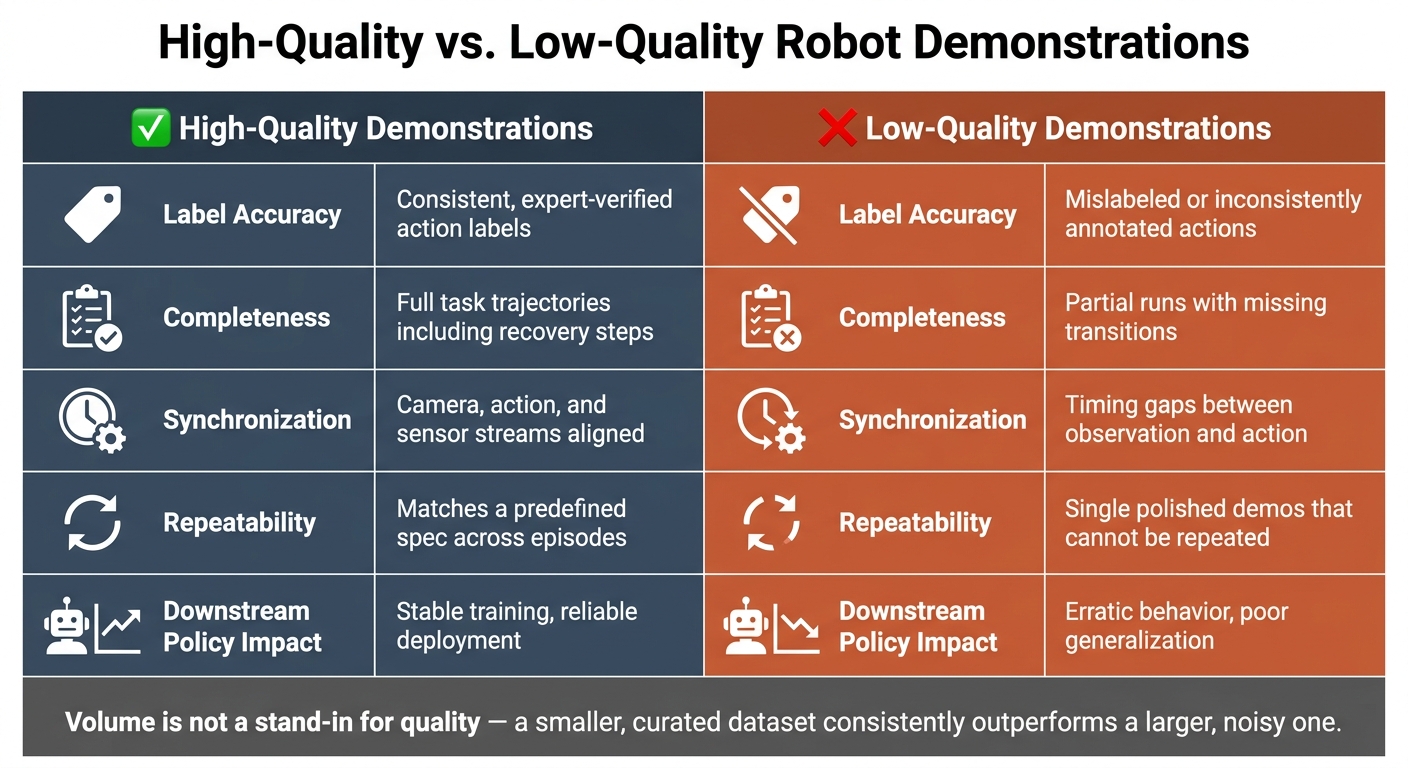
High-Quality vs Low-Quality Robot Demonstrations: Key Differences
More data only helps when it adds clean coverage and a steady signal. The core issue isn't dataset size. It's repeating the same errors over and over.
How Noise Compounds as Dataset Size Grows
As the dataset gets bigger, flawed episodes pile up too. A mislabeled action teaches the model the wrong link between what the robot sees and what it should do. A partial trajectory cuts out another needed transition. A timing gap pushes observations and actions further out of sync.
What do you get in the end? A policy trained on volume instead of signal.
The failure mode is pretty straightforward: bad samples don't fade away at scale. They start to take over.
When Smaller Curated Datasets Beat Larger Noisy Ones
A filtered dataset with full trajectories, accurate labels, and aligned sensor streams gives the policy a much cleaner target to learn from. Training tends to be steadier, generalization holds up better, and deployment performance is more dependable under real-world conditions. What matters most is repeatable lighting, timing, and task structure across runs.
The table below shows where the gap between high-quality and low-quality demonstrations shows up:
| Dimension | High-Quality Demonstrations | Low-Quality Demonstrations |
|---|---|---|
| Label accuracy | Consistent, expert-verified action labels | Mislabeled or inconsistently annotated actions |
| Completeness | Full task trajectories including recovery steps | Partial runs with missing transitions |
| Synchronization | Camera, action, and sensor streams aligned | Timing gaps between observation and action |
| Repeatability | Matches a predefined spec across episodes | Single polished demonstrations that cannot be repeated |
| Downstream policy impact | Stable training, reliable deployment | Erratic behavior, poor generalization |
That’s why demonstration quality needs to be checked by experts shaping frontier AI before training starts.
How to Improve Demonstration Quality Before Training
The fix starts before training. You want to catch weak demonstrations before they ever reach the pipeline.
A Pre-Training Data Quality Checklist
Before any episode enters your training pipeline, run it through a structured review. The goal is simple: catch label noise, missed steps, camera sync issues, and timing gaps while the episode is still easy to fix.
Use automation to flag the obvious problems. Let humans handle the gray areas, especially when labels are unclear.
It also helps to check the basics that can quietly wreck a dataset: clear camera streams, synced video, aligned sensor timestamps, and a complete observation sequence with no gaps. If an episode is only partly useful, review it at the episode or segment level. That gives you options. You can correct it, remove it, or down-weight it instead of throwing out the whole run.
Once the checklist starts catching errors, the next job is stopping those errors during collection.
Capture Practices That Reduce Quality Problems at the Source
The cheapest fix is to stop problems at capture time. Lock task instructions, camera placement, lighting, and reference objects before collection starts.
Treat the first successful run as your quality spec. Then compare later runs against it to check repeatability. That's what keeps the dataset coherent.
This layer is what turns demonstrations into training data you can use: egocentric video, multimodal sensor streams, and expert annotations.
And when capture still leaves holes, human teleoperation can step in and fill them.
Using Teleoperation and Human Review to Fill Data Gaps
Even with strong capture practices, some edge cases will still be missing. Human-in-the-loop teleoperation helps fill those gaps by generating targeted demonstrations for recovery actions, partial trajectories, and rare edge cases the original dataset didn't cover.
After automated checks flag a weak episode, human reviewers can decide whether to correct it, remove it, or down-weight it. That review loop helps keep weak episodes out of training.
These targeted runs close the exact failure modes that weaken imitation learning.
Conclusion: Build Quality-First Data Pipelines for Better Robot Policies
Label noise, missed steps, camera problems, synchronization errors, and timing gaps don’t just create small errors. They teach the model the wrong action mapping. That’s the core problem.
More data won’t save a bad dataset. Volume is not a stand-in for quality. The hard part - and the thing that sets strong teams apart - is building a checked dataset across hundreds of episodes.
So the fix has to start upstream. This isn’t a theory problem. It’s an operations problem: set capture standards before data collection begins, run pre-training checks for labels, completeness, sync, and timing, use human review for edge cases that automation misses, and use teleoperation to fill in missing demonstrations.
FAQs
How much label noise is too much?
In robot imitation learning, even small label noise can hurt performance. These policies are sensitive to bad labels, skipped steps, camera glitches, and timing gaps.
And those mistakes don’t just stay small. They stack up while the robot is acting, which can push it off the path of the task.
Adding more data sounds like an easy fix, but it usually isn’t. If the samples are poor, the robot just gets more practice learning the wrong behavior.
Should I drop bad demos or fix them?
If a demo has label noise, missed steps, camera calibration issues, or timing gaps, it can hurt imitation learning. Robots learn straight from the data in front of them, so bad demos teach bad habits.
That’s why high-quality demonstrations matter more than just piling on more data. If mistakes stay in the dataset, adding more examples usually doesn’t fix the problem. It just teaches the same wrong behavior again and again.
What should I audit before training starts?
Audit demonstration quality first. In robot imitation learning, label noise, missed steps, camera calibration errors, and timing gaps can send the wrong signal, and the model may read that signal the wrong way.
Low-quality samples usually hurt policy learning more than a bigger dataset helps. Why? Because flawed demonstrations teach the robot the wrong behavior, or at least leave it guessing about what it was supposed to do.