Teleoperation Explained: How Humans Still Power the "Autonomous" Robot

Leela Yanamaddi
August 11, 2026
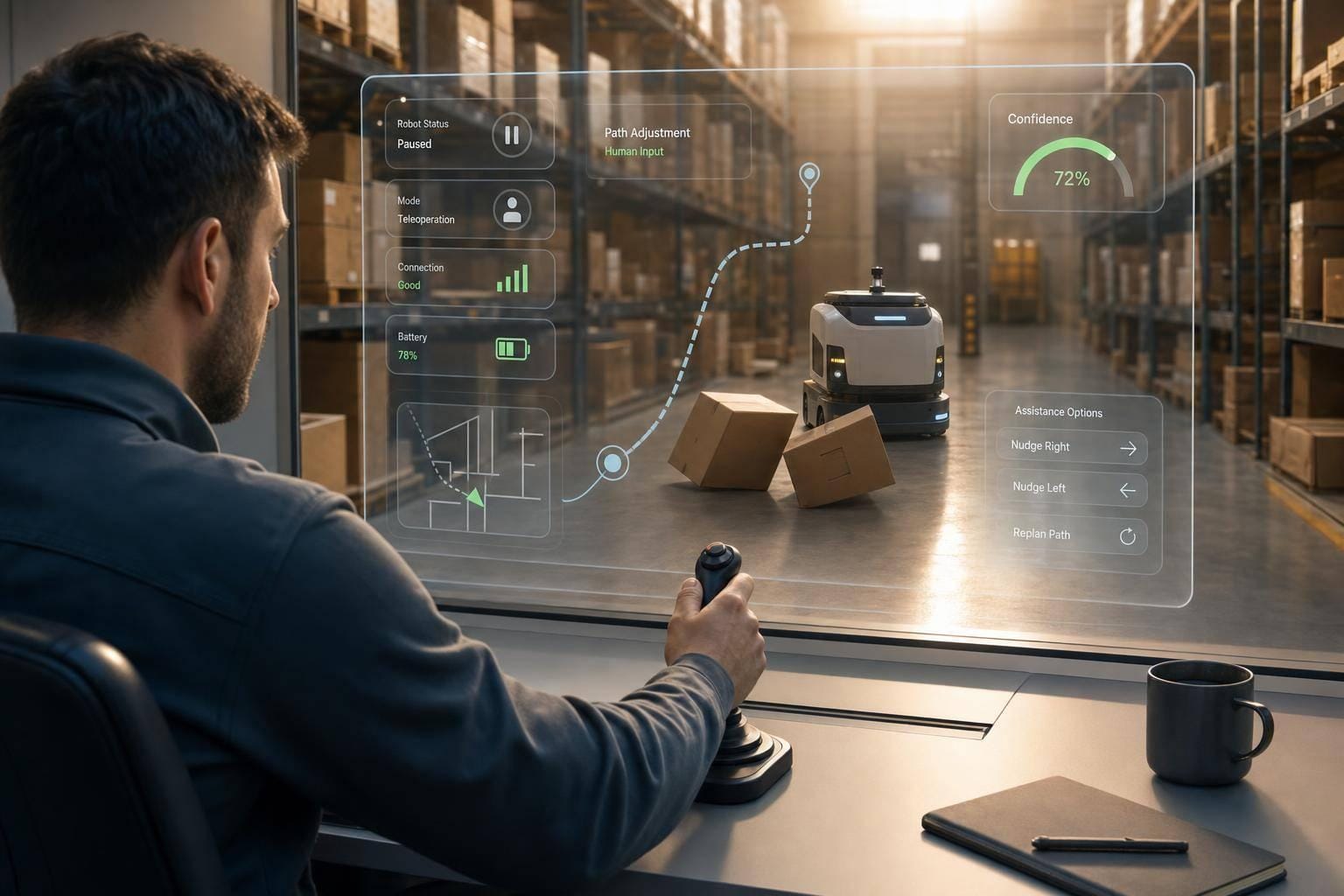
Most "autonomous" robots still need people to step in when things go off-script. I’d sum it up this way: robots handle the routine work, while humans deal with stalls, bad picks, blocked paths, and safety calls that software can’t sort out on its own.
If you want the short answer, here it is:
- Teleoperation is when a person remotely drives or controls the robot in real time.
- Supervision is when one person watches many robots and only steps in when needed.
- Remote assist is the middle ground: the robot runs by itself until it gets stuck, then asks for help.
- In many U.S. deployments, this handoff is what keeps fleets moving.
- During layout changes or peak periods, intervention rates can jump by 300% to 400%.
- For many warehouse tasks, end-to-end delay should stay under 150 ms. For fine contact work, teams may need less than 30 ms.
- If command streaming drops for more than 100 ms, systems often trigger a safe stop.
What stood out to me is simple: autonomy is not the whole system. The part that matters day to day is how fast a team can spot a problem, route it to the right operator, fix it, and hand control back without creating a safety issue.
Here’s the core idea in plain English:
- Robots fail in a few common ways: navigation, manipulation, perception, and safety
- Human operators recover those cases through consoles, camera feeds, maps, alerts, and control tools
- Every intervention can become training data for later model updates
- So teleoperation is not just backup control; it is also part of how robot systems improve over time
I see this article as a clear reminder that “autonomous” does not mean “human-free.” It usually means human help is built into the system.
How Does Teleoperation Work In Robotics?
Where Autonomy Breaks Down: Warehouses, Factories, and Mobile Robots
Even well-tuned robots fail in pretty predictable ways when the environment, object, or task shifts. The same trouble spots tend to show up again and again. On the autonomy spectrum, this is where supervised autonomy gives way to remote assist.
Navigation Failures: Stalls, Deadlocks, Docking Errors, and Blocked Paths
Warehouse floors don’t stay still. Pallets move, carts get left in the middle of aisles, and a spill can turn a clear route into a dead end in minutes. When the physical space no longer lines up with the robot’s map, the robot stops.
The most common navigation failures include stalls in crowded aisles, localization loss, docking errors where a robot can’t line up with its charging station, and deadlocks where two robots block each other with no clear right-of-way. These failures show up often in dynamic settings, especially during layout changes, software updates, or peak seasons, when intervention rates can jump by 300% to 400%.
Symbotic says teleoperation can correct most recovery cases, including spills, misaligned cases, and blocked routes, without sending people into the structure.
Manipulation and Perception Failures: Missed Picks, Bad Grasps, and Unfamiliar Objects
Robot arms are great at repeated picks. But give them an open box, an angled bundle, or a new SKU that falls outside the training data, and things get shaky fast. When confidence drops below a preset threshold, the system halts and hands the task to an operator. That operator may review the camera feed, retry the pick, guide the gripper, or reroute the item.
Safety and System Exceptions That Require Human Judgment
Not every intervention comes from a technical fault. Some moments need human judgment, plain and simple.
A child, pet, or emergency vehicle in the path, or a degraded camera feed, calls for human judgment - not a guess.
In September 2024, a Zoox vehicle in San Francisco encountered a fire truck and an ambulance blocking its route. A remote technician 35 miles away drew waypoints on a bird’s-eye view to guide it around the blockage and back into lane. The technician put it plainly:
"We are not in full control of the vehicle. We are providing guidance." - Marc Jennings, Remote Technician, Zoox
These cases show the exact handoff point between machine action and human recovery.
| Failure Category | Common Triggers | Human Role |
|---|---|---|
| Navigation | Stalls, deadlocks, docking errors, blocked paths, map mismatches | Rerouting, drawing waypoints, manual driving out of corners |
| Manipulation | Bad grasps, damaged packaging, novel SKUs, reflective surfaces | Approving retries, manual gripper control, validating non-standard grips |
| Perception | Low-confidence scores, sensor faults, unfamiliar objects, color errors | Labeling objects, confirming scene safety, overriding false stops |
| Safety | Near-collisions, emergency vehicles, hardware faults, connectivity loss | Judgment calls, triggering emergency stops, verbal communication via robot |
These failure modes mark the handoff point: autonomy runs until the system needs a person to recover the task, then control goes back to the robot.
How Teleoperation Works: The Human-in-the-Loop Workflow
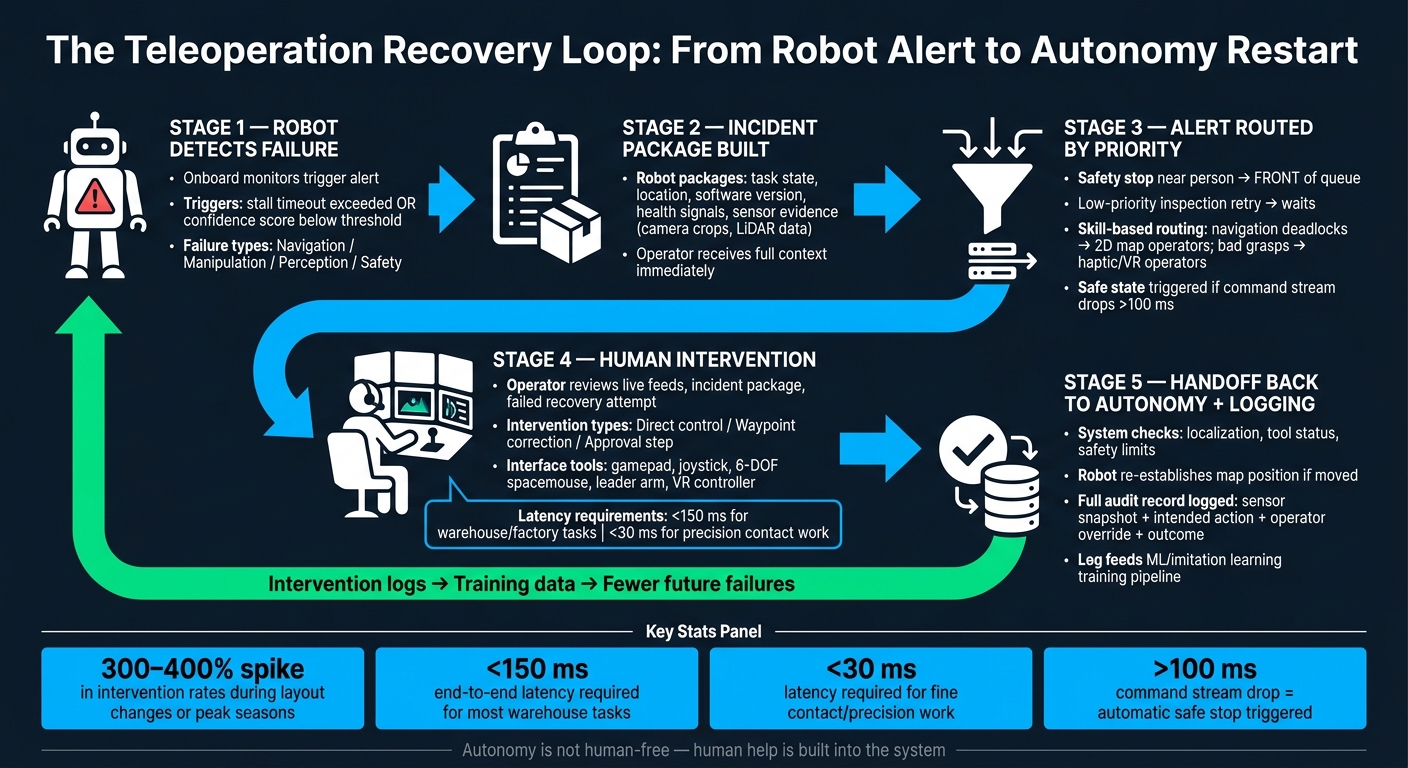
How Teleoperation Works: The Robot-to-Human Recovery Loop
Here’s the recovery loop from robot alert to restart. It covers the same stalls, deadlocks, bad picks, and safety exceptions from the previous section, and shows how each one gets fixed and passed back to the robot.
From Robot Alert to Operator Takeover
Stalls, bad picks, and safety stops kick off a standard recovery loop. Onboard monitors send an alert when a robot remains stalled past its timeout or when confidence falls below a set threshold.
The system then builds a structured incident package with the robot’s current task state, location, software version, health signals, and sensor evidence such as camera crops or LiDAR data. That gives the operator context right away instead of making them piece together the failure from scratch.
Next, alerts are routed by priority. A safety stop near a person moves to the front of the queue. A low-priority inspection retry can wait. The assigned operator opens live feeds, checks the incident package, and reviews the failed recovery attempt before taking over.
Remote Intervention in Practice
Intervention can take a few forms depending on the failure: direct control, waypoint correction, or a simple approval step.
In practice, this is about remote recovery, not full manual driving. Symbotic’s SymBot mobile robots use teleoperation to recover in rare cases when autonomous self-recovery doesn’t work, such as spilled substances or damaged packaging. Operators guide stalled bots remotely, and the company says this clears most stalls without stopping the system.
"Teleoperations allow humans to help a stalled bot recover from outside the structure, quickly and efficiently without shutting down any part of the system." - Symbotic
That’s the point. The human steps in for the odd failure, clears it, and gets out of the way. One supervisor can resolve exceptions fast enough to keep the fleet moving.
Handing Control Back to Autonomy and Logging the Event
Before autonomy resumes, the system checks localization, tool status, and safety limits. If the robot was moved during the intervention, it may need to re-establish its position on the map before autonomy can restart safely. The goal is a clean handoff. The robot should never shift from manual to autonomous mode without a confirmed known state.
Every intervention is logged with the failure state, operator action, and outcome. Those records become the data layer for improving future autonomy, so the same failure is less likely to trigger another human call.
"Every intervention is a labeled edge case, captured in context, with a human decision attached." - iMerit
Those logs then feed the consoles, alerts, and fleet software that let this workflow scale.
The Teleoperation Stack: Consoles, Video Feeds, Alerts, and Fleet Software
That recovery loop only works at scale when the software, network, and operator workflow are built as one system.
Operator Consoles, Camera Views, and Control Interfaces
A control station needs to give the operator live context and direct control so they can size up a failure and act fast. In practice, that means synced camera views, a map overlay, and LiDAR context that shows where the robot is inside the facility. It also means live robot health data on the same screen: battery level, network signal quality, joint states, and active safety flags.
The input device depends on the job. A navigation stall can often be fixed with a standard gamepad or keyboard. A harder manipulation failure may need a joystick, a 6-DOF spacemouse, a leader arm, or a VR controller. And here’s a detail that matters more than many teams expect: frame rate beats resolution. Operators generally do better at 640×480 at 30 fps than at higher resolutions with lower frame rates.
"The interface should show what the robot knows, what it is uncertain about, what action it is about to take, and how to stop it." - JJ Ben-Joseph, Founder and CEO, TensorSpace
Latency is just as important. End-to-end delay should stay under 150 ms for most warehouse and factory tasks. Precision contact work is far less forgiving and needs below 30 ms. Even before the rest of the system adds delay, network propagation across the continental U.S. takes 70–90 ms round trip on its own. That doesn’t leave much slack.
That kind of interface is only part of the story. At fleet scale, the next issue is deciding which robot needs help first.
Alerting, Escalation Logic, and One-to-Many Supervision
Tiered escalation logic sets the path: autonomous self-recovery first, then remote operator help, then an on-site technician if remote assist doesn’t work. In fleet supervision, skill-based routing sends navigation deadlocks to operators who work best with 2D map interfaces, while bad grasps go to operators using haptic or VR setups. Priority queues sort alerts by severity and operational impact so the most urgent exceptions get handled first.
Zoox's fusion center in Foster City, CA shows how this looks in practice. Technicians monitor robot taxis in San Francisco and Las Vegas, then guide stalled cars around obstacles with waypoint dots after an alert such as "Hero is not making progress 6:22:07 PM".
There’s also a hard safety rule underneath all of this: while a robot is waiting for an operator, it should move into a defined safe state. That might mean stopping in place, lowering a payload, or heading to a holding zone. If the command stream drops for more than 100 ms, a software watchdog should trigger an automatic safe stop.
Under that routing layer sits the software stack that keeps video, commands, telemetry, and logs lined up.
Teleoperation Software as Physical AI Infrastructure
The console and alerting layer sit above the control layer. Video streams usually run over WebRTC with VP8 or H.264. High-frequency control commands at 100 to 1,000 Hz often travel over UDP or WebRTC DataChannels to avoid head-of-line blocking. Fleet telemetry and lower-bandwidth status signals commonly use MQTT or WebSockets.
When those streams are synchronized within 10 ms, intervention logs become useful for machine learning and imitation learning workflows. Structured storage such as HDF5 also makes it easier to turn each intervention into training data.
That’s the key idea: the software layer that routes alerts, streams video, logs interventions, and feeds training pipelines is what turns each human assist into a lasting system improvement. In that sense, teleoperation is infrastructure, not just a control room.
What Companies Need to Run Reliable Robot Operations at Scale
Core Requirements: Latency, Safety Controls, Staffing, and Audit Trails
Once the stack is set, the hard part is day-to-day execution. The question becomes simple: can the system run well every shift, not just in a demo?
Teleoperation only scales when operations are dependable. In plain terms, four things need to work at the same time:
- low-latency connectivity you can count on
- enforced safety controls
- trained operators
- complete event logging
Latency has to stay inside the robot’s safety window for the task. In production, teams also need end-to-end encryption with TLS or VPN, plus role-based access control, so only authorized operators can take control of a robot.
Every intervention should create a full audit record. That record needs the sensor snapshot, the autonomy stack’s intended action, the operator’s corrective action, and the final outcome. If something goes wrong, that record shows what happened. If something goes right, it shows why.
Staffing matters too. Teams need enough coverage for peak alert volume, shift handoffs, and escalation tiers. A teleoperation setup can look solid on paper, then fall apart when too many alerts hit at once or a handoff gets messy.
Turning Interventions into Training Data for Better Autonomy
Once those controls are in place, each intervention should feed the next round of improvement.
Every intervention should log the sensor state, the robot’s intended action, the operator override, and the outcome. When teams sync and store those records cleanly, each intervention becomes a labeled edge case that the autonomy stack can learn from.
"Every intervention is a labeled edge case, captured in context, with a human decision attached. Feed those events back into training pipelines and your models learn faster, generalize better, and recover gracefully." - iMerit
That’s where teleoperation starts to do double duty. It helps the robot recover in the moment, and it also gives the team data for the next model update. Over time, as more intervention data piles up, more of those cases move back into autonomy.
Key Takeaways: Where Autonomy Ends and Human Operations Begin
At scale, the goal isn’t just recovery. The goal is to use each recovery to push the autonomy envelope a little farther.
In practice, robots still fail on edge cases. That can mean unfamiliar situations, operational failures, safety concerns, hard-to-handle objects, changes in the environment, or tasks outside the model’s limits. When autonomy runs out, teleoperation is what keeps the robot working.
Teleoperation isn’t a stopgap. It’s a permanent layer in production-grade robot operations. Teams that treat it like core infrastructure get higher uptime, faster recovery, and a growing training set that helps autonomy handle more over time.
FAQs
When should a robot ask for human help?
A robot should ask for human help when it hits the edge of what it can do on its own or runs into conditions it wasn’t built to handle.
This often comes up during exception handling. For example, the robot might get stalled, run into a jammed or damaged item, or face an unexpected obstacle that blocks the task.
Human help also matters in perception edge cases, when the robot can’t read the situation with enough certainty. The same goes for ambiguous decisions or any moment when the robot’s confidence drops below a set threshold.
How many robots can one operator supervise?
It depends on the system and on how hard the job is.
For complex work, or jobs that still need a lot of manual input, one-to-one teleoperation is common. One person controls one robot. That setup works, but it doesn't scale well when you're trying to run a full fleet.
In newer deployments, the setup often looks different. One operator may supervise a small fleet, or even dozens of robots, stepping in only for exceptions or to give guidance when needed. As autonomy gets better, operators spend less time on routine control and more time dealing with edge cases and task recovery.
What makes teleoperation reliable at scale?
Teleoperation works at scale when human judgment serves as a safety net for messy edge cases in the field. One operator can watch several robots at once and step in only when needed.
That setup depends on three things: strong infrastructure, an active learning loop that sends interventions back into training, and fail-operational design so robots stay safe and productive even if a connection drops or an operator isn’t available.