What Is Physical AI? The Next Big Shift in Manufacturing, Explained

Leela Yanamaddi
August 1, 2026
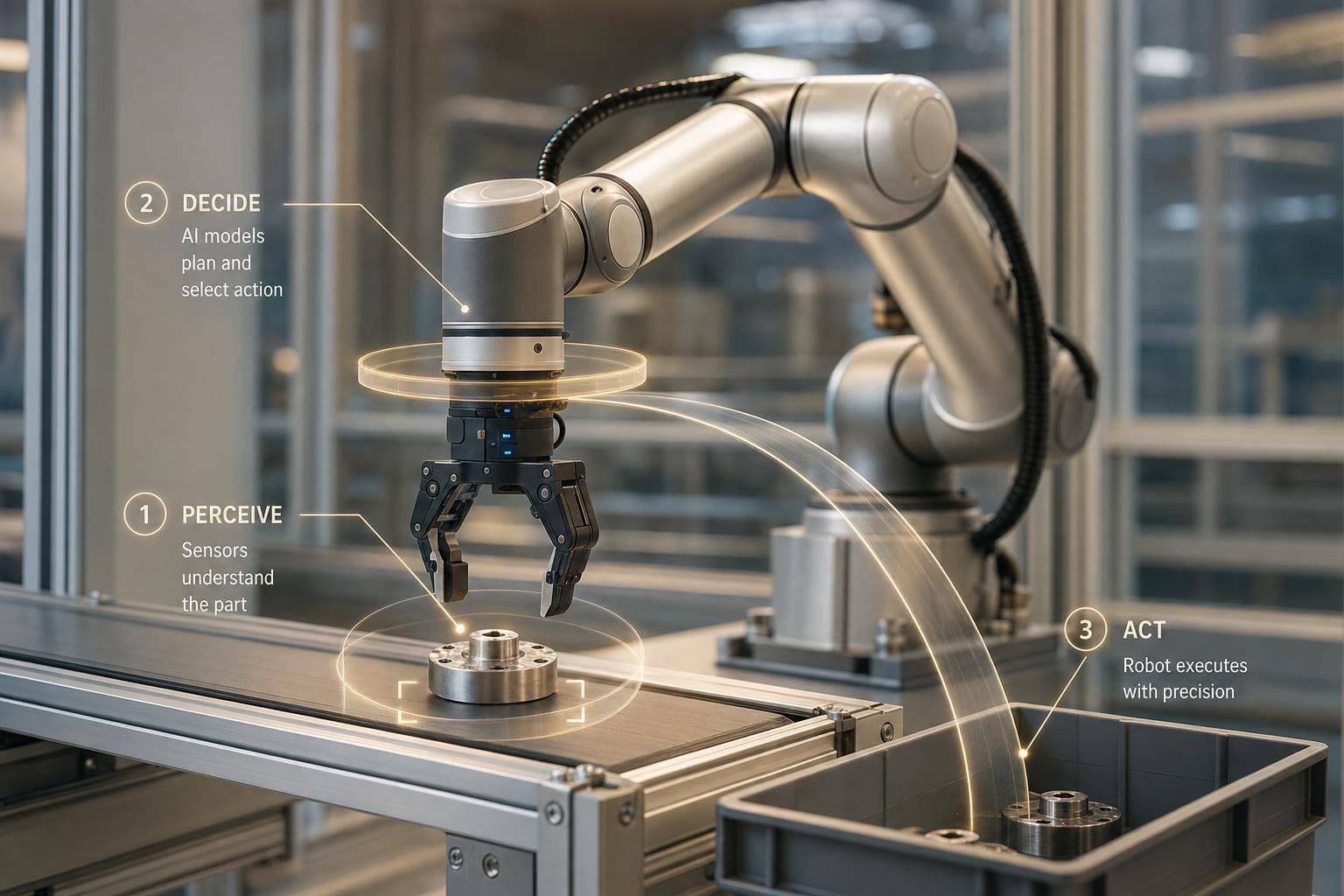
Physical AI means machines can sense, decide, and act on the factory floor instead of following fixed steps only. For manufacturers, that means better handling of variation, fewer stops when parts shift or lighting changes, and more use of robots in inspection, material movement, assembly support, and human handoff cases.
Here’s the short version:
- Physical AI = perceive, decide, act
- It is different from software AI because the output is a physical move, not just data on a screen
- It is different from fixed automation because it can handle rotated, off-position, or inconsistent parts within trained limits
- It works best in high-mix, changing production
- It depends on more than robots alone: edge compute, sensor data, teleoperation, monitoring, and retraining
- AI vision inspection can reach 97% defect detection, versus 82% for manual inspection and 80% for rules-based vision
- More than 50% of AI projects do not get past pilot stage, often because field hardware and model drift are hard to manage
- 22% of manufacturers plan to deploy some form of Physical AI by 2027
If I strip it down even more, the idea is simple: fixed automation follows instructions; Physical AI deals with change. That is why it matters now, as factories face labor pressure, reshoring, and more product variation.
A fast way to think about it:
| Topic | Fixed Automation | Physical AI |
|---|---|---|
| How it works | Pre-set logic | Model-based decisions |
| Best setting | Stable, repeatable lines | Variable, high-mix lines |
| When inputs change | Often stops | Can keep working within limits |
| Main needs | PLCs, fixed programs | Sensors, edge hardware, data, supervision |
So when I look at Physical AI in manufacturing, I do not see just a robot upgrade. I see a factory system built on data, local compute, safety controls, human backup, and constant model improvement.
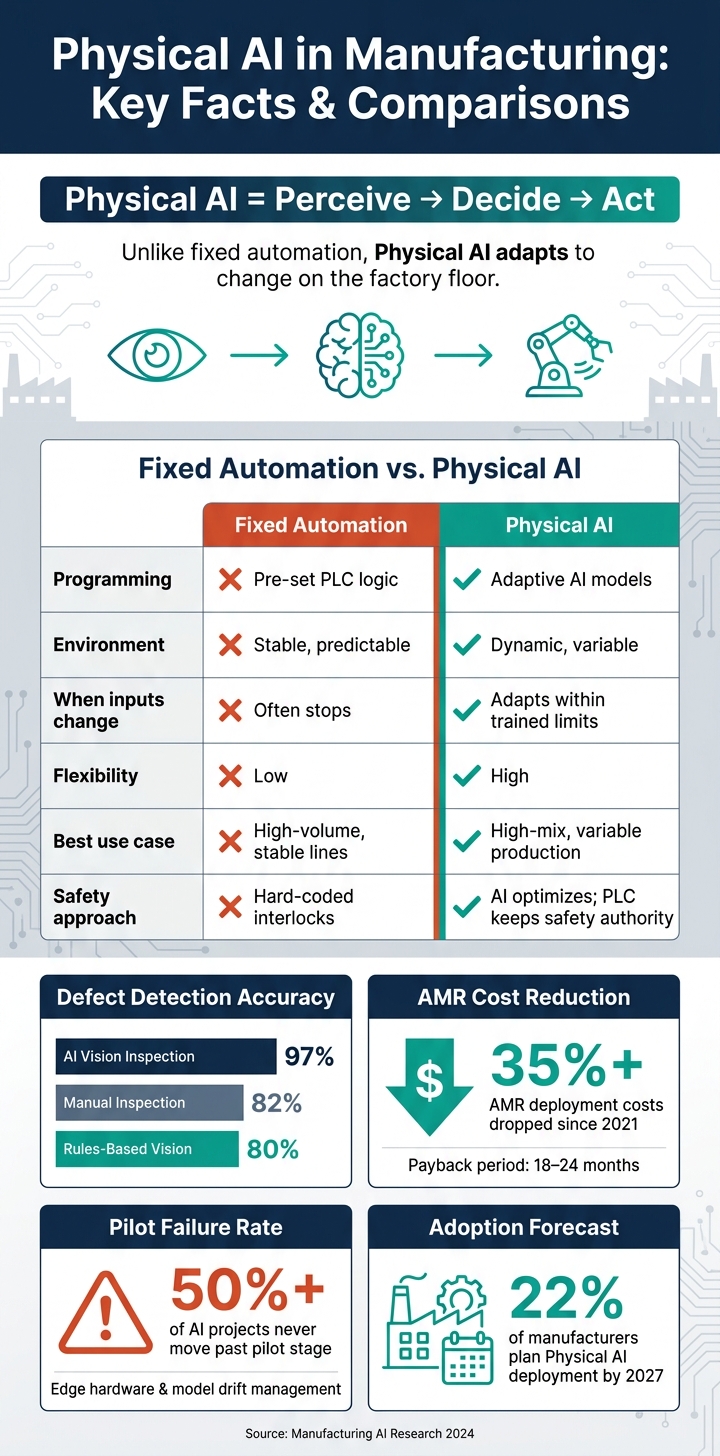
Physical AI vs. Fixed Automation: Key Differences & Stats for Manufacturers
Physical AI Explained: Why Robots Are Finally Learning Like Humans
What Physical AI means in a factory environment
In a factory, Physical AI means AI built into machines that sense the floor, decide what to do, and then act in the physical world. The output isn’t just data on a screen. It’s a robot picking a part, an AMR moving down an aisle, or a vision system rejecting a defect.
That changes the job in a big way. Factory floors aren’t neat lab settings. They’re variable, noisy, and safety-critical.
The hard part is that factories change all the time. Lighting shifts. Dust collects on camera lenses. Parts show up slightly out of position. Floor vibration can throw off sensor readings. That’s why Physical AI works differently from software AI.
Physical AI vs. software AI
Software AI produces digital outputs. Physical AI produces physical actions.
For manufacturing teams, that difference matters a lot. The setup, safety rules, and infrastructure needs are very different from what you’d expect with software-only AI. And the core of that difference comes down to one loop: perceive, decide, act.
The perception-decision-action loop
Every Physical AI system runs on the same basic cycle: perceive, decide, act.
First, sensors like RGB-D cameras, LiDAR, and tactile sensors collect data from the surroundings. Then an AI model running on local edge hardware, such as a GPU or NPU, interprets that data and figures out the next move. After that, an actuator, like a robot arm, gripper, or AMR, carries out the action.
Edge hardware matters because of latency. Cloud inference adds lag that production lines can’t absorb, so Physical AI systems make low-latency decisions at the edge fast enough to match line speeds. AI decisions also need to stay separate from deterministic safety controls, which keep override authority.
How Physical AI differs from conventional automation
Conventional automation - PLCs, fixed robot programs, and rule-based vision - works best when inputs stay stable. And when that setup stays the same, these systems can do the job well. The problem is simple: factory floors don’t stay that predictable for long.
Fixed programming vs. adaptive behavior
Traditional robots usually work only when inputs match pre-set cases. If a part shows up slightly rotated, or a new product version moves onto the line, the system may stop and wait for an engineer to reprogram it. That adds both time and cost.
Rule-based machine vision runs into the same wall. It performs best under the exact lighting and positioning it was calibrated for. Add glare, dust on a lens, or small surface changes, and results can slip. In production, AI-driven vision inspection reaches 97% defect-detection accuracy, compared with 80% for rules-based systems.
Physical AI handles off-center, rotated, or discolored parts instead of stopping at the first mismatch. That’s the big shift. It learns from diverse real-world and synthetic data, so the model can keep working even when conditions change.
This gap matters most in high-mix manufacturing, where changeovers happen often. On stable, high-volume lines with little variation, fixed automation can still be the right fit. But when manufacturers move toward lower-volume, higher-mix production, the rigidity of older systems turns into a direct operating cost.
Comparison table: Conventional automation vs. Physical AI
| Feature | Conventional Automation | Physical AI |
|---|---|---|
| Programming method | Fixed, rules-based PLC logic | Adaptive AI models (ML/neural networks) |
| Environment assumptions | Stable, predictable | Dynamic, variable |
| Sensor use | Simple triggers | Sensor fusion |
| Training data | Low (logic-based) | High (real-world telemetry and synthetic data) |
| Exception handling | Stops on unexpected input | Adapts within trained limits |
| Flexibility | Low; needs specialist reprogramming | High; handles variation |
| Safety approach | Physical barriers and hard-coded interlocks | AI optimizes; PLC keeps safety authority |
| Best use case | Stable, high-volume lines | High-mix, variable production |
You can see these differences most clearly in material handling, inspection, assembly support, and exception handling.
Where Physical AI appears in manufacturing workflows
The move from fixed automation to Physical AI tends to show up first in jobs where variation is part of the day-to-day. It doesn't roll into a factory all at once. It starts where rigid systems struggle most. In manufacturing, that usually means inspection, transport, assembly support, and exception handling.
Material handling, inspection, and assembly support
AI vision inspection is often the first place companies start because good vision makes the rest of automation far more workable. On actual production lines, AI-driven vision inspection reaches 97% defect-detection accuracy. That compares with 82% for manual inspection and 80% for standard rules-based machine vision.
Material handling is another strong fit. Autonomous Mobile Robots (AMRs) can move across factory floors and reroute if an aisle is blocked or the layout changes. That matters more than it may seem. A robot that only works in a perfectly stable setup isn't much help in a busy plant. AMR deployment costs have dropped by more than 35% since 2021, and payback periods can be as short as 18 to 24 months.
For assembly support, Physical AI is useful in tasks where part position, orientation, or presentation changes from one cycle to the next. That's where fixed systems often start to wobble.
Teleoperated exception handling
Even well-trained Physical AI systems run into cases they weren't built for. A part may come in at an odd angle. Packaging may be torn. A route may be blocked. Instead of stopping the line, these systems use human handoff paths so a remote operator can step in and keep work moving.
When autonomy hits its limit, a person takes over the tricky part and the process keeps going. Teleoperation works as a practical bridge between machine autonomy and human judgment. It also creates useful feedback for later learning while helping preserve uptime. In plain terms, it handles the tough exceptions and keeps the line running when the system can't finish the job on its own.
That blend of autonomous work, human override, and manual labor becomes clearer when you compare the three modes side by side.
Comparison table: Autonomous operation, teleoperation, and manual operation
| Feature | Autonomous Operation | Teleoperation | Manual Operation |
|---|---|---|---|
| Responsiveness | Milliseconds (edge computing) | Seconds (human reaction time) | Variable (human speed) |
| Scalability | High (fleet-wide deployment) | Medium (limited by number of robots per operator) | Low (limited by labor pool) |
| Labor intensity | Low (monitoring only) | Medium (remote intervention) | High (physical presence) |
| Safety oversight | System-led (proximity sensors) | Human-monitored | Human-led |
| Data generation | High (continuous sensor logs) | High (feedback for learning) | Low (unless digitized) |
| Best use case | Repetitive and variable tasks | Exceptions and edge cases | High-judgment or complex tasks |
Behind these workflows is a data and control stack that keeps robots learning, monitored, and usable at scale.
The data and infrastructure stack behind Physical AI
The model is only one part of the story. The stack around it decides whether Physical AI works on the factory floor or gets stuck after a pilot.
Real-world data, demonstrations, and teleoperation feedback
Factory data from the field matters because it reflects drift, wear, lighting shifts, and all the messy conditions that synthetic setups can miss. Human demonstrations give robots a starting point too. By watching how a person picks, places, or inspects a part, the model can learn basic task sequences that are hard to define with rules alone.
There’s another piece people often overlook: teleoperation. When a robot runs into an edge case and a remote operator takes over, that session becomes high-value training data for later runs. The robot doesn’t just get unstuck in the moment. It gets another example of what “good” looks like. Over time, that cuts down on intervention.
This creates a flywheel effect: better data leads to more capable models, which generate better operational data, which feeds the next round of improvement.
Monitoring, fleet operations, and manufacturing intelligence
Once the model is trained, the next challenge is keeping it dependable across robots, lines, and facilities. That’s where monitoring comes in. It turns a set of isolated robots into a managed fleet.
At scale, Physical AI needs a shared data layer that connects telemetry, model lineage, calibration logs, and escalation workflows across robots, lines, and sites. If a robot sensor starts drifting, or a model begins to slip, the monitoring system has to connect model lineage with physical asset calibration logs and use real-time telemetry to trigger alerts for sensor drift or mechanical wear.
This is one reason scaling is hard. More than 50% of AI projects fail to move past the pilot stage because managing edge hardware and model drift in field conditions is so complex.
Comparison table: Infrastructure required at each stage
Physical AI relies on different inputs and systems at each point in its lifecycle. What you need during training is not the same as what you need during deployment, supervision, or improvement.
| Stage | Required Data | Human Role | Software/Systems | Output |
|---|---|---|---|---|
| Training | Sensor logs, first-person video, synthetic data, digital twins | Providing demonstrations, labeling edge cases | Simulators (Gazebo, Isaac Sim), world models | Pre-trained policy models |
| Deployment | Real-time sensor fusion (LiDAR, Radar, Cameras) | System commissioning, setting intent | Edge compute (NVIDIA Jetson), ROS 2, MQTT | Autonomous physical action |
| Supervision | Live telemetry, performance KPIs, intervention logs | Teleoperation, exception handling | Fleet dashboards, HITL interfaces | Real-time intervention |
| Improvement | Failure logs, recovery demonstrations, drift data | Reviewing edge cases, fine-tuning | Deployment and retraining pipelines | Model updates, efficiency gains |
Conclusion: Key takeaways for manufacturing teams
The big shift is pretty simple: Physical AI moves robots from fixed tools to systems that can sense what's happening, make choices, and act without being guided through every single step. In manufacturing, that means a different way of running automation. Instead of relying on rigid programming, teams can use machines that respond to change as it happens.
Why does that matter? Because factories rarely stay perfectly predictable. Parts show up at odd angles. Lighting changes. Product mixes shift. New variants get added. Fixed automation often struggles in those moments, while Physical AI is built for that kind of variation.
You see the difference in day-to-day performance: more uptime, better recovery when something goes wrong, and more flexibility on the line. That's also why Physical AI fits best in high-variation production, not in stable, repetitive lines where standard automation already does the job well.
Physical AI is already showing up in areas like:
- Material handling
- Inspection
- Assembly support
- Exception recovery
And adoption is moving from talk to action. About 22% of manufacturers plan to put some form of Physical AI in place by 2027.
What sets one deployment apart from another isn't just the robot itself. It's the stack behind it: real-world data, demonstrations, teleoperation, monitoring, and edge compute. As Raj Sharma noted, the intelligence layer - data pipelines, simulation, models, reasoning engines, modernized IT infrastructure, and workforce readiness - matters more than the hardware.
For manufacturing teams, the robot on the floor is just the visible part. The bigger story is the system behind it. Physical AI isn't just a robot buy. It's a factory capability built across data, software, hardware, and operations.
FAQs
How do I know if Physical AI fits my factory?
Physical AI makes sense when your factory deals with high-mix, low-volume work, needs real-time perception and action, and already has the data and infrastructure to back it up.
Here’s the simple way to think about it: don’t start with the hype. Start with the floor.
Check four things:
- Production variability: Are products, tasks, or conditions changing often enough that fixed rules start to break down?
- Data readiness: Do you have usable data, plus the systems needed to collect, move, and act on it?
- A bounded pilot for one measurable process: Can you test it in one clear area where success is easy to track?
- Human oversight: Is there a person in the loop for edge cases, exceptions, and situations the system didn’t see coming?
That last point matters a lot. On a factory floor, weird cases always show up. A person still needs to step in when the system hits something outside its lane.
If all you need is rules-based office automation, Physical AI isn’t the right fit.
What data is needed to train Physical AI systems?
Physical AI systems run on a steady flow of high-quality operational data.
That matters because even well-run factories may see only a small number of rare events, like defects. So, training often leans on synthetic data from world models to generate realistic scenarios. Teams can then test systems in simulation before deployment, instead of waiting for those edge cases to show up on the factory floor.
They also pull in data from a few other sources: domain randomization, real-world system identification data, SCADA and edge-sensor telemetry, human demonstrations, and teleoperation logs. All of it gets brought together in a common data fabric.
How is safety managed when AI controls machines?
Safety in Physical AI comes down to a simple split: let the AI make some decisions, but keep hard safety rules outside the model.
AI models can generalize. That’s useful. But they’re not perfect, so human oversight and fallback systems still matter.
In practice, engineers usually keep legacy PLCs in charge, with absolute veto power over unsafe commands. They also confine AI to pre-verified operating boundaries. If a command moves outside normal parameters, machine assets can be isolated right away.
Before anything touches a live system, teams validate behavior through simulation-first development and hardware-in-the-loop testing. That way, they can see how the system responds before it has a chance to cause trouble.