Why Smarter Robots Alone Won't Fix Your Factory

Leela Yanamaddi
August 1, 2026
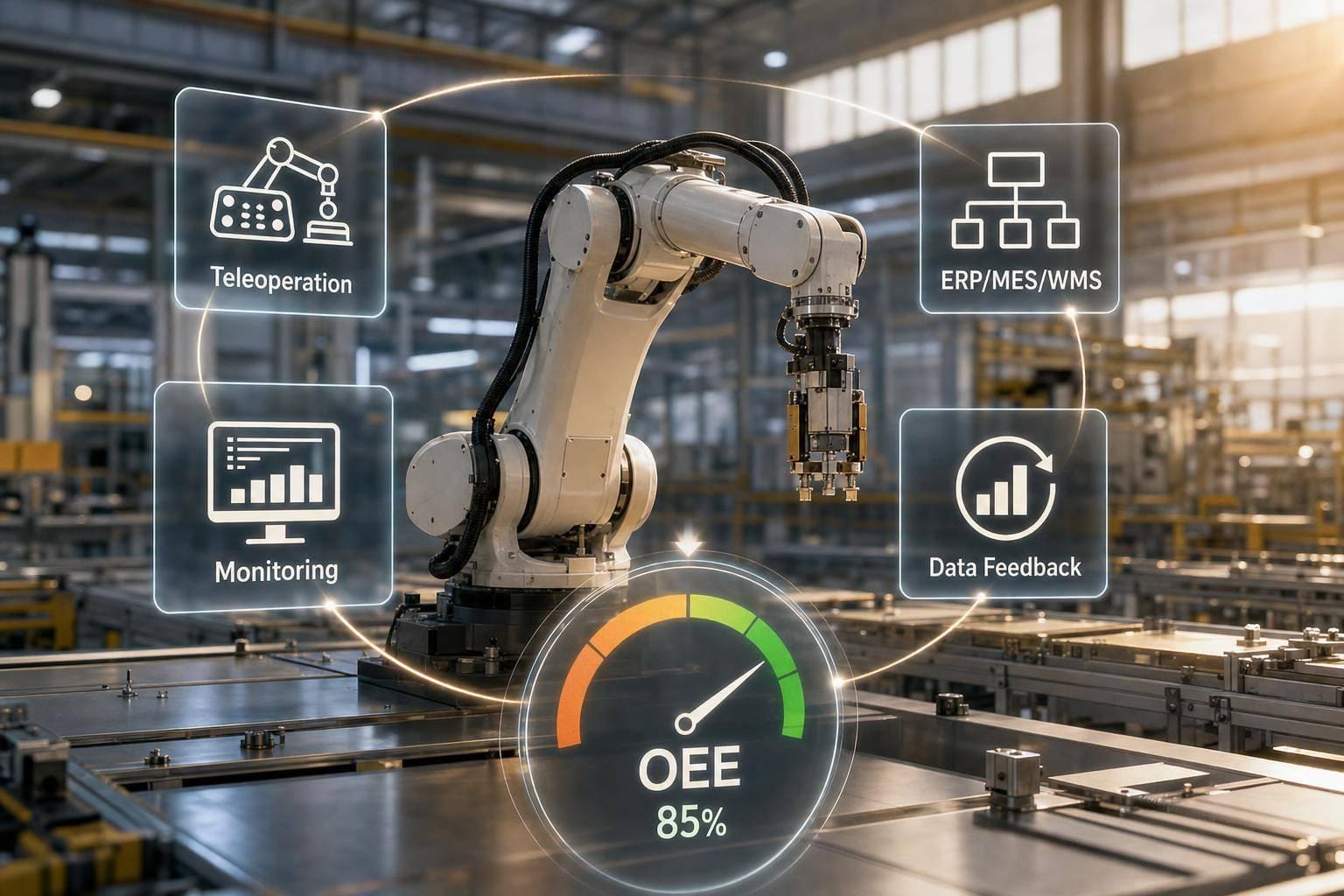
Smart robots do not fix factory output on their own. If you want better uptime, safer lines, and more parts out the door, you also need monitoring, human handoff, incident handling, clean data, and ties into systems like MES, ERP, WMS, and maintenance tools.
Here’s the short version:
- AI plans are moving fast: 68% of manufacturers said they expected AI at scale within 12 months, but 76% said bad data was a top risk.
- The main issue is not robot skill alone: factories lose time when robots hit edge cases, stall, and no one steps in fast.
- Human backup still matters: teleoperation, role-based alerts, and clear reset paths help keep a small issue from becoming a line stop.
- Logged failures matter: each override, jam, and drift event should feed data back into the system so the same problem is less likely next time.
- Plant system links matter too: without MES, ERP, WMS, and CMMS links, a robot may move parts but still miss production context.
- The end goal is simple: turn robot events and plant signals into action that cuts downtime and closes the gap between 40%–65% OEE and the 85% level many teams aim for.
My takeaway: if a robot fails and your plant cannot answer who gets alerted, what happens next, and how that event gets logged, then the weak point is not the robot alone. It’s the layer around it.
A simple way to think about it is this: robot model + human handoff + monitoring + system links + feedback data = a factory setup that keeps learning instead of just stopping.
Why autonomy alone breaks down in real production
Even strong robots can fail when the floor shifts faster than their training data. A system might work in a test, or even on a good day in production. But factories don't stay still. Parts vary. Layouts change. Moisture shows up where it wasn't before. And once conditions move outside what the robot has seen, production can stall.
That's the key point: in production, success isn't about whether a robot can complete a task once. It's about how fast the system gets back on track when something goes wrong.
Edge cases and unfamiliar conditions stop otherwise capable robots
Most failures don't look dramatic. They're small. But they cost time and money fast.
- A part gets mispicked
- An object shows up on the line where it shouldn't be
- A sensor is partly blocked by condensation
Any one of those can stop production if there's no clear recovery path.
A lot of the know-how needed to fix these moments still sits with experienced operators, not inside the robot's model or the plant's software. That's a big deal. If that operator knowledge never makes its way into the workflow, the factory has no clean way to learn from exceptions and improve robot performance over time. Model performance matters, but recovery design matters just as much.
The numbers back that up. In 2022, only 11% of manufacturers successfully scaled advanced-technology pilots across their production networks, leaving the vast majority stuck in pilots that never reach full deployment.
Autonomous-only deployments create slow recovery and higher operational risk
When a robot stalls and no person is looped in, the downside shows up right away: slow recovery, higher safety risk, and lower confidence in deployment.
The Avride case puts this into plain terms. In May 2026, federal investigators opened an inquiry into Avride, Uber's robotaxi partner, following 16 crashes in Dallas and Austin. The NHTSA cited concerns about system behavior in complex conditions. In practice, that means the system needs clear limits and human oversight in complex conditions.
Without defined escalation thresholds and human oversight, autonomous systems don't just fall short. They create new kinds of risk that weren't there before deployment. That's why the operating layer matters so much. Teleoperation, monitoring, and incident response aren't side features. On the floor, they're part of what keeps production moving.
The missing operating layer: human escalation, monitoring, and incident response
That operating layer has three parts: teleoperation, escalation, and incident response. A smarter robot model still doesn't tell you what to do when the robot stops. That's where a defined operating layer comes in: teleoperation, escalation, and incident response.
Teleoperation and human escalation keep work moving
When a robot runs into a situation it can't handle, the main issue isn't whether a person should step in. It's how fast that handoff happens and whether the person taking over has the right tools.
Teleoperation is the bridge. A remote operator can see what the robot sees, take control, guide it through the exception, and hand autonomy back once the situation is fixed. The goal is a human-supervised autonomy model: the robot handles what it knows, and a human enters the chain exactly when conditions cross a set threshold. That helps stop exceptions from turning into full line stoppages.
Full automation can make a system less resilient when people can't step in fast enough.
Escalation paths should be layered by role. An operator handles immediate adjustments. A shift supervisor gets notified when a drift keeps going. A plant manager steps in when the problem goes beyond the operator's authority. That setup keeps decisions at the right level and helps stop small issues from turning into full stoppages.
Fleet monitoring and incident-response workflows reduce downtime
Robot fleet monitoring answers three simple questions:
- What failed
- Who responds
- How often it happens
Health dashboards, alert routing, and intervention logs give operations, maintenance, and safety teams the visibility they need to respond fast and spot patterns over time.
Every manual override or teleoperation session should be logged with a reason. If you keep seeing the same stall again and again, you can trace it back to something like a humidity shift or a workflow gap. Each logged intervention becomes data you can use to cut repeat failures.
These workflows only work when the trigger, owner, and response are explicit. The table below maps common incident types to the signals that trigger them, the right escalation path, and the likely effect on production.
| Incident Type | Operational Signal | Escalation Path | Operational Impact |
|---|---|---|---|
| Process Drift | Moisture/Temp reading outside 5% band | Operator review; Supervisor alert if drift persists >90 seconds | Prevents batch contamination; minor throughput dip |
| Mechanical Jam | Motor torque spike / zero velocity signal | Remote teleop to clear; Maintenance if physical fix needed | Prevents hardware damage; 15–30 min downtime |
| Safety Breach | Light curtain breach / LiDAR proximity alert | Immediate E-stop; Safety Officer reset required | High safety impact; temporary full line stoppage |
| Supply Starvation | WMS signal: bin empty / part mismatch | Logistics alert to floor runner; Planner re-sequences | Prevents dry cycles; maintains flow via re-routing |
What factories need next: data pipelines and production system integration
Once incidents are handled, the next step is turning each one into structured data. Incident response keeps the line moving today. Logging what happened helps stop the same issue from coming back tomorrow.
Operational data turns daily failures into future autonomy gains
Every teleoperation session, manual override, and escalation trace can become a training example. But that only happens if each event includes a reason code, a failure clip, and the escalation path. Without that, the intervention disappears into the day’s noise.
And that loss adds up fast. About 40% of shop-floor knowledge in a factory lives only in operators’ heads - things like the humidity range that causes a hopper to jam, or the sound a bearing makes right before failure - and none of it sits inside an ERP or MES system. If no one logs that knowledge, getting it back later is tough.
The answer isn’t a bigger model. It’s better data collection.
Teleoperation traces, failure clips, intervention labels, and edge-case examples are the raw material for continuous model improvement. When the same stall keeps happening, the problem is often the missing data trail, not the model. Once that pattern is logged and labeled, it becomes a training example that can help stop the same stall next week. What’s missing, in many cases, is a process signal rich enough for a model to read events in real time.
At Teknor Apex's Rhode Island site, the team started with observability. They sequenced products onto a system tied to real-time load data, and changeover times fell by 33% to 50%. If production data isn’t legible, improvement is mostly guesswork.
Those labels only help when they move into the systems that run production.
Integration with MES, ERP, WMS, and maintenance systems makes robots useful at scale
A robot that can’t read the shift plan, inventory status, or maintenance state is cut off from the rest of the plant. It may still move parts, but it can’t act on what the factory needs right now.
Integration changes that. It lets robots respond to the live production schedule instead of stale assumptions.
- MES integration gives robots work instructions and machine context, so they can do the right task at the right time.
- WMS connectivity keeps material handling lined up with physical movement.
- ERP links let the system check inventory and purchasing status before taking on a task.
- CMMS integration means vibration or temperature data from a robot arm can trigger a maintenance ticket during planned downtime instead of after an unplanned stop.
The robot is one part of the production system, not a standalone worker. And the gap between a connected robot and a disconnected one shows up in output, traceability, and how the line handles problems.
| Dimension | Disconnected Robots | Integrated Robots (MES/ERP/WMS) |
|---|---|---|
| Throughput | Limited by isolated cycle times and manual part feeding | Optimized by real-time production schedules and load visibility |
| Coordination | Operates as an isolated island with no upstream context | Routes work based on technician availability and part status |
| Traceability | Manual batch logging; high risk of missing batch genealogy | Automated batch genealogy linked to work orders and quality systems |
| Exception Handling | Line stops until a human notices a fault or jam | Supervisor agents monitor for drifts and trigger escalation paths before failure occurs |
Without integration, the robot doesn’t know its task, context, or dependencies. That context is what the next layer of factory intelligence depends on.
Building a factory intelligence layer that improves uptime, safety, and throughput
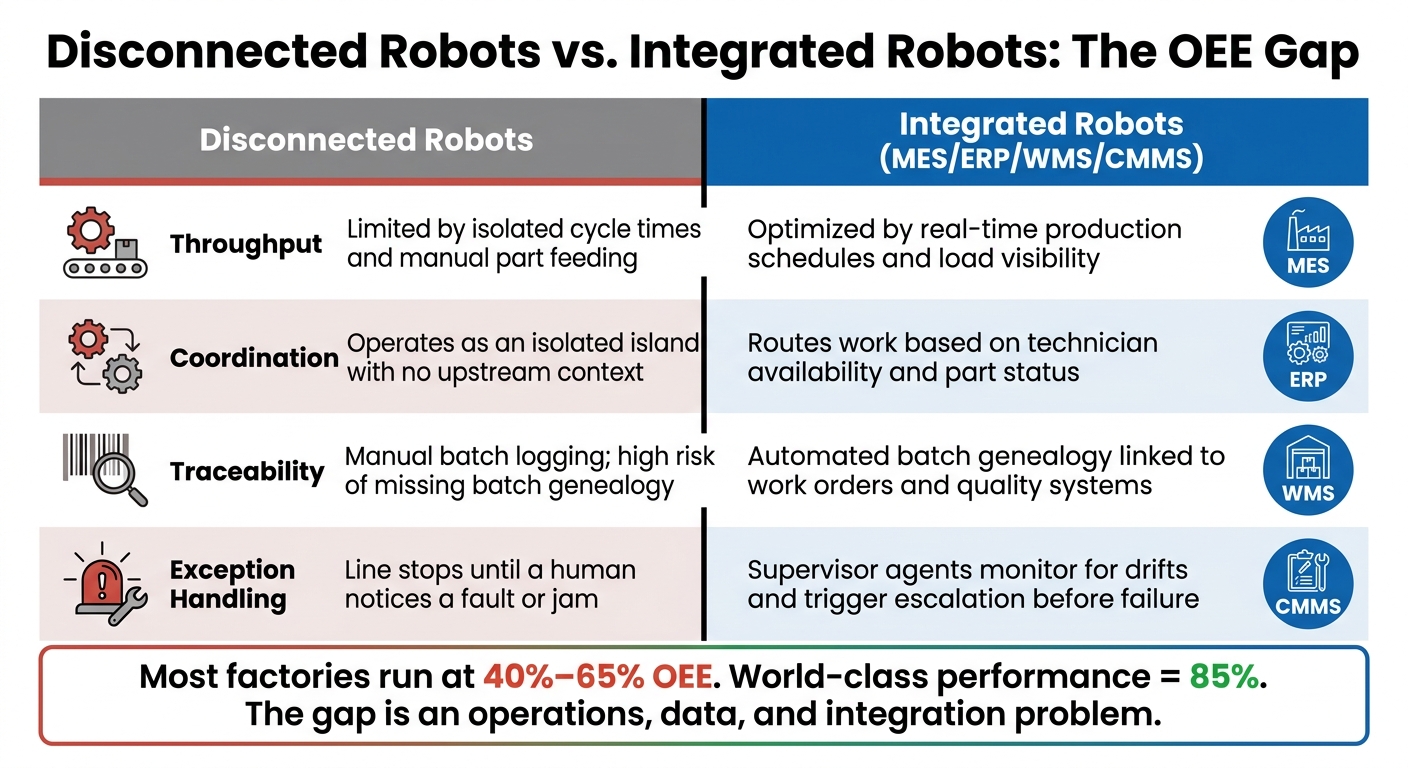
Disconnected vs. Integrated Factory Robots: OEE Impact & Key Dimensions
From isolated robots to a system that monitors, learns, and optimizes
Once a factory is connected, the next step is simple to say but hard to do: turn signals into decisions. That missing layer has three jobs. It needs to interpret signals, send action to the right people, and learn from every intervention.
Contextual analysis turns a temperature spike into an alert someone can act on. Routing makes sure that alert goes to the right role when the right team is on shift. Feedback logs each intervention so the system gets better over time. Put together, those three parts turn raw operational data into gains in uptime, safety, and throughput, not just more dashboards.
This is where the payoff starts to show. Alerts stop being noise and start becoming action before downtime begins. At one automotive components facility, a 12% deviation from baseline automatically triggered an alert to a specific technician, turning what had previously been a 4-hour unplanned failure into a planned 45-minute replacement with zero impact on output targets.
At plant scale, that logic becomes a control layer across the site, not just a feature inside one tool. Evlo.ai's Manufacturing Brain pulls data from robots, operators, machines, and production systems into one layer for monitoring, predictive maintenance, workflow optimization, and AI-assisted decisions across the plant.
Conclusion: what your factory actually needs beyond smarter robots
None of these problems are fixed by a smarter model alone. They’re fixed by the operating infrastructure around the model.
For manufacturing and robotics leaders, the practical questions are pretty direct: what happens when a robot fails, who gets notified, how fast do they respond, and does that event help the system improve next time? Most industrial facilities run at 40% to 65% OEE, while world-class performance sits at 85%. Closing that gap is an operations, data, and integration problem, and the layer that connects everything is what actually moves the line.
FAQs
What is the operating layer around robots?
The operating layer around robots is the infrastructure that links robot autonomy to dependable factory production.
Put simply: it helps robots work inside human judgment, physical limits, and business goals instead of acting on their own.
It usually includes integration and control, human escalation and troubleshooting, data and monitoring, and safety and governance. Together, these systems improve coordination, visibility, and resilience when exceptions or failures happen.
When should humans take over from a robot?
Humans should step in when a task calls for fast judgment, hands-on skill with different products, or dealing with situations that go past the robot’s programmed limits.
People also need to take over when conditions shift, parts jam, sensors drift, or other issues show up. The best setups use pre-defined escalation paths, so human oversight starts the moment a reading crosses a set boundary or an exception occurs.
Which factory systems should robots connect to?
Robots need to connect to the broader factory ecosystem. They shouldn’t work off on their own.
Key systems include MES for task dispatch, WMS for inventory and material flow, and ERP for scheduling and purchasing data.
They also need to connect with physical infrastructure like Wi‑Fi and safety sensors. And they should tie into human workflow tools, such as incident management and alert routing, so telemetry turns into action and operators can deal with exceptions.