The Rise of the "Factory Brain": One System to Run Every Machine

Leela Yanamaddi
August 5, 2026
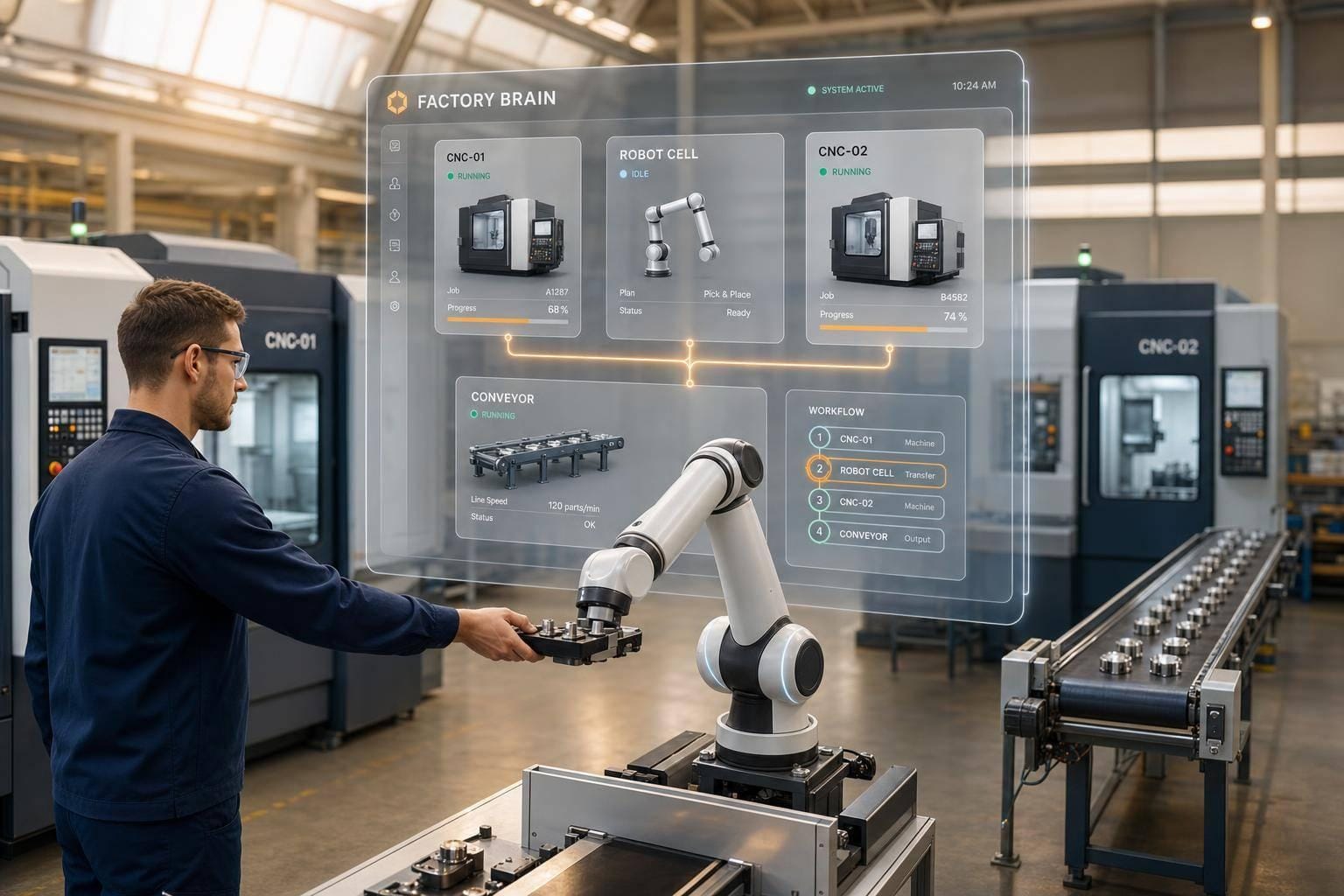
Factories don’t have a machine problem. They have a coordination problem. Even now, 50%+ of plants still use spreadsheets or manual entry to track output, downtime, and scrap, which leaves teams working from mixed numbers instead of one shared view.
If I had to sum up the article in plain English, it’s this:
- A Factory Brain is one software layer that sits above PLCs and SCADA
- It pulls data from machines, robots, sensors, and business systems into one place
- It helps route work, flag faults, send issues to the right person, and guide what happens next
- It depends on a connected data stack, including protocols like OPC UA, MQTT, Profinet, and EtherCAT, plus a Unified Namespace
- It links factory-floor data with MES, WMS, ERP, and CMMS
- It can cut lost production time, improve utilization, and give supervisors one clear view of the plant
A few numbers stand out. One site cut lost production time by 62% in two months. Advantech reported a 12% productivity gain over six months. MQTT can reduce network traffic by 80%–95% for slow-changing signals.
What matters most is simple: this is not just another dashboard. It is a control layer that helps machines, robots, and people work from the same data at the same time. And when automation gets stuck, the system can hand off to a human, log that step, and use it as training data later.
| Area | What changes with a Factory Brain |
|---|---|
| Visibility | One shared view instead of siloed tools and manual logs |
| Downtime | Faster fault tracing and issue routing |
| Robot fleets | Better task assignment across mixed vendors |
| Human handoffs | Remote support when automation cannot finish safely |
| Learning loop | Human interventions become labeled data |
So when I read this piece, the main takeaway is clear: the Factory Brain is the software layer that turns disconnected automation into one working system.
How PLCs Control Machines ⚙️ The Brain of Industrial Automation
What a Factory Brain is and what it controls
A Factory Brain is the software layer that connects factory systems and turns raw data into action. That distinction matters. The point isn’t just to show dashboards or log events. The point is to control what happens next.
A standard MES records orders and production data. A Factory Brain goes further. It uses that data to coordinate robots, spot incidents, reroute work, and send issues to operators when a person needs to step in.
In day-to-day use, that means one system has to manage equipment, material flow, and human response at the same time.
One layer connecting machines, robots, sensors, and people
This layer ties CNCs, presses, AMRs, cobots, sensors, cameras, and operators into a single control loop.
What it handles every day
During a normal shift, a Factory Brain:
- tracks machine status and OEE in real time
- watches robot health across the fleet
- directs material transport and task assignments
- runs automated quality checks
- spots anomalies
- manages escalation workflows when a human decision is needed
At Advantech, a dedicated "Production Line Efficiency Agent" detected bottlenecks in real time and delivered a 12% productivity gain over six months of operation.
How Evlo.ai fits this model

Evlo.ai is building this infrastructure layer for Physical AI settings. Its Manufacturing Intelligence platform - what the company calls the Manufacturing Brain - pulls together data from robots, machines, teleoperators, and production systems into one layer. It watches factory and warehouse operations, flags equipment problems before they cause downtime, supports human escalation workflows, and keeps improving performance across the facility.
What stands out in Evlo.ai’s model is the feedback loop between teleoperation and factory intelligence. Every time a human steps in to help a robot, the company’s teleoperation infrastructure creates data from that interaction. That data flows back into the manufacturing intelligence layer, creating a continuous learning loop between human operators and the machines they oversee.
"The layer that understands what's happening across a facility is the constant. The form factor acting on that understanding... is what will keep expanding." - Rae Jeong, Co-founder and CEO, Maneva AI
Next comes the infrastructure that makes this level of coordination possible.
The infrastructure needed to run every machine together
A Factory Brain runs on a connected stack, from sensor inputs all the way to ERP updates. That stack is what turns the Factory Brain from a system that just shows what's happening into one that can help control what happens next.
Connecting equipment across the factory floor
The first job is simple to describe and hard to do: get data out of every machine. Most factories have a mixed floor. You’ll see newer robots next to older equipment, and they rarely speak the same language.
For newer machines, standard protocols like OPC UA help systems work across vendors. MQTT moves lightweight event data across the network with very little overhead. It only sends data when a value changes, which can cut network traffic by 80–95% on slowly changing signals. For motion control, high-speed protocols like Profinet and EtherCAT handle the deterministic timing that PLCs need.
Older equipment is harder to connect, but it’s far from a dead end. One practical option is to use non-invasive clip-on current sensors. These sensors read a machine’s electrical signature without touching PLC code or changing the OT network.
Once the data starts flowing, it needs structure. A Unified Namespace (UNS) gives the factory a shared data layer where each machine publishes its state once, and any authorized application can use that data on its own. That setup replaces a messy web of point-to-point connections that gets out of hand fast as more systems are added. And once machines can publish dependable data, the next step is moving that data fast enough to act on it.
Data pipelines, edge systems, and operator oversight
Raw machine data only matters if it gets to operators or automation in time to do something with it. That’s where edge computing earns its keep. It keeps real-time decisions close to the machine, while model training and long-term analytics happen in the cloud. With the edge handling time-sensitive work, the Factory Brain can coordinate activity across the rest of the plant without waiting on distant systems.
There’s also a human check built into the flow. Safety-critical actions still require operator approval.
Integration with MES, WMS, ERP, and maintenance systems
A Factory Brain doesn’t rip out the systems already running the business. It sits above them and connects them.
Data from across the operation feeds into the same intelligence layer:
- Production schedules from the MES
- Inventory positions from the WMS
- Open work orders from the ERP
- Maintenance records from the CMMS
When a machine goes down, the Factory Brain can look across maintenance history, current schedules, and open work orders at the same time. That gives the operator the context needed to decide what should happen next.
This is how manufacturers close the gap between what’s happening on the shop floor and what shows up in business systems. Without that connection, teams end up arguing over conflicting reports about last week’s production. A connected Factory Brain creates one source of truth.
With the infrastructure in place, the Factory Brain can start coordinating live production during the shift.
How the Factory Brain works during a normal shift
Once the factory is connected, the Factory Brain runs the shift in real time.
Real-time monitoring, alerts, and incident escalation
When an alert fires, the Factory Brain decides where it should go next. If the issue is clear and the response is repeatable, it can act on its own. If the situation is less clear, it sends the case to an operator with the right context already attached.
That matters most with gray-area faults. Maybe a robot arm starts moving erratically. Maybe a conveyor keeps stalling. Maybe a motor temperature reading looks off, but not enough to trigger an obvious shutdown. Instead of dumping that problem on a person with no background, the system routes it to the right operator with live telemetry, video, and a short action summary.
After alerts are sorted, the same system assigns the work needed to keep production moving.
Task coordination across robots, machines, and human teams
The Factory Brain takes a production goal and turns it into coordinated work across machines, robots, and technicians. A goal like "Produce 100 units" becomes a set of executable steps. AMRs move material, cobots feed lines, vision systems trigger inspections, and technicians get assigned based on priority.
If a machine goes offline, the system traces the fault, generates maintenance procedures, and schedules technicians. Foxconn's "MoMClaw" multi-agent system, implemented in August 2026 on NVIDIA's FOX blueprint, projects an 80% improvement in root cause analysis time and a 10% decrease in machine failure rates by connecting sensors and machine signals into a single agentic coordination layer.
When automation can't finish a step safely, control shifts to a remote operator.
Teleoperation handoffs and learning from interventions
Not every situation can be handled on its own. When a robot runs into something outside its training - like an odd object orientation, an unexpected change on the floor, or a safety-critical edge case - the Factory Brain hands control to a remote operator. That operator gets live video, telemetry, and incident context before taking over.
Each intervention then becomes labeled data. Over time, that helps the system handle more of these cases on its own.
"The real expertise lives with the person who's run a line for twenty years and can tell you something's off before a sensor ever flags it. We build around that knowledge instead of assuming a model can replace it."
- Rae Jeong, Co-founder and CEO, Maneva AI
This is the model Evlo.ai is building toward in its teleoperation infrastructure. It connects vetted remote operators to robots in the field, records each intervention as labeled data, and feeds that data back into the system so robots can take on more over time.
Business impact: less downtime, better utilization, clearer decisions
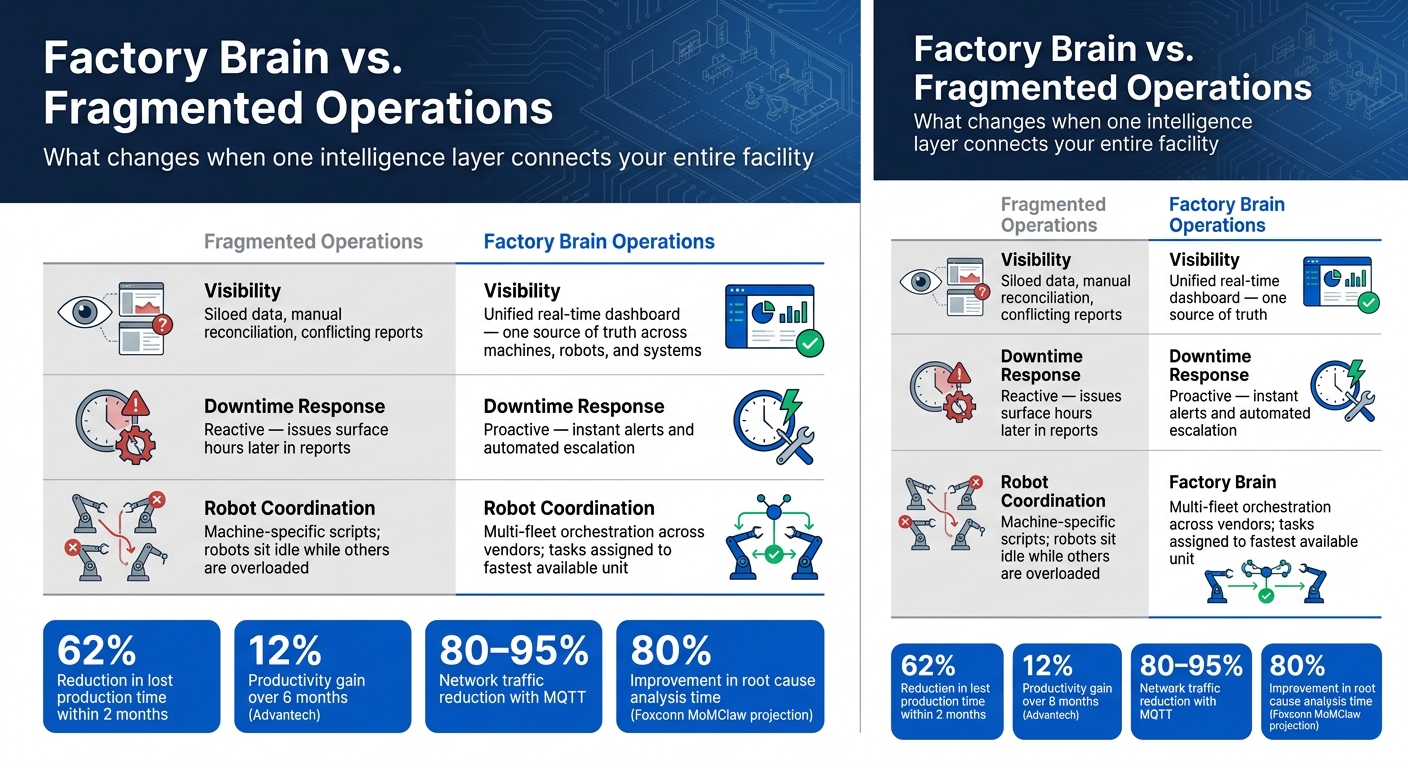
Factory Brain vs. Fragmented Operations: Key Metrics & Impact
Once the Factory Brain starts coordinating the shift, the results show up where plant teams feel them most: uptime, asset use, and decision speed.
Where downtime reduction actually comes from
Downtime usually starts small. A signal gets missed. A warning sits in one system while the manual lives in another and the work order is buried somewhere else.
When telemetry, manuals, and work orders sit in one place, teams can trace faults in minutes instead of hours. Foxconn's "MoMClaw" multi-agent system projects an 80% improvement in root cause analysis time and a 10% decrease in machine failure rates by connecting sensors and machine signals into a single agentic layer. One manufacturer cut average lost production time from four hours to under 1.5 hours - a 62% reduction - within two months of deploying a visibility layer.
"Automation executes tasks; it does not automatically give you one source of truth across plants. That's a separate layer." - Lauren Dunford, CEO, Guidewheel
That quote gets to the point. Automation can make a machine run. It doesn't, by itself, give supervisors a clean view of what's happening across the plant. That extra operating layer is what helps teams spot issues early, route them to the right people, and act before a small fault turns into a long stop.
Lower downtime is one part of the story. The same control layer can also cut idle capacity.
How utilization and production visibility improve
In mixed-robot environments, orchestration layers assign tasks to the fastest available unit, no matter who made the robot, which cuts idle time across the fleet. Pegatron estimates a 15% reduction in asset redundancy costs by using a factory manager agent to coordinate robot utilization more efficiently.
The visibility side matters just as much. Supervisors get one real-time view of OEE, throughput, and downtime categories across every line. Instead of piecing together conflicting reports from separate systems, they work from one source of truth. Advantech reported a 12% productivity improvement over six months after deploying a Production Line Efficiency Agent to detect bottlenecks and generate shift reports.
That kind of improvement doesn't come from magic. It comes from seeing what equipment is doing right now and coordinating the assets already on the floor.
Conclusion: the Factory Brain as the operating layer for Physical AI
The upside is straightforward: faster detection, better utilization, and clearer decisions.
| Dimension | Fragmented Operations | Factory Brain Operations |
|---|---|---|
| Visibility | Siloed data and manual reconciliation | Unified real-time dashboard; one source of truth across machines, robots, and systems |
| Downtime Response | Reactive; issues surface hours later in reports | Proactive; instant alerts and automated escalation |
| Robot Coordination | Machine-specific scripts; robots sit idle while others are overloaded | Multi-fleet orchestration across vendors; tasks assigned to the fastest available unit |
This is the direction Evlo.ai's Manufacturing Brain is designed to move toward: one intelligence layer that monitors machines, supports operators, learns from interventions, and keeps each part of the facility connected. The business impact comes from the same connected stack described throughout: teleoperation data, unified factory intelligence, and the infrastructure that ties them together.
FAQs
How is a Factory Brain different from MES or SCADA?
A Factory Brain is an orchestration layer that sits above existing MES and SCADA systems. SCADA handles real-time machine supervision, while MES manages production orders and workflows. The catch? Those systems often run in separate silos.
A Factory Brain brings them together in one intelligence hub. It helps coordinate operations, automate decisions that span multiple systems, and deliver proactive insights across the factory floor. It works with your current setup instead of replacing it.
Can a Factory Brain work with older machines?
Yes. A Factory Brain can work with older machines by using non-invasive hardware, retrofit sensors, or communication gateways to connect legacy equipment.
For example, it can use clip-on current sensors to turn a machine’s electrical signature into live operational data, without PLC reprogramming or network changes.
That means older assets don't need a major overhaul to join the same monitoring and coordination setup. Instead of ripping out equipment that still does the job, you can bring those machines into one shared view and start tracking how they’re running.
What does it take to implement a Factory Brain?
Implementing a Factory Brain means adding a single intelligence layer on top of systems you already use, like PLCs, SCADA, and MES, without ripping anything out.
In practice, this usually comes down to three parts: a consistent data layer, a digital twin to test workflows and robot behavior before changes hit the floor, and agentic orchestration to coordinate decisions across the operation.
Most teams don’t try to do everything at once. They start with a focused pilot, learn what works, and then expand with human oversight. To measure impact, they usually watch metrics like OEE, MTTR, and first-pass yield.