The $5 Trillion Robotics Boom Nobody's Talking About

Leela Yanamaddi
August 8, 2026
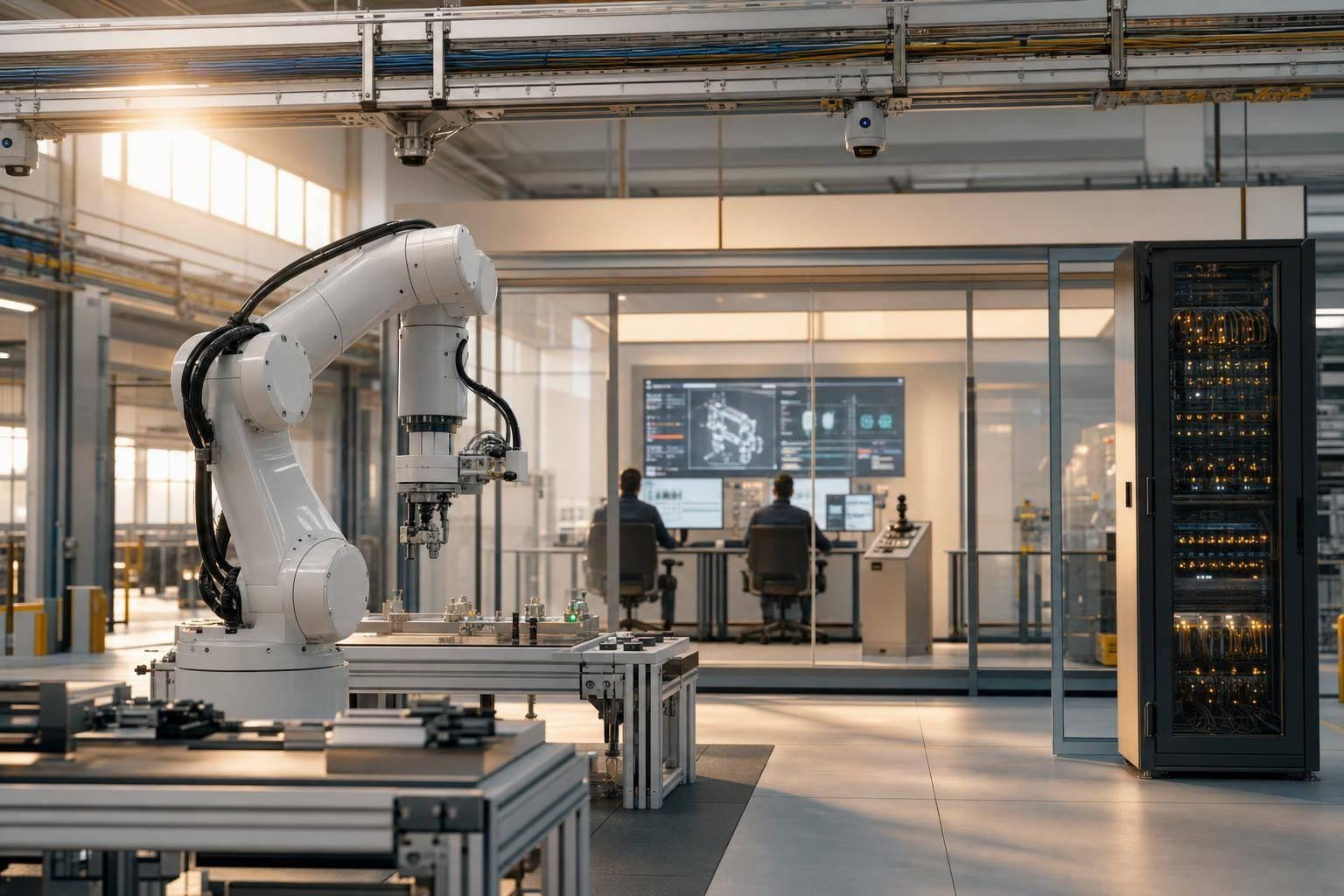
The big money in robotics may not be the robot. It may be the stack around it. If humanoid robotics reaches $5 trillion by 2050, a large share of that spend could sit in data, teleoperation, monitoring, and plant software and Physical AI that keeps robots working day after day.
Here’s the short version:
- Robot sales are only part of the market.
- Each new task can cost $50,000 to $150,000 in training data and human demos.
- Teleoperation was about $120 per operator-hour in early 2026, which turns human backup into a repeat service line.
- Weak recovery systems can lead to 10% to 15% throughput loss.
- Plant software and digital twins can cut downtime by double-digit percentages.
- The best long-term asset may be the data created from failures, resets, and task flows across live sites.
If I were judging this market, I would focus less on how many robots a company ships and more on whether it owns the layer between the robot and the business result. That is where margin, repeat revenue, and hard-to-copy data can build.
What matters most is simple: Can the system learn new tasks, recover from errors, and improve across sites without sending people back on-site every time? That question says more about the business than the robot demo does.
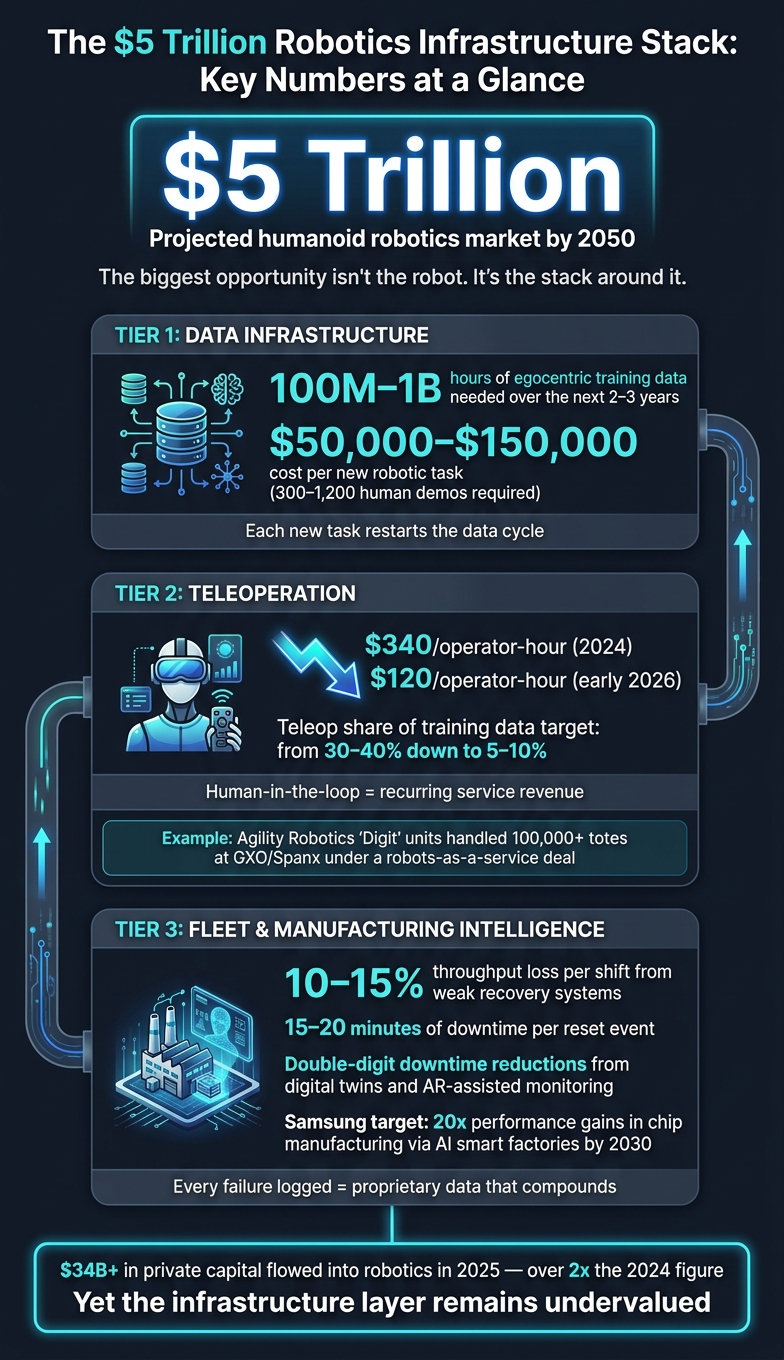
The $5 Trillion Robotics Infrastructure Stack: Key Numbers at a Glance
Robots Are About to Create a $7 Trillion Market
The Infrastructure Stack Behind Robotics Deployments
Every live robot relies on a stack underneath it: data, teleoperation, and facility intelligence. That stack decides whether a robot pulls its weight or ends up sitting idle.
It’s also where deployment value turns into recurring spend. Each layer feeds the next. Failures lead to retraining, teleoperation fills in the gaps, and fleet data helps the next rollout perform better.
Here’s how the core layers break down:
| Infrastructure Layer | Primary Function | Key Stakeholders | Revenue Sources (USD) |
|---|---|---|---|
| Data Infrastructure | Collecting egocentric video, haptic data, and sensor streams for model training | ML Researchers, Data Scientists, Data Vendors | Data licensing, annotation services |
| Teleoperation | Human-in-the-loop control for edge cases and high-fidelity task demonstrations | Remote Operators, Site Supervisors | Managed service contracts, teleop-as-a-service |
| Fleet & Manufacturing Intelligence | Uptime tracking, error triage, and facility-level workflow optimization | Operations Managers, Plant Directors, MLOps Teams | SaaS subscriptions, uptime-based SLAs, throughput performance contracts |
Data Infrastructure: Egocentric Video, Multimodal Data, and Task Demonstrations
Physical AI starts with egocentric data: first-person video, haptic signals, and sensor streams that record human movement and context. This isn’t like text data. It’s scarce, costly, and hard to build at scale. Leading robotics labs may need 100 million to 1 billion hours of pre-training data over the next two to three years.
That demand shows up fast at the task level. A single new robotic task usually needs 300 to 1,200 human demonstrations and a data budget of $50,000 to $150,000. And that bill doesn’t disappear after the first setup. Each time a facility adds a new task, the cycle starts again.
Teleoperation and Human-in-the-Loop Control
Teleoperation does two jobs at once. First, it produces gold-standard motor command data for training. Second, it gives teams a live fallback when a deployed robot runs into an edge case it can’t handle on its own.
The price has come down a lot, from about $340 per operator-hour in 2024 to about $120 per operator-hour in early 2026. Even with that drop, teleoperation still matters. Labs are trying to cut its share of training data from 30%–40% to 5%–10% by swapping in cheaper egocentric human footage. That helps on cost, but it doesn’t remove the need for people in the loop. Edge cases don’t go away. Human intervention is still the safety net while autonomy improves.
Fleet Monitoring and Manufacturing Intelligence
Once robots are deployed at scale, the hard part shifts from training them to running them day after day. Fleet software handles task sequencing, spots failures, and manages recovery. If that recovery logic is weak, even one jammed part or sensor failure can cause a 10% to 15% throughput loss. Each recovery event the system logs also becomes proprietary operational data that can improve later deployments.
Manufacturing intelligence pushes this one step further. Instead of looking only at a single robot, it gives teams plant-wide workflow visibility. Early industrial deployments using digital twins and AR-assisted monitoring have already shown double-digit downtime reductions. As more robots come online, facilities with this layer can spot bottlenecks faster and improve throughput over time.
That’s where recurring economics start to show up in a serious way.
Where the Hidden Trillions Come From
The money piles up in the layer that keeps robots working, learning, and getting better. Think data pipelines, teleoperation services, orchestration software, and plant-wide intelligence platforms. That's why the biggest upside shows up in recurring infrastructure, not in one-off robot sales.
Revenue from Data, Teleoperations, and Managed Services
This spending repeats across every new task, site, and layout change. Data collection, annotation, and licensing aren't one-time setup items. They start over each time a facility needs a new capability.
Teleoperation adds another stream of revenue. At roughly $120 per operator-hour in early 2026, remote intervention is sold as a recurring service contract. Agility Robotics' "Digit" units handled over 100,000 totes at a GXO-operated Spanx fulfillment center in Georgia under a robots-as-a-service deal that bundles hardware, software, and ongoing human support into one recurring contract.
Revenue is part of the story, but the bigger prize sits in day-to-day performance.
Operational Value from Uptime, Safety, and Throughput
Deployability depends less on raw failure rate and more on how fast the system gets back on its feet. A robot running at 95% accuracy across 50 cycles an hour still creates 50 failures per shift. Without automated recovery, one jammed component can cost 15 to 20 minutes of downtime per reset, which adds up to a 10% to 15% total throughput loss per shift.
That changes the math fast. Orchestration software that spots and fixes those failures on its own doesn't just save labor time. It protects revenue in a direct, measurable way.
Long-Term Value from Plant-Wide Intelligence
The compounding effect kicks in when data from single robots is pooled across one facility or many facilities. Every recovery event, every task sequence, and every sensor anomaly turns into a data point that improves the next rollout. Samsung Electronics' plan to move all global manufacturing to AI-driven smart factories by 2030, built on digital twin simulations targeting 20x performance gains in chip manufacturing, points to where the business is headed: data, recovery, and control.
Facilities that build this layer early end up with a proprietary operational dataset that rivals can't copy without years of live deployment. That's where the long-term moat - and the long-term margin - actually sits. That's the lens investors and operators should use in the next section.
How to Evaluate the Opportunity by Company Type
The same infrastructure gap shows up in different ways for builders, operators, and investors.
For Robotics Companies: Map Autonomy Gaps to Infrastructure Needs
Start with a simple check: do you have enough data, remote intervention, and fleet visibility to deploy with confidence? The distance between a polished robot demo and a system that works day after day is usually infrastructure.
Each weak spot points to a different layer. If the robot still struggles with certain tasks, that points to collection infrastructure: teleoperation rigs, data pipelines, and human review queues. If the issue is breakdowns, the problem sits in the orchestration layer, which handles exception recovery, task sequencing, and autonomous restarts. And if your team is buried in manual interventions - tickets, resets, and on-site visits - that points to teleoperation and human-in-the-loop systems, where remote operators step in and also create new training data.
Focus on orchestration and deployment first. Those layers collect the operating data that stacks up with every site.
That same data and control layer also decides whether you can grow past a single site or stay stuck in one-off deployments.
For Manufacturers and Warehouse Operators: Audit Operational Blind Spots
The fastest way to spot where robotics infrastructure can pay off is to look at what's already failing. Begin with downtime sources. Track micro-stops - the short, frequent interruptions that don't trigger a major alarm but quietly chip away at throughput over a shift.
Next, trace your incident escalation path. If a robot fails at 3:00 a.m. and the only fix is sending in an on-site engineer, your infrastructure still doesn't scale. Check whether your robots send failure data into your warehouse or plant management system, or whether each machine runs like a black box. When telemetry is disconnected, every failure stays trapped in one place. It doesn't help the next shift, the next site, or the next deployment.
That's where the blind spots become clear. Fleet monitoring stops being just a dashboard and starts turning into plant intelligence.
| Audit Area | What to Measure | Red Flag |
|---|---|---|
| Downtime sources | Frequency and duration of micro-stops | Short interruptions are not logged automatically |
| Incident escalation | Time to resolution when a robot fails overnight | Requires an on-site engineer instead of remote recovery |
| Telemetry connectivity | Whether robot data feeds plant or warehouse management systems | Robot data is siloed from broader operations |
| Staffing for failure | Headcount dedicated solely to robot resets | Humans are still needed to intervene, log incidents, and reset systems |
For Investors: Look for Assets That Gain Value With Use
One of the clearest signs that separates durable robotics infrastructure from a one-time hardware sale is whether the asset gets better as it is used. A robot sale is a CapEx transaction. An orchestration layer that logs every failure, recovery, and task sequence across deployments becomes a recurring data asset that is harder to push aside over time.
In physical AI, value sits in the operating layer, not just the model.
Screen for four asset types:
- Proprietary failure data gathered from live environments
- Teleoperation networks that also serve as training data pipelines
- Agent runtimes that coordinate continuous physical operations
- Workflows tied directly into customer operations
More than $34 billion in private capital flowed into robotics-related companies in 2025 - over 2x the 2024 figure. Even with that level of funding, the infrastructure layer still gets less attention than its role would suggest in making every robot commercially viable.
Those are the assets to screen for.
How Evlo.ai is built for the robotics infrastructure market

Evlo.ai focuses on the layer that makes robots usable in day-to-day operations: data, remote supervision, and facility intelligence. That’s where recurring revenue tends to live, and where leverage builds with each new deployment.
Phase 1 and 2: from Physical AI data infrastructure to robot teleoperations
Phase 1 is about building pipelines for embodied training data: egocentric video, multimodal sensor streams, and real task demonstrations.
Phase 2 adds trained remote operators to handle edge cases. That helps keep robots productive while also collecting high-quality intervention data. The same layer also supports fleet monitoring, safety monitoring, and human-in-the-loop intervention across distributed deployments.
Each session does two jobs at once: it keeps the robot working today, and it helps the system perform better tomorrow.
Phase 3: manufacturing intelligence as the facility operating layer
As deployments grow, the value moves from task-level support to facility-wide control. Phase 3, the Manufacturing Brain, brings together robot, machine, worker, and workflow data for monitoring, predictive maintenance, analytics, and workflow optimization in factories and warehouses.
The result is predictive operations. The system spots degradation early, routes a remote operator when needed, and feeds each event back into continuous learning. In plain English, every incident helps improve the operating layer.
Conclusion: the biggest opportunity is the infrastructure every robot depends on
The bigger opportunity is the infrastructure that turns robots into reliable production systems.
FAQs
What does the $5 trillion robotics boom actually include?
The $5 trillion robotics boom isn’t just about the robots themselves. It also includes the full stack needed to put Physical AI to work in real-world settings and keep it getting better over time.
That means things like sensors and perception systems, upgrades to facilities and physical spaces, and data and training pipelines such as teleoperation and human-in-the-loop operations. It also covers platforms for fleet monitoring, task orchestration, and continuous performance feedback.
Why is robotics infrastructure more valuable than robot sales alone?
Robotics infrastructure often matters more because it turns a one-time robot sale into something that can scale and keep gaining value over time. Tools like deployment platforms, fleet monitoring, teleoperation, and simulation help teams roll out each new deployment faster and with fewer failures.
It also helps solve some of the most expensive bottlenecks in Physical AI, like real-world data collection, system integration, and rare edge cases. That gives infrastructure a stronger moat, while standalone hardware sales are more exposed to commoditization and deployment risk.
How can a company tell which robotics layer to invest in first?
Prioritize the layer that lines up best with three things:
- technical maturity
- data sovereignty needs
- impact on repeatability
Some underbuilt areas, like edge compute and data collection, may give you more room to win. Proprietary or hybrid data infrastructure can help protect operational intelligence. And layers that improve simulation fidelity, sensor fusion, or closed-loop learning are often better suited to the jump from the lab to the factory floor.