How Self-Supervised Adaptation Cuts Sim-to-Real Gap

Leela Yanamaddi
September 3, 2026
A robot can look solid in simulation and still fail on the floor. I’d sum up the fix like this: use unlabeled site data before launch to tune perception, state estimation, and then control, while tracking task success, takeover rate, safety events, perception error, and time-to-completion.
Here’s the short version:
- Simulation scales well, but it misses parts of live settings like lighting, sensor noise, latency, friction, clutter, and drift.
- Domain randomization helps during sim training by varying conditions.
- Domain adaptation lines up sim-trained features with sensor input from the target site.
- Self-supervised adaptation uses unlabeled logs from staging, pilot runs, teleoperation, and shadow mode to tune the model without hand-labeling large datasets.
- The usual order is: train in sim → collect target-site logs → tune perception first → tune control later → test on the same tasks and logs.
- The main signals are temporal consistency and high-confidence pseudo-labels.
- The main goal is simple: cut silent failures and lower human takeovers before rollout.
If you want the core idea in one line, it’s this: the sim-to-real gap shrinks when I feed pre-launch field logs back into training instead of trusting simulation alone.
Quick Comparison
| Method | Main data source | What it does best | Limits |
|---|---|---|---|
| Domain randomization | Simulation data | Builds tolerance to variation early | Still tied to sim assumptions |
| Domain adaptation | Small amount of target-site data | Aligns sim features with site input | Often needs some labeled or paired data |
| Self-supervised adaptation | Unlabeled target-site logs | Tunes the model with data teams already collect | Quality depends on log coverage and checks |
What matters most is not just tuning the model, but where the logs come from:
- Staging: good for perception encoder updates
- Shadow mode: good for feature and state-estimation tuning with zero control risk
- Pilot-site testing: good for control tuning with supervision
- Teleoperation: good for hard edge cases and expert traces
A simple way I’d judge progress:
- Task success rate
- Human takeover rate
- Perception error
- Safety events
- Time-to-completion
If those numbers move in the right direction on the same tasks and logs, the gap is getting smaller.
The rest of the piece explains how that loop works in practice and where teams get the data to run it.
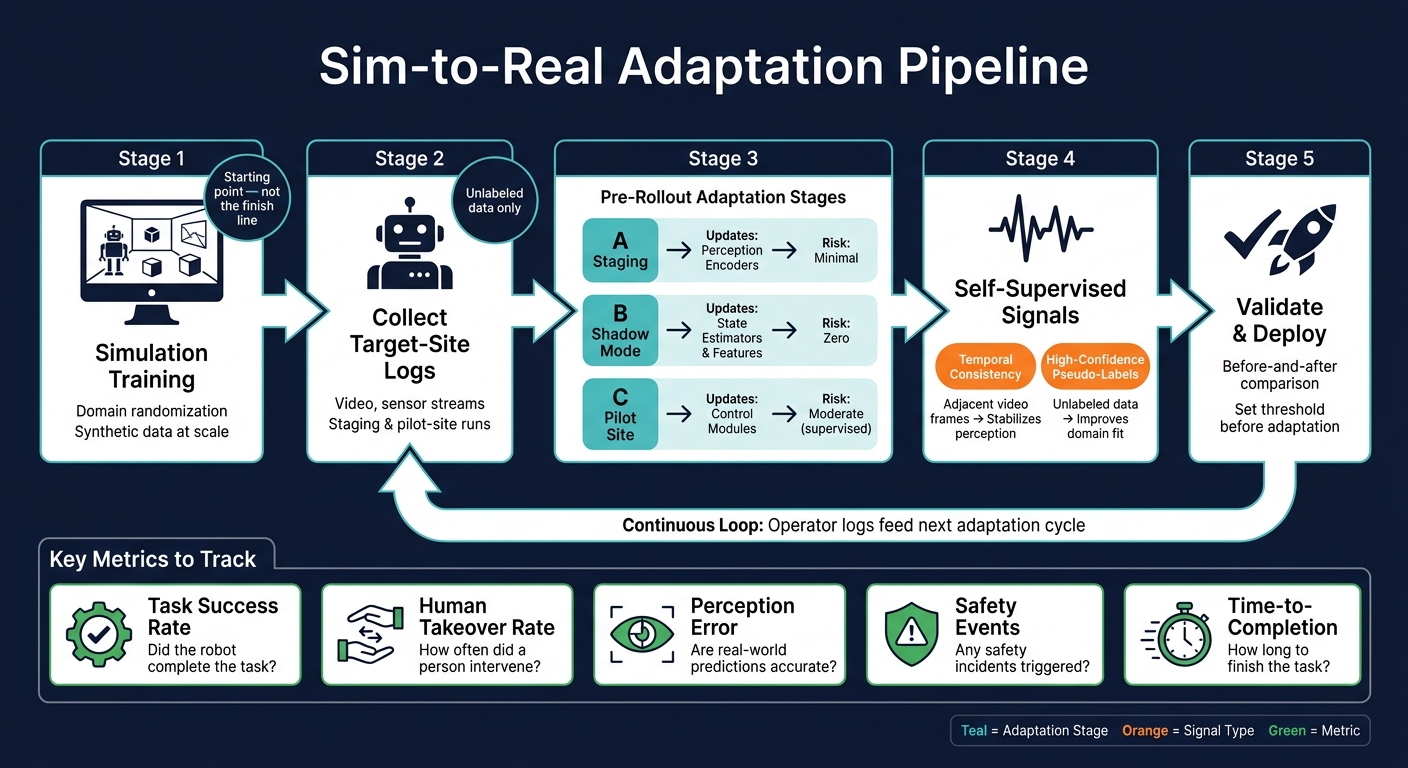
Sim-to-Real Adaptation Pipeline: From Simulation to Field Deployment
How Does Sim-to-real Transfer Work In RL Robotics? - AI and Machine Learning Explained
From Simulation to Deployment: Where the Gap Enters the Pipeline
The sim-to-real gap shows up at every handoff between training and rollout.
Simulation Training Builds Scale but Not Full Realism
Simulation gives teams scale. You can generate synthetic data, run training loops over and over, and test many cases without touching a physical system. Domain randomization helps too. By changing conditions during training, teams keep the model from getting stuck on a single environment.
But there’s a catch: the model is still learning from approximations. And those approximations don’t match the physical world perfectly. That mismatch creates domain shift once the model leaves simulation and meets actual conditions. It’s also why teams gather real-world logs before rollout.
Collecting Target-Domain Data Before Rollout
Once the model leaves simulation, adaptation starts with the place it will actually operate in. To shrink the gap, teams collect unlabeled data from the deployment environment before rollout. In practice, that often means:
- video
- sensor streams
- robot interaction logs from staging runs or pilot-site testing
Those logs are then used for adaptation before deployment.
It also helps to define what “good” means before collecting data. Teams that set measurable benchmarks early are less likely to fall into a common trap: gathering a pile of logs without a clear bar for what the adapted model must do.
Pre-Rollout Adaptation Stages
Adaptation happens in stages, and each stage updates a different part of the model.
| Stage | Environment | What Gets Updated |
|---|---|---|
| Staging | Controlled staging environment | Perception encoders |
| Shadow Mode | Live environment, no robot action | State estimators and feature representations |
| Pre-Production Fine-Tuning | Pilot site with supervision | Control modules |
The workflow looks like this: synthetic training → pilot data collection → self-supervised tuning → rollout.
Those staged logs then feed the self-supervised losses covered next.
How Self-Supervised Adaptation Works
Once pilot or shadow-mode logs come in, self-supervised adaptation refines sim-trained features without labels.
Consistency Losses for Stable Real-World Perception
A practical place to start is temporal consistency. If the scene hasn’t changed, perception shouldn’t bounce around from frame to frame. So when predictions drift across adjacent video frames, that drift becomes the training signal.
That matters a lot for mobile robots working in changing light. A robot moving from a bright aisle into a dim corner shouldn’t suddenly “see” the world in a shaky way.
Representation Tuning and Pseudo-Labels
Consistency losses help steady predictions. Then high-confidence pseudo-labels tune representations for the target domain. Human review still matters, but it acts as a validation step, not the main adaptation signal.
The order here is important. First, adapt perception. Then fine-tune control logic once the model is grounded in the target domain.
Comparison of Adaptation Signals
| Signal Type | Data Requirements | Strengths | Best-Fit Use Case |
|---|---|---|---|
| Temporal Consistency | Adjacent video frames | Reduces noise sensitivity; stabilizes perception | Mobile robots and AMRs in changing light |
| High-Confidence Pseudo-Labels | Unlabeled target data plus model confidence threshold | Improves target-domain fit without manual labels | High-stakes tasks such as kitting or quality inspection |
These signals matter most in staging, shadow mode, and pilot runs, where the model sees real logs before field rollout.
Where Teams Use Adaptation Before Field Rollout
Self-supervised work depends on one simple thing: where real logs show up in the pipeline. These losses matter most when teams run them on real pre-rollout logs, because each setup produces a different kind of data.
Lab-in-the-Loop and Pilot-Site Adaptation
Lab-in-the-loop and digital twin setups are usually the first places teams get real adaptation data. The idea is straightforward: test new workflows and safety logic with simulated data before the robot goes anywhere near a live site. That keeps risk low while checking sim-trained models against edge cases.
Pilot sites add the next layer. They reveal site-specific behavior under real conditions, which matters a lot for mobile robots and warehouse sorters.
When those setups start showing failure cases, teams usually move to teleoperation and shadow mode. That’s where the richest logs tend to come from.
Teleoperation and Shadow Mode as Data Sources
When lab and pilot runs don’t catch enough edge cases, teleoperation and shadow mode become the go-to sources for harder examples.
Teleoperation records hard target-domain cases without needing manual labels. Human takeovers create expert traces for unfamiliar, unsafe, or out-of-distribution situations. Those traces help future autonomy and cut down on manual corrections over time.
Shadow mode works differently. The model runs passively next to the live system and its outputs are compared without giving it control. The main payoff is the data: passive logs from live conditions that help teams validate fleet-wide updates on AMRs and AGVs before a broader rollout.
Comparison of Pre-Rollout Adaptation Setups
| Adaptation Setup | Data Richness | Operational Risk | Implementation Effort | Best Use for Adaptation |
|---|---|---|---|---|
| Lab-only | Low (simulated) | Minimal | Low | Initial model validation for all systems |
| Pilot-site | Medium (real-world) | Moderate | Medium | Mobile robots and warehouse sorters |
| Teleoperation-driven | Very high (expert traces) | Low | High | Complex manipulators and humanoid tasks |
| Shadow mode | High (passive logs) | Zero | Low | Fleet-wide updates for AMRs and AGVs |
Richer data usually takes more effort. Put plainly: better traces cost more to gather, but they lower risk before rollout.
Measuring Impact and Closing the Loop
Metrics That Show the Gap Is Shrinking
Once adaptation changes the model, test it on the same tasks and logs used during tuning. That gives you a clean before-and-after view. The clearest sign of progress is better task performance in the field, not just a model that behaves differently on paper. Use the same rubric across both runs so you can see what actually changed. And set the success threshold before adaptation starts.
The main metrics to track are:
- Task success rate: Did the robot complete the assigned task?
- Human takeover rate: How often did a person need to step in or take over?
- Perception error: Are the robot's real-world predictions still accurate?
- Safety events: Did the system trigger any safety incidents during operation?
- Time-to-completion: How long did the robot take to finish the task?
Track both performance and safety. A system can look fine in automated checks and still be wrong in ways that matter. Those quiet misses - silent failures - are easy to miss if you only look at pass/fail outputs. Use expert-reviewed benchmarks to spot the issues automated checks miss.
Key Takeaways for Physical AI Deployment
Simulation is a strong starting point, but it isn't the finish line. The same logs used earlier should become the baseline for retraining and validation. Shadow mode, teleoperation, and pilot-site runs all serve the same purpose: feed the next adaptation cycle. Use those logs to retrain, validate, and repeat before rollout.
Pre-rollout adaptation stages cut field risk because they surface gaps before those gaps turn into live failures. And the loop can't stop at deployment. Operator interventions, shadow logs, and pilot-site records should feed the next round of retraining and validation.
These metrics keep the pre-rollout loop honest. For Physical AI teams, that loop is the infrastructure layer: collect operational signals, send them back into adaptation, and improve each deployment. Evlo.ai's approach - spanning data collection, managed teleoperation, and manufacturing intelligence - is built to keep those signals moving so each deployment creates better data for the next one.
FAQs
Why isn’t simulation alone enough?
Simulation rarely reflects every source of sensor noise, system dynamic, and change in the physical world. That’s why self-supervised adaptation matters. After a model is trained in simulation, it can keep adjusting in deployment by using consistency losses or by fine-tuning on live sensor streams from the field.
Evlo.ai supports that feedback loop by recording human teleoperation interventions as labeled data. Those interventions can then go back into the system to improve autonomous performance and help shrink the sim-to-real gap even more.
What unlabeled logs work best?
Unlabeled target-domain logs from actual deployment tend to work best here because self-supervised adaptation relies on consistency losses to line up behavior learned in simulation with what happens in the field.
Most teams start by training in simulation. Then they use deployment logs from live systems, along with feedback loops, to tune models before rollout. Evlo.ai supports this workflow through Physical AI infrastructure, including teleoperation data that can help improve models over time.
How do teams know adaptation is helping?
Teams use self-supervised adaptation to see if simulated models line up better with real-world sensor data and system behavior. They do this with consistency losses and target-domain tuning.
Before a field rollout, robotics teams run this step to deal with real-world variables that training often misses. Evlo.ai supports that work with teleoperation infrastructure that records human interventions as retraining data, which creates a continuous learning loop.