RobotOps and Production Model Rollouts

Leela Yanamaddi
August 29, 2026
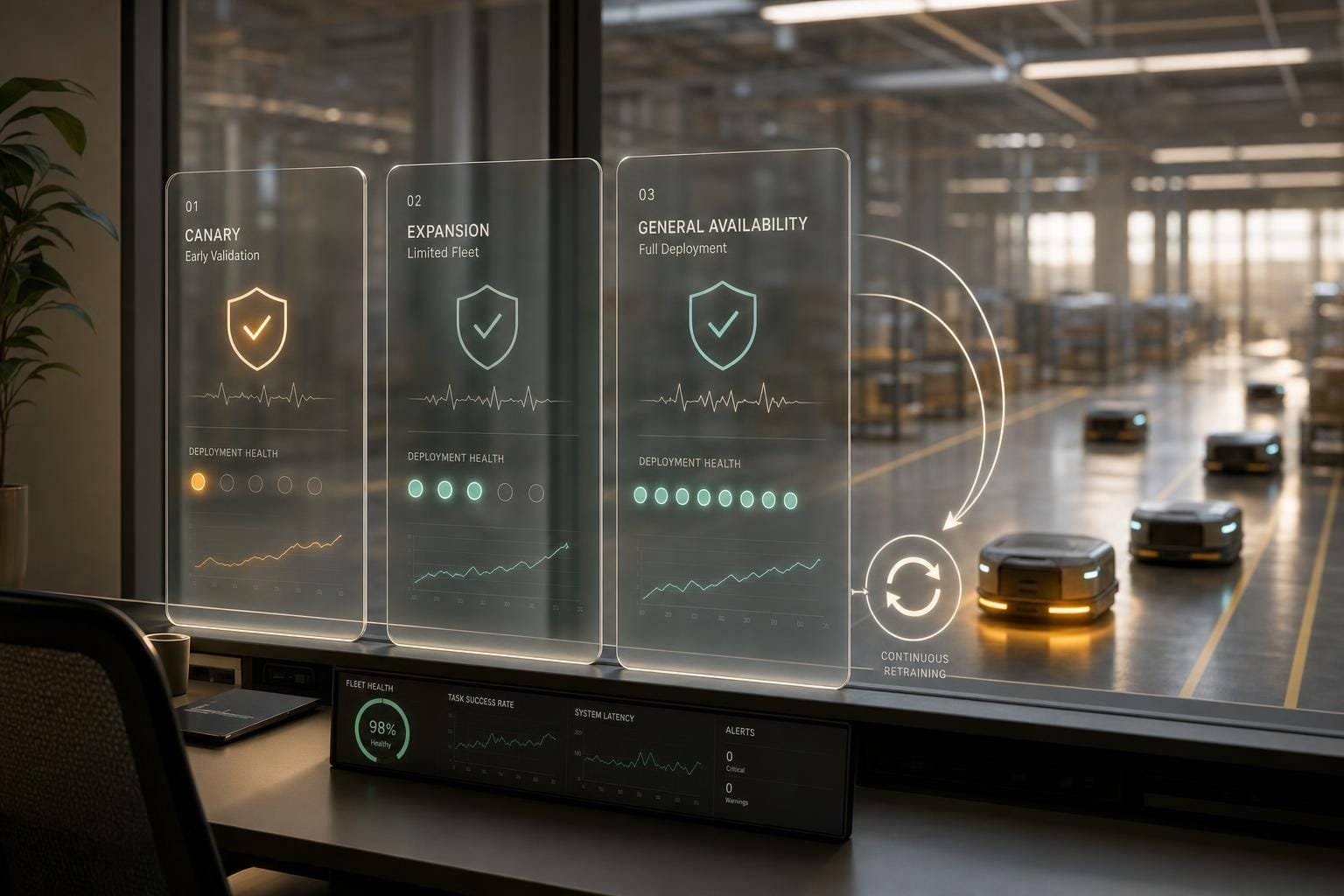
If you run robots in live sites, shipping a model is only half the job. The hard part starts after release: deciding which robots get it, when to expand it, what signals to watch, and how to roll back fast if failure rates, stuck events, or safety stops go up.
I see this article making one main point: MLOps, CI/CD, and RobotOps do different jobs. MLOps helps teams train and track models. CI/CD helps teams move code and artifacts through release pipelines. RobotOps is the layer for live fleet control - with segmentation by robot, site, and task, staged rollout gates, field health signals, alerts, human handoff, intervention logs, and data sent back into retraining.
If I had to boil it down, here’s the whole article in a few bullets:
- RobotOps is for robots already working on floors, in warehouses, and in factories
- MLOps is for model training, testing, lineage, and registry work
- CI/CD is for shipping software artifacts through release steps
- Robot fleets need checks tied to physical behavior, not just uptime or test accuracy
- A bad rollout can hit throughput, safety, uptime, and inventory
- The missing piece in many stacks is structured intervention data from human takeover and field failures
The biggest gap is simple: CI/CD can tell you whether software deployed, and MLOps can tell you how a model scored before release. But neither one, by itself, tells you whether Robot 17 at Site B in cold storage now gets stuck 23% more often or needs more human help after the update.
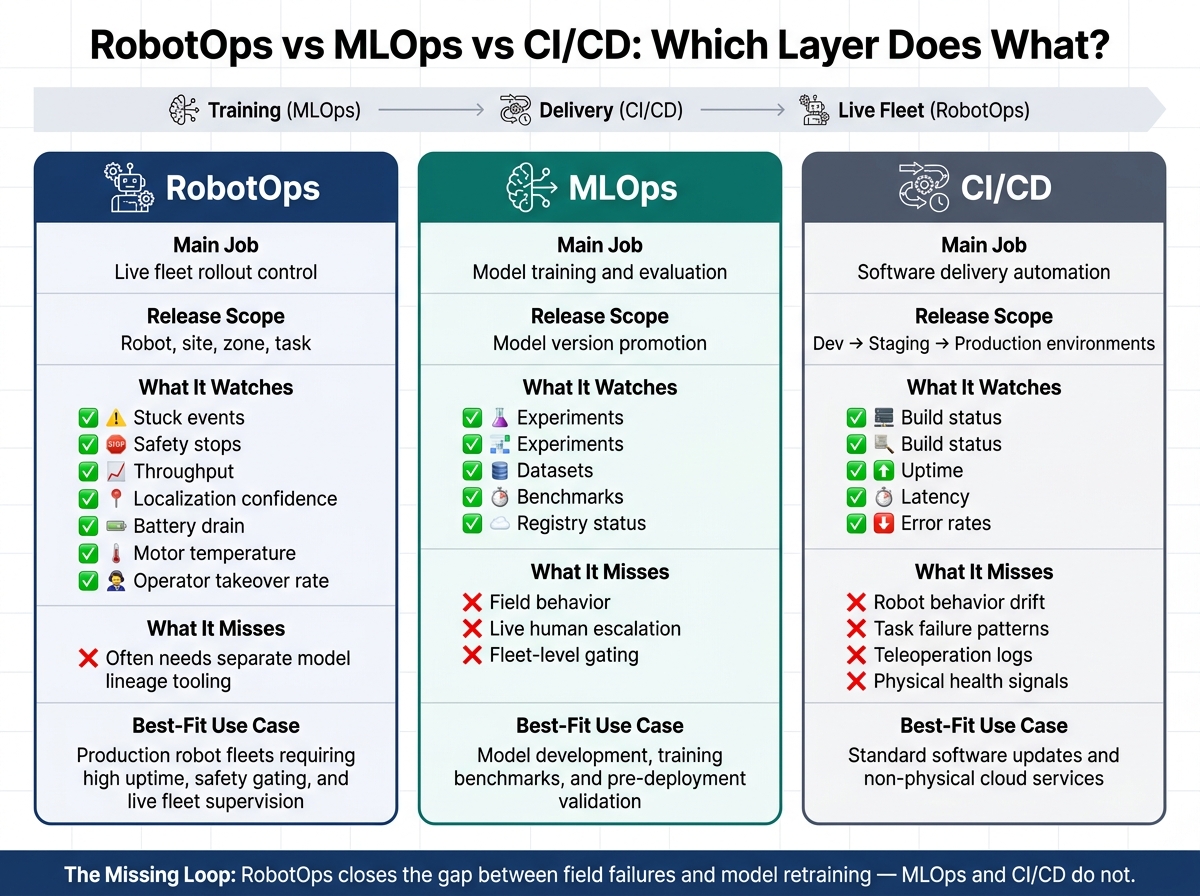
RobotOps vs MLOps vs CI/CD: Which Layer Does What?
Quick Comparison
| System | Main Job | Release Scope | What It Watches | What It Misses |
|---|---|---|---|---|
| RobotOps | Live fleet rollout control | Robot, site, zone, task | Stuck events, safety stops, throughput, localization, battery, operator takeover | Often needs separate model lineage tooling |
| MLOps | Model training and evaluation | Model version promotion | Experiments, datasets, benchmarks, registry status | Field behavior, live human escalation, fleet-level gating |
| CI/CD | Software delivery | Dev, staging, production | Build status, uptime, latency, error rates | Robot behavior drift, task failure patterns, teleoperation logs |
So if you’re asking, “What tool do I need?” my read is simple:
- Choose MLOps if your main problem is training and model tracking
- Choose CI/CD if your main problem is release automation
- Choose RobotOps if your main problem starts after deployment, when robots meet site conditions, hardware differences, and human fallback
That’s the lens for the rest of the piece.
1. evlo.ai
Evlo.ai is building Physical AI infrastructure for robot operations, teleoperation, and factory intelligence. The platform focuses on the parts that start to matter once robots are live in production: live fleet oversight, human escalation, intervention logging, and retraining feedback.
Fleet Segmentation
The platform is designed to segment fleets by robot, site, and task, while giving teams one place to monitor deployed machines.
That split matters. A rollout rule that makes sense for one robot may not fit another. The same goes for one site versus another, or one task versus the next.
Release Control
When autonomy can't finish a task, remote operators can step in and take over. That gives teams a controlled fallback during rollout instead of leaving failures unmanaged.
Health and Intervention Signals
Evlo.ai logs human interventions, corrections, and judgment calls. In plain English, it shows where autonomy broke down and where people had to step in.
Continuous Learning Loop
Those intervention logs can feed retraining, cut repeat escalations, and connect rollout with model improvement. So teleoperation isn't just a support layer. It's part of the rollout control stack.
2. RobotOps rollout platforms
Dedicated RobotOps platforms are built for robot fleets that are already out in the field, working in physical spaces where model updates can affect production, safety, and uptime. That changes the job of the platform.
This isn’t about building the model. It’s about rolling it out with control once those robots are live.
RobotOps platforms put the focus on fleet visibility, staged release control, and feedback from day-to-day operation. If a model update causes trouble, the impact isn’t abstract. It can slow a facility down, create safety issues, or take robots offline.
Fleet Segmentation
RobotOps platforms split fleets into groups based on things like hardware version, site, autonomy level, and task type. That way, a new manipulation model doesn’t hit every arm in every facility at the same time.
Instead, teams can roll it out in stages across different operating conditions. That matters because robots in one location, on one hardware setup, or doing one type of job may behave very differently from the rest of the fleet.
Release Control
Staged release is the core function here.
Instead of a simple “deploy” or “don’t deploy” choice, RobotOps platforms support progressive rollouts with clear gates between phases. A small cohort of robots gets the update first. If health metrics stay within range, the release moves to the next tier.
It’s a lot like testing the water before diving in. You start small, watch closely, and only expand when the data says it’s safe to keep going.
Health and Intervention Signals
During a rollout, the signals that matter most come from the field in real time.
RobotOps platforms track operational performance, safety, and intervention signals as live health indicators. If those signals cross a set threshold, alerts fire and human operators step in. Every intervention is logged for post-rollout review.
Those logs matter because they show what happened when the update met actual operating conditions, not just lab tests.
Continuous Learning Loop
Intervention logs and operator corrections feed back into retraining pipelines. That creates a closed loop between rollout and retraining.
In plain English, the rollout doesn’t just ship the model. It also generates the field record teams use to improve the next version. That record is what rollout tooling adds beyond training systems.
3. Traditional MLOps training systems
If RobotOps handles live fleet releases, MLOps handles model creation before deployment.
That’s what these systems were built for: taking a model from raw data to a trained, evaluated artifact. They tend to be strong at experiment tracking, dataset versioning, benchmark testing, and training pipeline management.
But their job usually ends at the model artifact. It doesn’t extend to the robot operating in the field.
Fleet Segmentation
Traditional MLOps systems usually think in terms of model versions and org-wide deployment, not robot-, site-, or task-level segmentation. They favor org-wide model promotion, not robot-, site-, or task-level control.
Release Control
In traditional MLOps, release control usually means moving a model from staging into production. That still fits software release management. It’s not the same as the rollout control RobotOps needs for robots in the field.
Health and Intervention Signals
In traditional MLOps, health usually means benchmark accuracy on a held-out test set. Intervention usually means offline correction, not live operator escalation.
Continuous Learning Loop
Even newer systems still need a separate path to capture field interventions and feed them back into training. Those corrections come from live robots, not offline test sets.
So MLOps is useful for training, but it’s still incomplete for live robot rollout control.
4. General-purpose CI/CD deployment systems
General-purpose CI/CD tools were built to ship software in a reliable, repeatable way. That works well for code delivery.
But robot model deployments are a different beast.
The gap shows up when rollout decisions depend on how robots behave in the field, the conditions at each site, and whether a human needs to step in. In that setup, standard CI/CD can handle the delivery mechanics but not the full decision layer around model rollout.
If MLOps manages model creation, CI/CD manages delivery mechanics.
Fleet Segmentation
CI/CD systems usually think in terms of environments like dev, staging, and production.
That model is fine for web apps. It starts to fall short with robots.
CI/CD treats rollout targets as environments, not as individual robots, sites, or task types. For robot fleets, that distinction matters because one model may behave differently depending on where it's deployed and what the robot is doing.
Release Control
Some rollout patterns do carry over pretty well. Staged rollouts and canary releases are good examples.
You can limit a new model to a small subset of units before sending it to the rest of the fleet. CI/CD is pretty comfortable with that kind of release flow.
The problem is what happens next.
Rollback logic in CI/CD usually assumes software failures: crashes, bad responses, broken services. Robot deployments often fail in quieter ways, through subtle behavior drift in the physical world. A robot may still be online, still responding, and still passing standard checks while making worse decisions on the floor. That means the usual health checks can miss the signals that matter most.
"Today's AI is fluent and often accurate but when it's wrong, no one can point to why. That's a black box problem, and it gets more consequential at scale." - UnlikelyAI
Health and Intervention Signals
CI/CD systems are built to monitor infrastructure metrics like uptime, error rates, and latency.
What they don't track is just as important for robots:
- behavior drift
- verified human expertise
- escalation decisions in the field
In plain terms, CI/CD can move artifacts forward, but it doesn't send field corrections back into training pipelines.
So yes, CI/CD is useful for delivery. It just doesn't cover the fleet controls and rollout governance needed for robot deployments, which the next section takes up.
How RobotOps Differs from MLOps and CI/CD in Fleet and Release Controls
RobotOps treats the live fleet as the thing you deploy to, not just a software setup in the abstract. That changes how teams handle segmentation, rollout gates, health checks, and human intervention.
Fleet segmentation by robot, site, and task
RobotOps segments live fleets by robot class, hardware revision, site, and zone. That level of control matters because robots in different places, or with different hardware, can react very differently during a rollout. A model or firmware update that works fine in one warehouse may stumble in another. MLOps and CI/CD tools usually don't support that kind of fleet-aware control out of the box.
Release control from lab to full fleet
Lab-to-fleet rollout moves through gates. Instead of pushing updates in one shot and hoping for the best, RobotOps lets teams step through release stages tied to how robots behave in the field.
| Rollout Stage | Description | RobotOps Application |
|---|---|---|
| Lab Staging | Controlled, non-production validation | Testing a new navigation model in a mock warehouse layout |
| Canary Release | Deployment to 1–5% of the fleet | Pushing a firmware update to one robot at a single site |
| Zone-Based | Rollout limited to a specific physical area | Deploying a new picking model only in the cold storage zone |
| Blue-Green | Two fleet versions running in parallel, then switching | Swapping an entire site to a new model version |
| Fleet-Wide | Full deployment after all gates pass | Pushing a validated safety patch to every robot globally |
RobotOps adds site- and zone-aware gating. In plain English, release decisions are tied to physical conditions on the ground, not just pass/fail checks in a test setup.
Health signals and alerts during rollouts
Rollout gates should be driven by field risk, not just model metrics. RobotOps watches the signals that show what is happening on the floor right now.
| Signal | Why It Matters During a Rollout |
|---|---|
| Battery drain rate | Abnormal drain can indicate inefficient motion or a regression |
| Motor temperature (°F) | Spikes can indicate mechanical stress |
| Localization confidence | Drops indicate the model is struggling with the physical environment |
| Network latency | Poor connectivity can disrupt inference or telemetry |
| Stuck events per hour | Sudden increases flag navigation or manipulation regressions |
| Units per hour | Throughput decline is often the first visible sign of behavior degradation |
| Safety-triggered stops | Any spike here should halt the rollout immediately |
When any of these signals cross set thresholds, RobotOps platforms can pause the rollout and trigger an alert on their own. That matters because a dip in localization confidence or a spike in stuck events is not just a dashboard blip. It can be the first sign that robots are drifting into unsafe or unproductive behavior.
Intervention logs and human escalation
When a robot fails in a way autonomy can't resolve, a person steps in. In a RobotOps platform, that intervention is logged with structure: the robot ID, the site, the task, the failure classification, the operator who responded, the action taken, and the outcome. Teleoperation records and operator notes are attached to that same event.
That kind of record keeps the human judgment layer in view. MLOps and CI/CD usually miss it.
"The best AI models don't learn by themselves. They learn from people with real-world expertise. Every correction. Every judgment call. Every nuanced decision. That's what makes AI smarter." - Evlo AI
This is what turns rollout control into an operational feedback loop.
Feeding deployment data back into training
Rollout telemetry does more than tell you whether a deployment passed or failed. It shows where the model struggled, under what conditions, and what needs work next.
Intervention logs, teleoperation traces, and operator corrections are high-fidelity labeled data. In a RobotOps platform, that data feeds back into retraining pipelines for autonomy and perception models. RobotOps turns field failures into training data. MLOps and CI/CD systems do not close that loop natively.
Pros and Cons
This summary pulls the rollout tradeoffs into one place. Each layer handles a different part of the rollout process. Trouble starts when a team tries to force one tool to cover training, delivery, and live fleet control all at once.
| System Type | Key Advantages | Key Limitations | Best-Fit Use Case |
|---|---|---|---|
| RobotOps Platforms | Fleet-specific targeting; real-time health monitoring; staged rollout gating; intervention logging | Often lacks deep integration with model training lineage | Production robot fleets requiring high uptime, safety gating, and live fleet supervision |
| MLOps Systems | Strong dataset lineage; rigorous model evaluation; experiment tracking; model registry management | No robot-specific field telemetry, hardware-in-the-loop controls, or intervention workflows | Model development, training benchmarks, and pre-deployment validation |
| CI/CD Tools | Automated release pipelines; established release discipline; version control | No support for robot safety checks, physical health signals, teleop records, or field intervention workflows | Standard software updates and non-physical cloud services |
The table makes the split pretty clear. RobotOps is best at live fleet control. It handles staged gating, health signals, and intervention logging. MLOps does its best work before deployment, where lineage, evaluation, and registry control matter most. CI/CD is strong at automated delivery, but it mainly covers software release mechanics.
So the real question is simple: what layer is your team missing right now? Training control, delivery control, or live fleet control?
For teams running high-stakes autonomous deployments at scale, the hard part is closing the loop between rollout data, human supervision, and retraining. That added complexity is the price of closed-loop rollout control.
Conclusion
Robot rollouts are live operations, not just software deployment. That’s why the rollout layer matters just as much as training and shipping.
Key takeaways
The core distinction is simple: MLOps controls what gets trained, CI/CD controls what gets shipped, and RobotOps controls what happens after a model lands on a physical machine in the field.
Without intervention data, rollout stops at deployment instead of feeding the next model.
How teams should choose
The comparison comes down to the problem you need to solve. Pick the layer that fits the job: model improvement, controlled fleet release, or feedback from field failures back into training.
As fleets grow across multiple sites, task types, and hardware variants, the gaps between training systems, delivery pipelines, and live fleet supervision get expensive fast. That’s the real line between the three tool categories. A purpose-built Physical AI infrastructure layer that connects training, rollout, and field feedback - like the one Evlo.ai is building across teleoperation and manufacturing intelligence - helps close the gaps between training, release, and live operations.
The right choice depends on the weakest link in your rollout chain.
FAQs
When do you need RobotOps?
You need RobotOps when models move from training into deployment on physical robots and have to be managed safely at scale.
The focus is day-to-day stability: fleet segmentation, staged releases, health monitoring, and alerting so teams know when to roll back or step in. Evlo.ai supports this with teleoperation and human-in-the-loop workflows, which help handle edge cases and feed model improvement.
What rollout signals matter most?
The most important rollout signals are health signals, real-time alerting, and intervention logs. Together, they show when performance slips, bring problems to light fast, and record human actions when a model fails.
RobotOps uses fleet segmentation and release controls to stage rollouts carefully and reverse them safely. Intervention data then feeds future training and continuous learning.
How do intervention logs improve models?
Intervention logs make models better because they show exactly where autonomy broke down and how a person had to step in. That gives teams a clear record of repeat edge cases, helps them fine-tune behavior, and creates data they can use later for model retraining.
In RobotOps, these logs sit alongside fleet segmentation, release controls, health signals, and alerting. Together, they help teams roll out changes more safely and keep improving over time.