Everyone's Building Robots. The Real Money Is in the Infrastructure.

Leela Yanamaddi
August 15, 2026
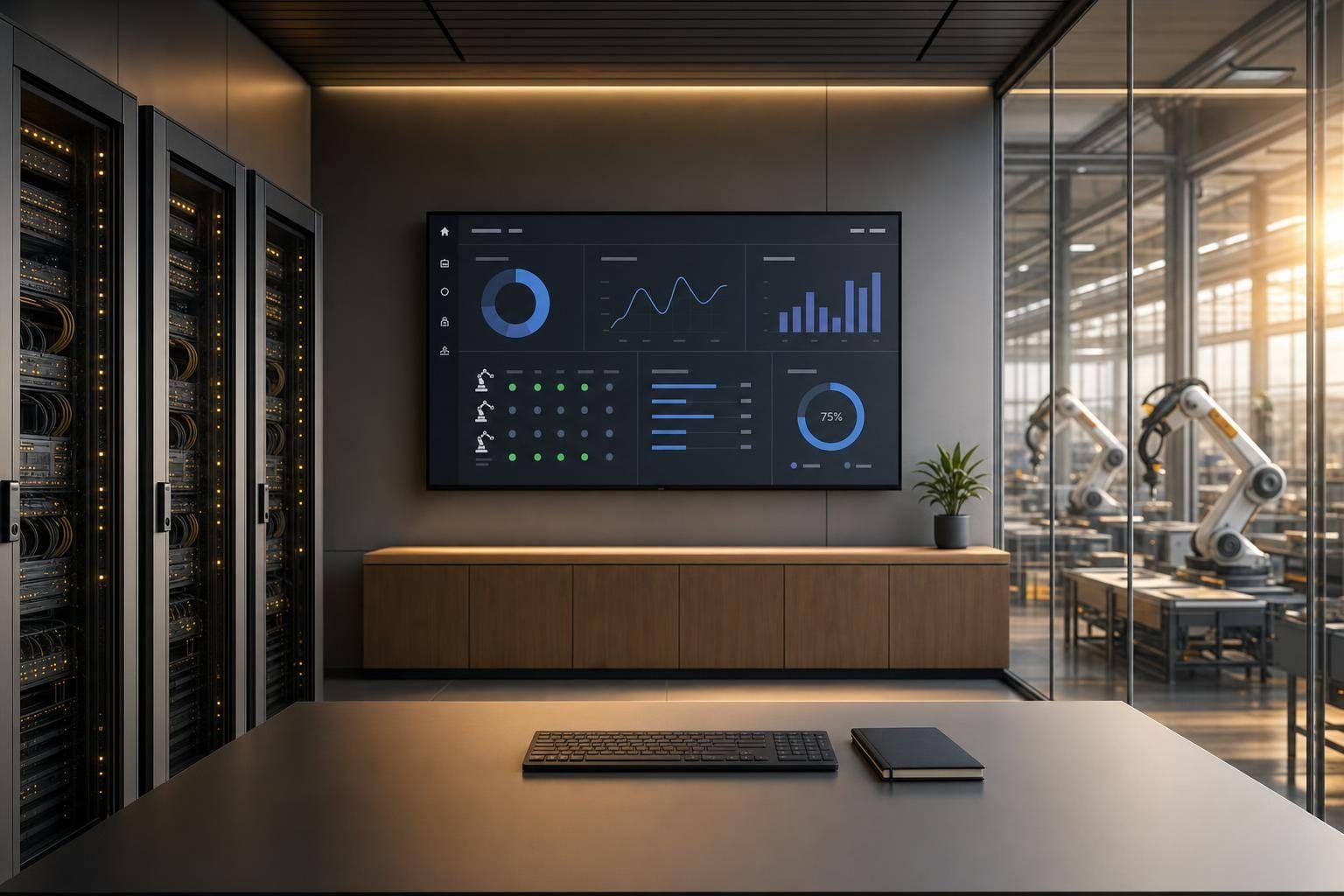
If I had to sum it up in one line: robot hardware gets the attention, but the stack behind it is where repeat sales and long-term margins tend to live.
I see the article making one clear case: if you want robots to work across many U.S. plants, warehouses, or logistics sites, you need more than a good machine. You need a system that keeps improving after install. In this piece, that system has 5 parts:
- Data pipelines that feed models with task-specific video, sensor, text, and demo data
- Teleoperation that lets people step in when robots fail and turn fixes into training inputs
- Fleet monitoring and safety escalation that spot repeat failures across sites and route risk to people or fallback modes
- Manufacturing intelligence that ties robot signals to plant goals like uptime and throughput
- Robot hardware that still has to perform on the floor, shift after shift
A few numbers stand out. The article points to about $5 billion in near-term spend on egocentric data collection, with a path toward $50 billion as demand spreads into niche industrial datasets. That matters because a one-time robot sale is one thing. But a software and service stack that grows with every new site can turn into recurring revenue.
What I take away is simple: the hard part is not one demo. It’s getting the same output across shifts, teams, and locations. That is why the money may stack up faster in data, monitoring, support, and plant software than in the robot alone.
Quick comparison
| Layer | What it does | Main business angle | Main limit |
|---|---|---|---|
| Data pipelines | Supply task data for training and retraining | Usage-based or SaaS-style revenue | Setup cost and coordination |
| Teleoperation | Fix failures in the moment | Service + software revenue | Labor and network demands |
| Fleet monitoring | Track health, failure patterns, and safety events | Per-device recurring fees | Tight system integration |
| Manufacturing intelligence | Link robot data to plant targets | Enterprise software revenue | Long sales cycles |
| Robot hardware | Perform the physical task | Upfront sale + service contract | High unit cost and uneven margins |
So if I were reading this as a buyer or investor, my takeaway would be: don’t just ask whether the robot works. Ask which layer keeps paying each time deployment count goes up.
1. Physical AI data infrastructure
Before a robot can do useful work on a factory floor, it needs data that mirrors how people move, pick up objects, and handle tasks in messy, changing settings. Buyers aren’t just paying for a machine. They’re paying for systems that keep supplying the model with better production data after deployment. That understanding comes from first-person video, sensor streams, text labels, and human demonstrations collected at scale.
This is the first revenue bottleneck. The problem isn’t the robot itself. It’s the data that teaches the robot what factory conditions look like in practice. Evlo.ai estimates that about $5 billion may be spent on egocentric data collection in the near term, with the broader market possibly reaching $50 billion as demand spreads into specialized industrial and niche datasets.
Human know-how is what turns raw training data into something useful. Generic datasets tend to fall apart in factories and warehouses because the work is too specific. Robotics companies need task-specific, environment-specific, continuously updated pipelines that match actual operating conditions.
The hard part is repeatability and traceability. As robot fleets get bigger, the data pipeline has to keep sending the model fresh examples, especially when robots run into new objects, layout changes, or failure modes. Each deployment should send new examples back into the training pipeline. A data layer that improves from every deployment builds on itself over time. A one-time dataset purchase doesn’t.
When the data layer misses a case, human operators step in and fill the gap. That’s where teleoperation becomes the next control layer.
2. Teleoperation and human-in-the-loop systems
Most robot fleets begin with partial autonomy. That’s the normal starting point. Robots still run into edge cases: unfamiliar objects, layout changes, and tasks they haven’t seen before.
When the data layer misses one of those cases, teleoperation steps in and closes the gap. It fixes the task in the moment and creates training data at the same time. But that feedback loop only works when each intervention is captured, reviewed, and sent back into the fleet.
"The best AI models don't learn by themselves. They learn from people with real-world expertise. Every correction and judgment call from experts improves the system." - Evlo AI
Once teleoperation becomes part of day-to-day work, the issue shifts from simple task recovery to operational scale. It’s not enough to rescue a single failed task here and there. The harder part is getting repeatable performance across shifts, sites, and operators.
As system coverage gets better, intervention rates tend to drop. But that doesn’t make the support stack less important. In fact, that stack is what makes progress possible in the first place, because it records what went wrong, how a person fixed it, and where that fix should go next.
The infrastructure stack has four jobs:
- low-latency remote control
- safety escalation
- logging every intervention
- integration with fleet monitoring and manufacturing systems
Without those pieces, teleoperation is just a stopgap. With them, it turns into a steady source of training data and uptime. Those same interventions also feed fleet monitoring and safety systems, where failures can be detected, escalated, and contained before they spread.
3. Fleet monitoring and safety escalation platforms
Those intervention logs don't just solve one-off issues. They turn into fleet signals.
Teleoperation can fix a single robot failure in the moment. Fleet monitoring shows you when that same failure keeps showing up across robots, sites, and shifts. Once robots are running at fleet scale, the question changes. It’s no longer just “can we fix this?” It becomes “why does this keep happening, and where else is it happening right now?” Without that layer of visibility, an issue at one site can stay buried until it turns into lost production.
A fleet monitoring platform gives operators one central view across the entire deployment. They can see which robots are healthy, which are degraded, and which are in escalation. When a robot runs into a high-risk or unfamiliar scenario, the platform can automatically route it into a safer fallback mode or send it to a human operator. That process needs to work the same way across the fleet. Safety escalation has to be repeatable at scale.
Traceability is mandatory. At this stage, AI starts to look less like a tool and more like infrastructure. Operators need to know how a decision was made, not just what happened.
"Today's AI is fluent and often accurate but when it's wrong, no one can point to why. That's a black box problem, and it gets more consequential at scale." - UnlikelyAI
Each escalation also needs a fleet-level audit trail. That record lets operators review decisions, update models, and assign accountability across every site in the deployment. It also feeds maintenance and plant optimization, helping teams spot plant-wide bottlenecks that factory systems can act on.
4. Manufacturing intelligence and factory operating systems
Fleet monitoring tells you how robots are doing. Manufacturing intelligence takes that stream of data and connects it to the whole plant - machines, people, and workflows - so operators can make production decisions instead of staring at dashboards. That’s the point where robot signals turn into action on the factory floor.
Those fleet signals only matter if they make it to the plant layer. SCADA and MES manage monitoring and execution. Manufacturing intelligence sits above them and links those systems to production goals. So instead of setting up manual alerts for every possible failure mode, operators can define the outcome they want - like cutting unplanned downtime - and let the system spot patterns, flag risks, and show the next steps.
The big test is repeatability. One good run doesn’t mean much. The system has to produce the same result across shifts, sites, and changing conditions. That’s what lets one deployment work across an entire facility. The best platforms don’t just read data. They help teams define what “good” looks like, then track whether operations keep meeting that mark.
Explainability is non-negotiable. Operators need a clear record of why the system flagged a risk, changed a workflow, or pushed a decision up the chain. The audit trail from fleet monitoring feeds straight into this layer. Escalation records, intervention logs, and robot health data all become inputs for a facility-level intelligence system that can spot plant-wide patterns, predict failures before they happen, and help teams deal with issues before production gets thrown off.
When the software stack is solid, the bottleneck shifts to the robot itself.
5. Robot hardware and standalone deployments
Once the software stack is in place, the last question is simple: can the robot keep up production-level performance on its own?
Robot hardware gets most of the attention, and that makes sense. A working robot on a factory floor is easy to see, easy to touch, and easy to demo. It feels like proof.
What standalone deployments can deliver
Standalone systems can create value right away. They can take on a defined task and become more autonomous over time, breaking a goal into steps and continuing to iterate until the job is done.
Where standalone hardware hits its limits
The hard part is not getting one good run. The hard part is getting the same result across shifts and sites.
Without data pipelines, human fallback, and fleet monitoring, a robot loses context and recovery paths the moment conditions change. And without infrastructure that preserves context and splits workflows, robots run into loss of context, where each new interaction means rebuilding the background and goals from scratch.
That problem gets expensive fast. Costs rise nonlinearly as deployments grow, especially when there is no context-preserving infrastructure. At that point, failures are not just hardware defects. They point to missing infrastructure for context, recovery, and scale.
The repeatability gap
The gap between a demo and a deployment comes down to repeatability. Hardware is the part people see, but infrastructure is what makes the system reliable enough to scale.
Infrastructure vs. Robots Alone: Pros, Cons, and Tradeoffs
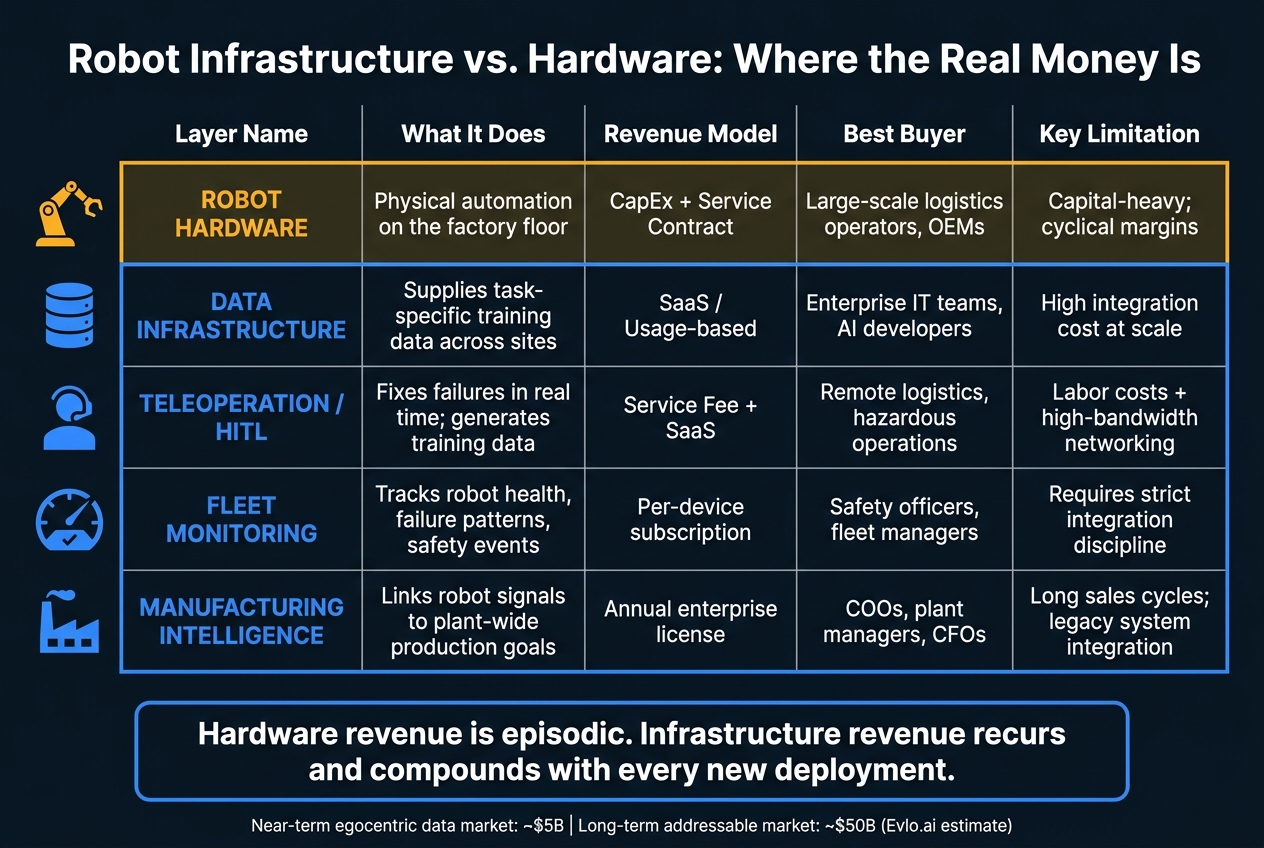
Robot Infrastructure vs. Hardware: Revenue Models & Business Tradeoffs
The repeatability gap from the last section isn't just a product issue. It's a business decision. Buyers, operators, and investors all run into the same question: where do the economics still work when deployments start to multiply?
Robot hardware matters. You can't automate physical work without it. But as fleets grow, infrastructure starts to stack up in a way hardware doesn't. Data, teleoperation, monitoring, and factory software keep building across deployments. A robot unit is still a robot unit. That shifts the core question from Can this work? to Which layer keeps paying off at scale?
Each infrastructure layer comes with its own friction. Sometimes it's labor. Sometimes it's integration. Sometimes it's compliance. Put side by side, the tradeoffs become a lot easier to see.
"The demo always dazzles. The problem starts at the second one, the tenth, the version that has to match the first across a whole campaign." - Vladyslav Chepernatyi
| Subject | Pros | Cons | Best Buyer | Typical Revenue Model |
|---|---|---|---|---|
| Robot Hardware | Immediate physical automation; tangible asset value | Capital-heavy and cyclical; high maintenance costs | Large-scale logistics operators, OEMs | CapEx + service contract |
| Data Infrastructure | High leverage via reuse across sites and models; scales with software margins | High initial integration cost; scale adds coordination complexity | Enterprise IT teams, AI developers | SaaS / usage-based |
| Teleoperation / HITL | Improves uptime; captures edge cases for retraining | Adds labor costs; requires high-bandwidth networking | Remote logistics, hazardous operations | Service fee / labor-plus-SaaS |
| Fleet Monitoring | Enhances safety; provides decision traceability for regulators | Requires strict integration discipline; vulnerable to data silos | Safety officers, fleet managers | Per-device subscription |
| Manufacturing Intelligence | Direct link to plant ROI; improves operational efficiency | Long enterprise sales cycles; deep legacy-system integration | COOs, plant managers, CFOs | Annual enterprise license |
This split in revenue shape is what separates durable infrastructure companies from one-off hardware vendors. Revenue model drives durability. Hardware revenue tends to be episodic. Infrastructure revenue tends to recur and compound. That's the big edge: infrastructure scales with deployment count, not just unit count.
Conclusion
Across all five layers, the pattern is the same: robots draw the attention, but infrastructure brings in durable revenue because it sits inside day-to-day operations.
These layers matter because they collect data, route exceptions, and keep context in place across deployments. They also get harder to replace as they build up learning, memory, and workflows over time. That’s what turns a deployment into repeatable revenue. That is the real moat.
"At that scale, AI stops being a product. It becomes plant infrastructure: it drives uptime, safety, and throughput." - UnlikelyAI
Physical AI plays by the same rule. Once a system is built into governance, safety routing, and human review, replacing it becomes an operations change, not a simple procurement swap.
For buyers and investors, the signal is pretty clear: multi-site deployment is what separates durable infrastructure companies from one-off hardware vendors. The best companies show they can repeat performance across sites.
Robots sell the demo. Infrastructure sells the deployment.
FAQs
Why is robotics infrastructure more profitable than robot hardware?
Robotics infrastructure tends to be more profitable because it tackles the main bottlenecks that limit fleet scale and day-to-day reliability.
It includes the core systems robots need to work in production: real-world video data pipelines, teleoperation, fleet monitoring, and safety escalation workflows. Those systems help robots perform more consistently on the floor, not just in demos. And that creates lasting value by supporting safer, steadier operations across logistics and manufacturing.
What infrastructure do robots need to scale across multiple sites?
Robots need an AI fabric that coordinates operations and keeps execution consistent across sites. It should tie AI intelligence to enterprise intent so systems can learn and improve across the organization, instead of working in silos.
They also need modular architectures and continuous delivery pipelines to keep reliability, performance, and stability in place across different environments.
How does teleoperation improve robot performance over time?
Teleoperation helps robots perform better by adding a human-in-the-loop safety check for moments when autonomy falls short.
That human input matters. It creates a feedback loop that supports accountability, reliability, and oversight. And over time, each intervention does more than solve the problem in front of it. It also helps validate model behavior and keep robot performance steady and productive in live production environments.