Why Every Deployed Robot Is Really an Infrastructure Problem

Leela Yanamaddi
August 24, 2026
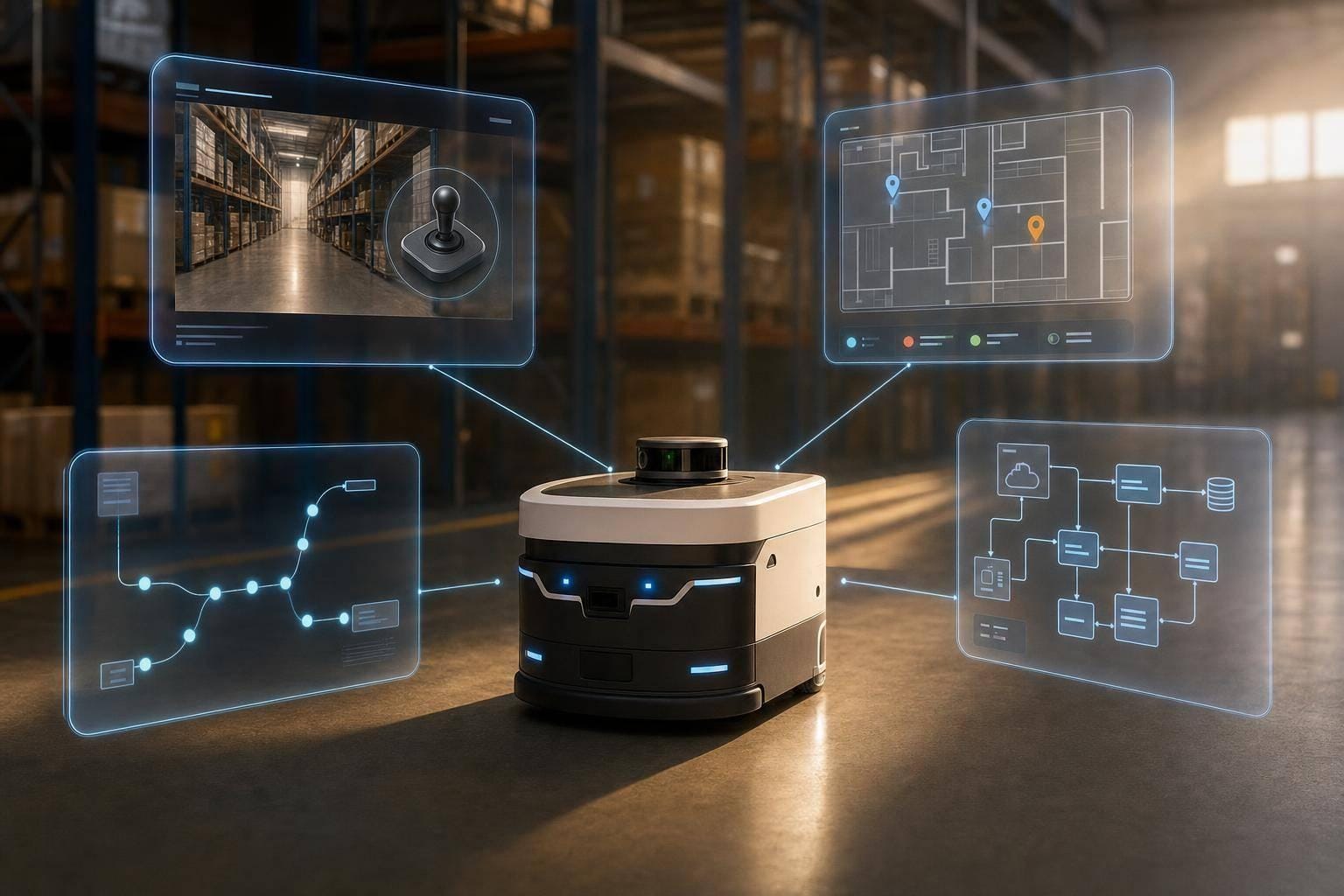
A robot can hit 95%+ task success in a pilot and still slow a full shift in production. In my view, the main issue is usually not the robot alone. It is the system around it: handoff to people, fleet status, safety steps, data flow, and links to warehouse or factory software.
Here’s the short version:
- Demos test skill. Production tests repeatability.
- Most failures start outside the robot: weak network links, poor task routing, missing logs, and unclear ownership.
- Every deployment needs four support layers: human takeover, fleet monitoring, data feedback, and software integration.
- Scale makes small gaps expensive. One unclear stop-and-restart process can turn into lost throughput across zones or sites.
- The goal is simple: fewer stalled tasks, lower downtime, and faster recovery when things go wrong.
If I had to reduce the article to one line, it would be this: you do not deploy a robot by itself; you deploy a support system around it.
A few points stand out:
- When teams skip manual intervention logging, the same issue can return shift after shift.
- When robots cannot read tasks from a WMS or write results back, teams lose status visibility and throughput data.
- When fleets grow from one area to many, response time, coverage hours, and incident ownership start to matter more than pilot performance.
| Layer | What it does | What happens without it |
|---|---|---|
| Human-in-the-loop | Lets a person step in on edge cases | Tasks stall and uptime drops |
| Fleet monitoring | Shows failures as they happen | Teams find out too late |
| Data feedback | Turns overrides into fixable patterns | The same mistakes repeat |
| System integration | Connects robots to core workflows | Robots become side systems |
Bottom line: if you want a robot fleet to keep working on Monday at 2:00 p.m., not just during a polished demo, you need the support stack in place before scale.
Where deployed robots actually break: the hidden infrastructure gaps
Most robot failures in production don't begin with the robot itself. In many cases, the problem starts earlier: missing orchestration, weak escalation paths, or poor data capture. These breakdowns tend to fall into three layers: orchestration, escalation, and learning.
Connectivity, orchestration, and visibility failures
When task assignment, execution, and monitoring are split apart, robots slow down, pause, or act in uneven ways. On the surface, it can look like the robot is at fault. But the deeper issue is often the system that passes information between the robot and the warehouse or factory workflow around it.
Without solid monitoring, operators are basically flying blind. They spot problems only after the shift has already taken a hit. And when task assignment isn't tightly linked to the rest of the operation, the robot may just sit there waiting for instructions that never arrived in a usable form. That's an orchestration gap.
Human escalation and safety process failures
When a robot runs into an edge case it can't handle, the next step should be obvious. Too often, it isn't. There's no clear escalation path, no incident response plan, and no playbook for pausing and restarting work safely.
Without clear logs showing what caused the stop, one stuck robot can slow down an entire zone while people stand around trying to figure out who should make the call. That's an escalation gap.
Missing learning loops after exceptions
Every operator intervention matters. Manually guiding a robot, overriding a bad pick, or restarting a stalled task all reveal something useful. They show where the robot's autonomy fell short and what the right response should have been.
If those manual fixes aren't logged, the same problems come back shift after shift. That's a learning gap.
Those failures define the production stack the robot needs.
The infrastructure stack every production robot needs
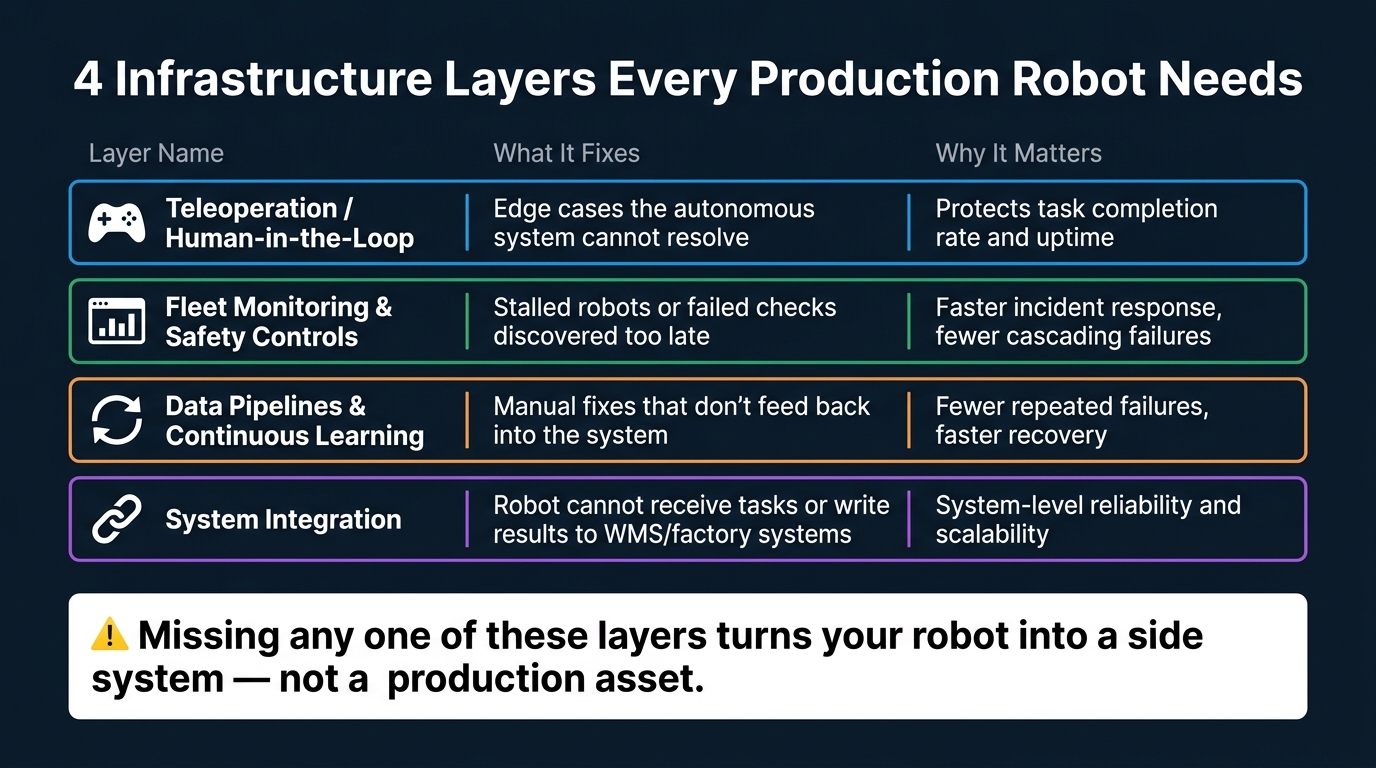
4 Infrastructure Layers Every Production Robot Needs
Those failures point to one thing: a production control stack around the robot. The answer isn't just a better robot. You also need a stack that catches exceptions, routes work to people when needed, and sends every incident back into operations so the system gets better over time.
That production stack has four parts.
| Infrastructure Layer | What It Fixes | Why It Matters |
|---|---|---|
| Teleoperation / Human-in-the-Loop | Edge cases the autonomous system cannot resolve | Task completion rate, uptime |
| Fleet Monitoring & Safety Controls | A stalled robot or failed check is discovered only after it disrupts the shift | Faster incident response, fewer cascading failures |
| Data Pipelines & Continuous Learning | Manual fixes don't feed back into the system, so errors repeat | Fewer repeated failures, faster recovery |
| System Integration | Robot cannot receive tasks or write results back to warehouse/factory systems | System-level reliability, scalability |
Teleoperation and human-in-the-loop control
This is the first layer for a reason: every deployment needs a safe way to hand off edge cases. Remote intervention isn't a backup plan you hope never to use. It's part of a production robot stack. In practice, production autonomy always includes a human fallback.
Edge cases need a clear takeover path. An operator console gives a remote teleoperator live state and task context. Escalation queues send the request to the right human operator. The aim is simple: resolve the issue, log what happened, and make sure the same problem doesn't keep showing up.
Fleet monitoring, incident response, and safety controls
A single dashboard with every robot's status in real time can change how a facility runs. But visibility by itself isn't enough. It has to trigger a defined response.
Instead of finding out there's a problem only after a zone falls behind, supervisors can see it the moment a robot goes offline, a task queue stalls, or a health check fails. That shift helps stop a small issue from turning into a shift-wide outage.
Standardized incident codes also matter. When every failure is logged the same way, teams can build runbooks: step-by-step response procedures for the most common failure types. A robot that stops mid-aisle needs a different runbook than one that loses connectivity or triggers a safety sensor. Shutdown and restart procedures also need to match facility safety rules, with clear records of who approved what and when.
Data pipelines, system integration, and continuous learning
Every manual override and robot exception is operational data that should shape future behavior. Telemetry signals, video clips, sensor readings, and intervention events only help if they're captured and tied to an outcome. A manual override is useful data. Without storage and tagging, the same failure can happen again with no fix.
The same idea applies to system integration. A robot that can't read from the warehouse management system doesn't know what task to run next. One that can't write back leaves the operation blind on inventory and throughput. Integration makes the robot part of the operation, not a side system.
Once these layers are in place, the next question is scale: what has to exist before one robot becomes a fleet?
How to move from pilot to production without hitting an infrastructure wall
Once the robot stack works in pilot, the next test is scale. And that test usually hits harder than teams expect. The biggest shift between pilot and production isn't just the number of robots. It's the day-to-day load the system has to handle.
What to set up during the pilot phase
A lot of teams tune a pilot for a good demo, not for repeat use. That's the trap. The pilot should show that the system can repeat the same result under normal operating conditions. One good run is a starting point, not proof that the setup is ready.
Treat the pilot as a check on the minimum production infrastructure you’ll need later. That means you should:
- Confirm network connectivity across the full operating area
- Capture basic telemetry for each shift
- Log every manual intervention with an owner and an outcome
- Assign clear escalation ownership
- Connect the robot to at least one core workflow system
That last point matters more than it may seem. You don’t need full system integration on day one. But you do need enough connection to surface gaps before scale turns them into expensive habits.
What changes when fleets expand across zones or sites
As fleets grow, the operating model changes. It's not just “more robots.” Small hassles in a pilot can turn into direct throughput loss once you spread robots across zones or sites. At that stage, the main limit is usually coordination, coverage, and response discipline across the operation, not the robots themselves.
Centralized monitoring stops being optional. Standard teleoperation workflows need to line up with operating hours and site activity. SLA targets also need to be written down, including required uptime, acceptable mean time to recovery, and the named owners when those targets are missed.
Data pipelines need to grow with the fleet too. Every intervention at one site can help prevent the same issue at another. But that only happens if those events are captured in a structured way across sites. If not, that learning gets lost.
A production deployment readiness checklist
Use the checklist below as the last gate before scale.
| Readiness Area | What "Ready" Looks Like |
|---|---|
| Network reliability | Connectivity validated across all operating zones and shifts, not just the pilot area |
| Integration depth | Robot tasks, status, and outcomes flow into your warehouse or factory workflows |
| Remote operations coverage | Trained teleoperators available whenever robots are active |
| Safety governance | Shutdown, restart, and escalation procedures documented, approved, and tested |
| Uptime analytics | Real-time visibility into downtime, recovery thresholds, and owners |
| Closed-loop learning | Intervention events captured, tagged, and fed back into improvement workflows |
Conclusion: the real bottleneck is the operating system around the robot
The robot is rarely the bottleneck. More often, the problem in production sits in the layer around it: connectivity, monitoring, human escalation paths, data capture, and integration with the workflows the robot is meant to support.
"The AI demo is easy. Consistency is the job." - Vladyslav Chepernatyi
That point maps cleanly to robotics. In this context, consistency comes from the setup around the machine - the systems that catch exceptions, pull humans in when needed, and send failure data back into operations.
That stack is what turns a working pilot into a dependable production system. It leads to fewer stalled shifts, faster recovery, and better scaling across sites. In plain English: the gap between a pilot that works once and a system that keeps working is the infrastructure around the robot.
Build that infrastructure before pushing for scale, and teams are far less likely to hit the production wall. The teams that get to dependable production usually do the same thing: they put the operating layer in place first, then roll out the robots.
FAQs
What infrastructure should be in place before scaling a robot fleet?
Before you scale a robot fleet, set up the systems that keep robots working day to day in the field, not just the robot model.
That means putting the right support around the fleet: teleoperation backstops, fleet monitoring, incident response, data pipelines for performance analytics, human escalation workflows, safety controls, and integration with warehouse or factory operations.
Think of it like this: a robot fleet doesn't run on hardware and software alone. It also runs on the people, processes, and tools behind it. If one of those pieces is weak, scaling can slow down fast.
Use uptime analytics to spot bottlenecks early and fix them before they drag down production scaling.
How do I know if a robot issue is really an infrastructure problem?
A robot issue usually points to infrastructure, not the core model, when the failure comes from the systems around it.
That often means checking for gaps in teleoperation backstops, fleet monitoring, or incident response. If those support layers are weak, even a solid model can still fail in the field.
If problems keep showing up in edge cases, navigation, or scaling even after model updates, the choke point is likely somewhere else. In most cases, that means the data pipelines, human escalation workflows, or factory integration. Ongoing downtime is another strong signal that the model may not be the main problem.
What should a pilot prove before moving to production?
A pilot needs to prove more than basic hardware performance. It should show that the support systems around that hardware are ready for dependable production use.
That means fleet monitoring, data pipelines, incident response, and reliable human-in-the-loop oversight. Those pieces matter because they help handle edge cases, protect safety and uptime, and make the system fit into existing operations without constant friction.