Rights-Cleared vs Scraped Training Data: What Actually Holds Up in an Audit

Leela Yanamaddi
October 15, 2026

I would approve training data based on its records - not its label. Before you ingest video, request 4 linked records: source history, use permissions, privacy records, and processing logs tied to the delivered files.
Here’s what I check for either dataset type:
- Source and authority: Who supplied the footage, who owns the rights, and whether the facility allowed recording and sharing.
- Allowed uses: Training, fine-tuning, evaluation, commercial use, and redistribution need separate checks.
- People and private details: Worker and visitor protections, confidential material, and any required redactions.
- File history: IDs, hashes, edits, annotations, and versions must match the delivery.
- Later obligations: Restrictions, deletion requests, and rights changes must link to affected training runs and models.
Quick Comparison
| Check | Rights-cleared data | Scraped data |
|---|---|---|
| Starting records | Licenses, releases, collection logs | Source URLs, retrieval dates, archived terms |
| Permission review | Confirm the supplier can grant your planned uses | Check legal grounds and restrictions for each source |
| Shared standard | File-linked privacy and processing records | File-linked privacy and processing records |
Public access is not permission to train. I use the same rule for both: <u>approve only the files and uses the records support</u>. Limit supported uses, pause unresolved questions for legal or privacy review, and block files with missing or conflicting records.
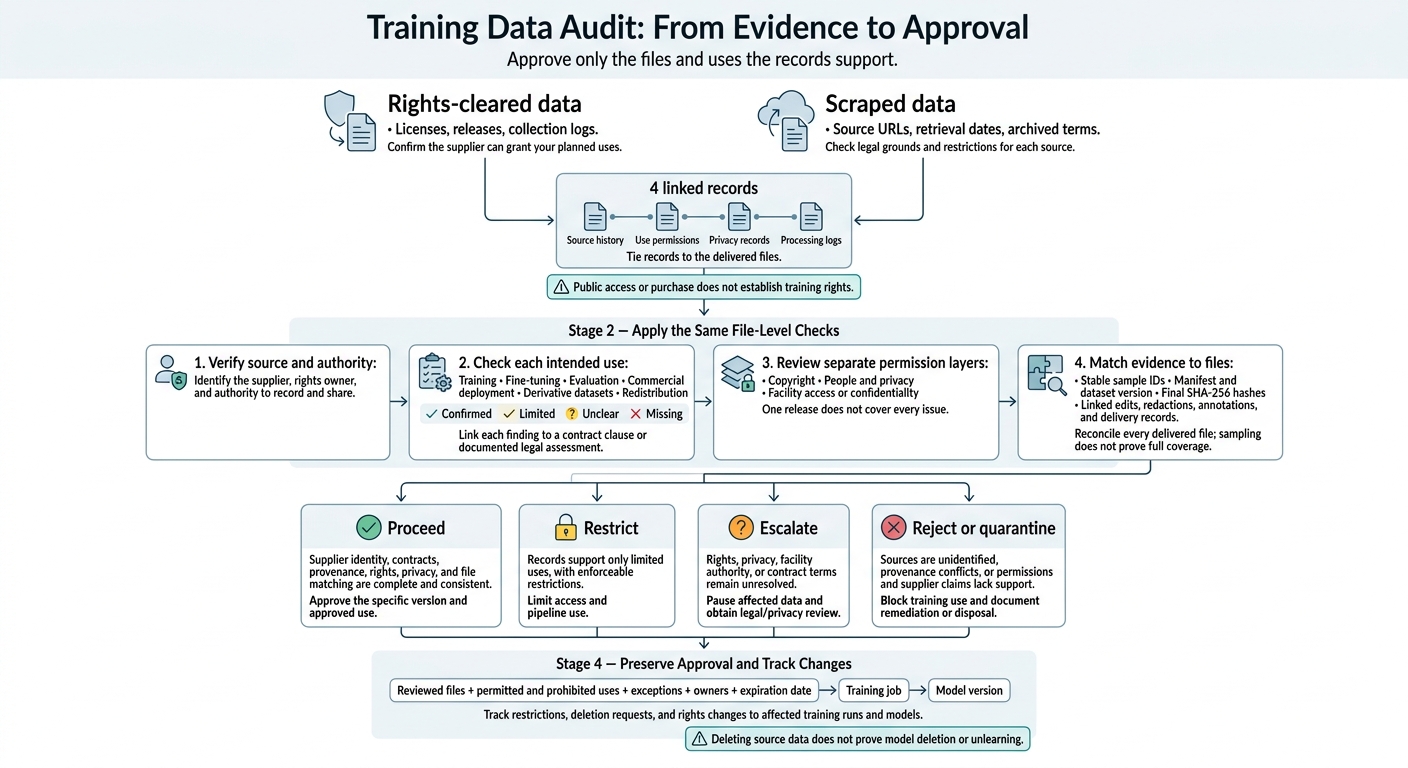
Training Data Audit: From Evidence to Approval
Licensing of Data for AI Model Training | Ong Johnson & Lo Khai Yi
Rights-Cleared vs Scraped Data: What Auditors Need
Test supplier claims against the files you received. The checklist below applies the same audit standard to rights-cleared and scraped datasets.
| Audit factor | Rights-cleared data: verify | Scraped data: verify |
|---|---|---|
| Origin | Named collector, commissioned production, licensed archive, or identified contributor | Original website, platform, channel, account, or repository - not just the scraper |
| Permissions | Agreement or license covering the delivered footage and intended uses | Source terms, uploader authority, platform restrictions, and any separate license |
| Intended use | Which training, fine-tuning, evaluation, and commercial uses the agreement permits | Whether each proposed use has documented legal support |
| People recorded | Releases, notices, privacy basis, and bystander controls | The same protections; an uploader’s permission does not cover everyone shown |
| Facility authorization | Authority to record and disclose the site and its processes | Whether the source creator had that authority |
| Traceability | File hashes and linked records of edits, redactions, annotations, versions, and delivery | Retrieval dates, downloaded-file hashes, archived terms, and linked processing and delivery records |
| Continuing obligations | Attribution, deletion, restrictions, renewals, reporting, and reuse limits | Takedown, license changes, account removal, privacy requests, and source-term changes |
Public access or purchase does not establish training rights. The license must cover the intended use. The U.S. Copyright Office notes that downloading, copying, transferring, and converting works into datasets are legally relevant acts. Fair use depends on the case - it is not a blanket training right.
Check Permissions for Each Intended Use
Once you’ve documented origin and traceability, check what each file may be used for. Create a use matrix covering training, fine-tuning, evaluation, commercial deployment, derivative datasets, and redistribution. Mark each activity confirmed, limited, unclear, or missing, and link each finding to a contract clause or documented legal assessment.
Research permission does not automatically cover commercial deployment. Likewise, evaluation permission does not necessarily allow training or fine-tuning.
Check limits on attribution, noncommercial use, territory, term, sublicensing, retention, and deletion. Permission to record or sell footage is not the same as authority to license its reuse. Ask for the chain of title and an exceptions schedule that identifies excluded material - not just the supplier’s assurance.
Review Copyright, Privacy, and Facility Permissions Separately
Keep separate findings for copyright, people, and facility access or confidentiality. A contributor release does not resolve coworkers’ privacy, embedded music or artwork, confidential screens, or restricted industrial processes. Record the permission or control for each issue. Don’t treat one control as coverage for all three.
Apply this rule even when several rights issues appear in a single recording.
Hypothetical warehouse audit: A supplier delivers a 20-minute recording of a robot moving cartons. Coworkers, customer shipping labels, a proprietary control panel, and background music appear. The participating employee’s release does not cover all of them. Request facility authorization, worker and visitor records, a customer-label handling plan, and a copyright review for music and screen content. Require evidence of any redaction or exclusion. If those controls remain unsupported, quarantine the recording or accept only a verified, sanitized subset.
Records to Request Before Ingesting Video Data
Once permissions are scoped, request a file-to-source evidence packet for every delivered file type: robotics video, wearable footage, audio, sensor streams, and teleoperation logs. Each packet should include a manifest, dataset version, delivery date, and named contact for claims, corrections, and deletion requests.
Rights-Cleared Data: Licenses, Releases, and Collection Records
Get the agreements and evidence that the supplier has authority to grant the license. Link collection dates, locations, and contributor and facility IDs to signed releases, notices, or license terms.
Check customer-use and downstream-sharing rights, retention terms, withdrawal procedures, and who handles claims from original sources. Collection logs should identify cameras, microphones, wearable devices, robot sensors, sampling rates, and time synchronization. They should also state whether raw files were retained.
Scraped Data: Sources, Terms, and Permission Reviews
For scraped data, focus on source records rather than supplier paperwork. Request exact URLs or repository paths, acquisition timestamps with time zones, source snapshots, and the licenses and terms in effect when the data was acquired. Include API authorization evidence, robots.txt snapshots, and any AI opt-out records.
Acquisition records alone don’t prove the right to use the data. Require a documented, source-by-source review of permissions, privacy records, uploader authority, platform limits, and source-specific restrictions. Refer unresolved grounds for use to counsel.
Both Categories: File History from Source to Delivery
Require stable sample IDs that link source files, permission records, derived clips, annotations, and final SHA-256 hashes. Processing logs should record timestamps; operators, automated services, or tools; tool versions; input and output IDs; and changes made through filtering, redaction, compression, or conversion. For sensor streams and teleoperation logs, preserve calibration, clock offsets, dropped-packet records, and frame-rate changes.
Then verify that every delivered file matches its logged history. Reconcile the manifest with the delivery and recalculate hashes after transfer. Investigate unmatched or changed files, then trace selected samples through their full history.
Require screening flags for faces, voices, children, private interiors, precise locations, and confidential industrial content. Redaction records should identify what changed and whether those changes affected labels or sensor alignment.
Supplier Audit Checklist and Approval Rules
After collecting provenance and permission records, make a yes-or-no decision on supplier approval.
Check Contracts and Match Records to Files
Procurement must verify who the supplier is and what rights it can grant. Check its legal entity, jurisdiction, address, dataset owner of record, collection partners, and authority to grant the rights being used. Require signed contracts that specify the dataset version, permitted training uses, geography, warranties, indemnities, audit rights, and termination obligations.
Data engineering must go beyond spot checks. Report the percentage of delivered files matched to provenance and rights records, broken down by source and dataset component. Sampling does not prove full coverage. Log each missing document as a finding, with a severity level, owner, and remediation deadline.
Check Privacy, Exclusions, and Change Controls
Legal or privacy makes privacy decisions; data engineering enforces exclusions and keeps disputed records out of new training runs. Require versioned changes and supplier notices about material changes to rights, permissions, or scope, as well as takedown demands and privacy incidents.
Track dataset-to-model lineage to identify affected experiments and model versions. Deleting source data does not prove model deletion or unlearning. Treat removal or retraining as a separate, documented decision. The FTC has required deletion of models and algorithms developed using unlawfully obtained data.
Decide Whether to Proceed, Restrict, Escalate, or Reject
Use the findings below to determine whether a dataset can enter training, needs restrictions, or must be blocked. “Proceed” requires complete evidence linked to the files.
| Outcome | Evidence threshold | Required action |
|---|---|---|
| Proceed | Supplier identity, contracts, provenance, rights, privacy, and file matching are complete and consistent. | Approve the specific version and approved use. |
| Restrict | Records support only limited uses, with enforceable restrictions. | Limit access and pipeline use. |
| Escalate | Rights, privacy, facility authority, or contract terms remain unresolved. | Pause affected data and obtain legal/privacy review. |
| Reject or quarantine | Sources are unidentified, provenance conflicts, or permissions and supplier claims lack support. | Block training use and document remediation or disposal. |
The approval record controls all later training runs that use the same files. The approver must sign off on the reviewed files, permitted and prohibited uses, exceptions, owners, and expiration date. Link that approval to the training job and model version.
Conclusion: Choose Data with Records That Match the Files
Rights-cleared data starts with stronger collection records, but approval still depends on file-level evidence. Scraped data needs source-specific proof that the intended use is permitted.
Compare both dataset types using the same file-level standard from the supplier checklist.
| Audit test | Rights-cleared data | Scraped data |
|---|---|---|
| Starting evidence | Licenses, releases, and collection records | Source URLs, capture dates, terms, and legal grounds |
| Use compatibility | Confirm planned training and commercial uses | Verify source-specific permitted uses |
| Remaining checks | Privacy and capture-to-delivery records | Privacy and capture-to-delivery records |
The label matters less than whether the permissions, privacy records, and file history match the delivered files.
Apply this standard to evlo.ai-managed collections and licensed datasets. Request collection-level permissions and any applicable participant and facility releases tied to the delivered files. “Managed” and “licensed” are labels; the records must establish scope.
For robotics and manufacturing data, check operator, facility, and operational-use permissions alongside privacy records. Teleoperation requires operator agreements that cover reusing demonstrations and interventions in training. For manufacturing-intelligence workflows, verify facility authorization, confidentiality limits, and permission to use operational data to train later systems.
Require a dated, version-controlled evidence packet that matches the exact files and intended workflow. It should include the file manifest, source and acquisition records, permissions, privacy records, processing history, and exclusions.
FAQs
How can I verify a supplier’s training-rights claims?
Require a rights register that links every file and contributor to records showing its source, signed consent forms, written site permission, and licenses covering training, evaluation, commercial use, and sublicensing. Check geographic limits, expiration terms, dataset metadata, and the dataset card.
Set these documentation requirements before acquisition, then verify compliance through independent acceptance testing. Reject any delivery without 100% documented rights for your intended use.
Can I use only the cleared clips from a dataset?
Yes, as long as you carefully document the selection process. Keep a provenance record for each clip, and verify that every segment has a consent reference, license, and processing history.
Quarantine or remove files with unknown rights or unresolved personal information. Don’t allow conditional use. Update episode manifests and version logs to reflect the filtered dataset and keep a clear audit trail.
What if permissions change after I train a model?
Treat the affected data as restricted. Immediately quarantine or remove files that no longer have valid rights or consent. Keep an auditable record of the withdrawal or license change, the action taken, and the removal date. This keeps datasets and training histories traceable.
For future use, release a new, versioned dataset that leaves out the retracted content and meets the updated requirements.