Reactive vs. Proactive: How Smart Factories Stay Ahead of Breakdowns

Leela Yanamaddi
August 20, 2026
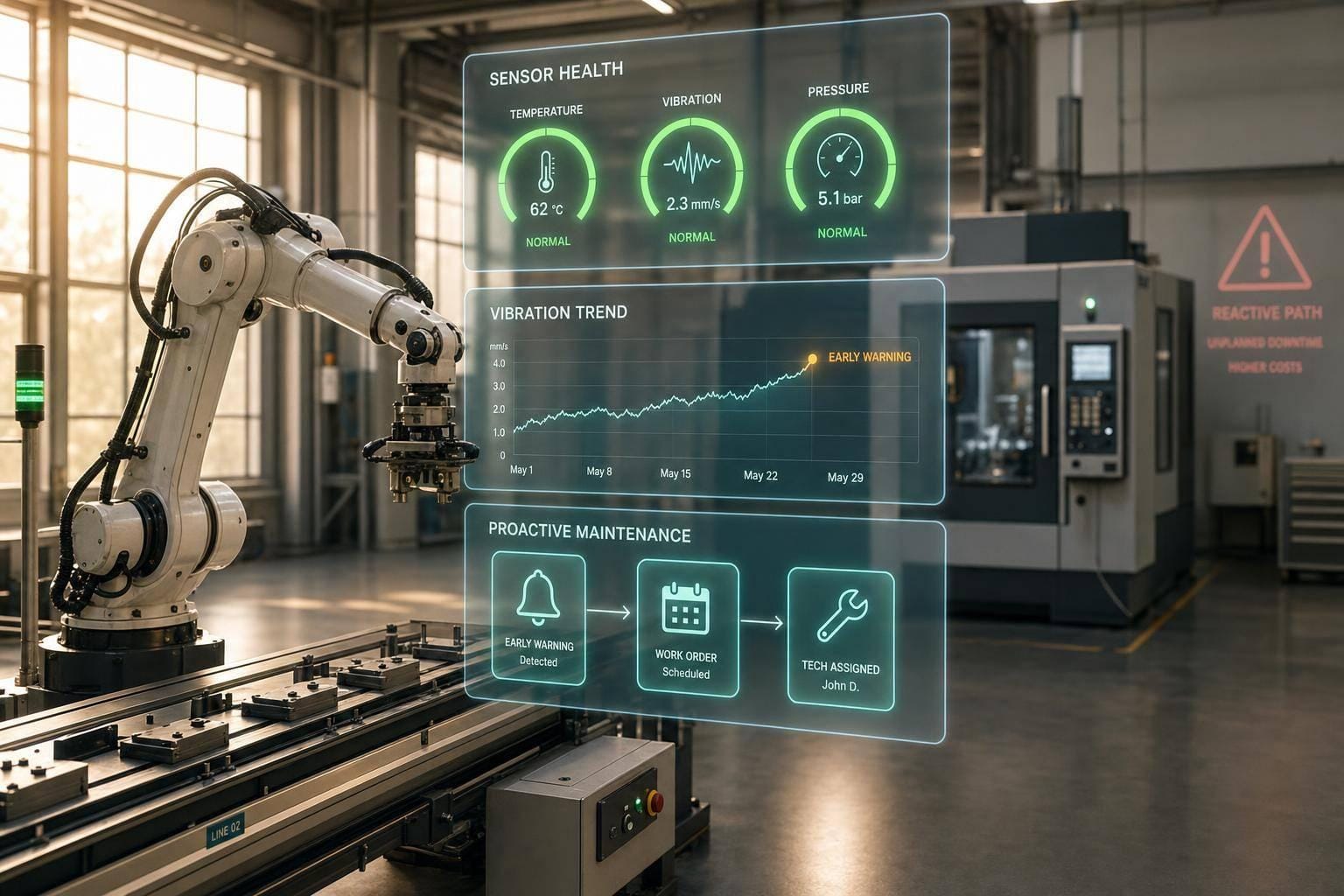
If you wait for a machine to fail, you've already lost production time. In most plants, unplanned downtime can cost thousands of dollars per hour, and the damage often spreads beyond one asset.
I’d sum up the article like this: smart factories cut downtime by watching for early warning signs, turning sensor data into alerts, and sending those alerts to the right person before a full stop happens. The shift is simple: move from repair after failure to action before failure.
Here’s the article in plain English:
- Reactive maintenance starts after a fault, stoppage, or emergency alarm.
- Signal-driven maintenance starts when data shows drift in temperature, vibration, current draw, or cycle time.
- Predictive models help sort noise from risk and point teams to the next step.
- Human review still matters, especially for edge cases and robot intervention.
- Escalation rules keep alerts from sitting idle.
- Planned work windows cost less than surprise downtime and cause less line disruption.
What this means for you: if your team can spot changes early, assign alert owners, and act in scheduled windows, you gain more uptime, steadier maintenance spend, and less firefighting.
Reactive Maintenance versus Predictive Maintenance (PdM)
Quick Comparison
| Area | Reactive | Signal-Driven |
|---|---|---|
| Trigger | Fault, stoppage, manual report | Early alert, health trend |
| Timing | After failure | Before downtime |
| Downtime | Unplanned | Scheduled when possible |
| Cost pattern | Volatile | More predictable |
| Team role | Emergency response | Review, plan, intervene |
| Data use | After-the-fact | Used to flag risk early |
In short, I see the article as a case for one clear change: don’t wait for the breakdown signal when smaller signals show up first.
Reactive operations: what happens when you wait for things to break
Reactive maintenance, also called run-to-failure, begins only after a machine, robot, or production line stops working. There’s no early-warning tracking and no condition-based action before the problem hits.
What reactive workflows look like on the plant floor
On the plant floor, the first alert usually shows up when the damage has already started. A reactive workflow often begins with a fault code, an operator report, an emergency stop, or an incident log. At that point, the team is no longer trying to prevent the issue. They’re trying to figure out what went wrong and get things back up and running.
Those signals confirm that a failure has happened. They don’t give you a heads-up before it does.
Where reactive operations create the most risk
The costs add up fast:
- Unplanned downtime
- Overtime labor
- Spare-parts delays
- Scrap
- Quality loss
- Safety risk
- Unpredictable maintenance spending
That’s why smart factories try to spot warning signs before the failure itself.
Preventing breakdowns: how smart factories use signals, analytics, and alerts
Smart factories don’t wait for a fault code or a full shutdown to tell them something’s wrong. They watch for early signs that a failure is starting to build. That means continuous monitoring, paired with fast escalation when something looks off. Machine and robot health data can feed models that spot issues, estimate likely impact, and suggest what to do next.
The signals that matter before a failure happens
The most useful signals are the ones that show how an asset’s normal behavior is changing over time. If health data starts drifting away from its usual pattern, the system can flag that shift before the machine fails.
That’s where the value kicks in. Instead of relying on gut feel or rough timing, teams can make maintenance decisions based on evidence. But raw signals alone don’t do much. They become useful when analytics turn those changes into something a team can act on.
How predictive maintenance turns sensor data into action
Predictive maintenance starts to matter when analytics turn monitoring data into a clear next step. The strongest setups also bring in human expert judgment to improve anomaly detection.
With that human-in-the-loop approach, teams can:
- review alerts in context
- focus on the issues that matter most
- decide when to step in before downtime begins
That makes the process a lot less like guesswork and a lot more like reading the road ahead before you hit traffic.
What better outcomes look like in practice
When alerts are prioritized and sent to the right people, the effect on operations becomes easier to measure. When monitoring, analytics, and escalation work as one system, factories can respond earlier and with more consistency as issues start to surface.
AI systems can break a goal into actions, check results, and adjust as conditions shift. That cuts down the time between detection and intervention and helps keep production on schedule.
Reactive vs. prevention-focused: a direct comparison of cost, uptime, and control
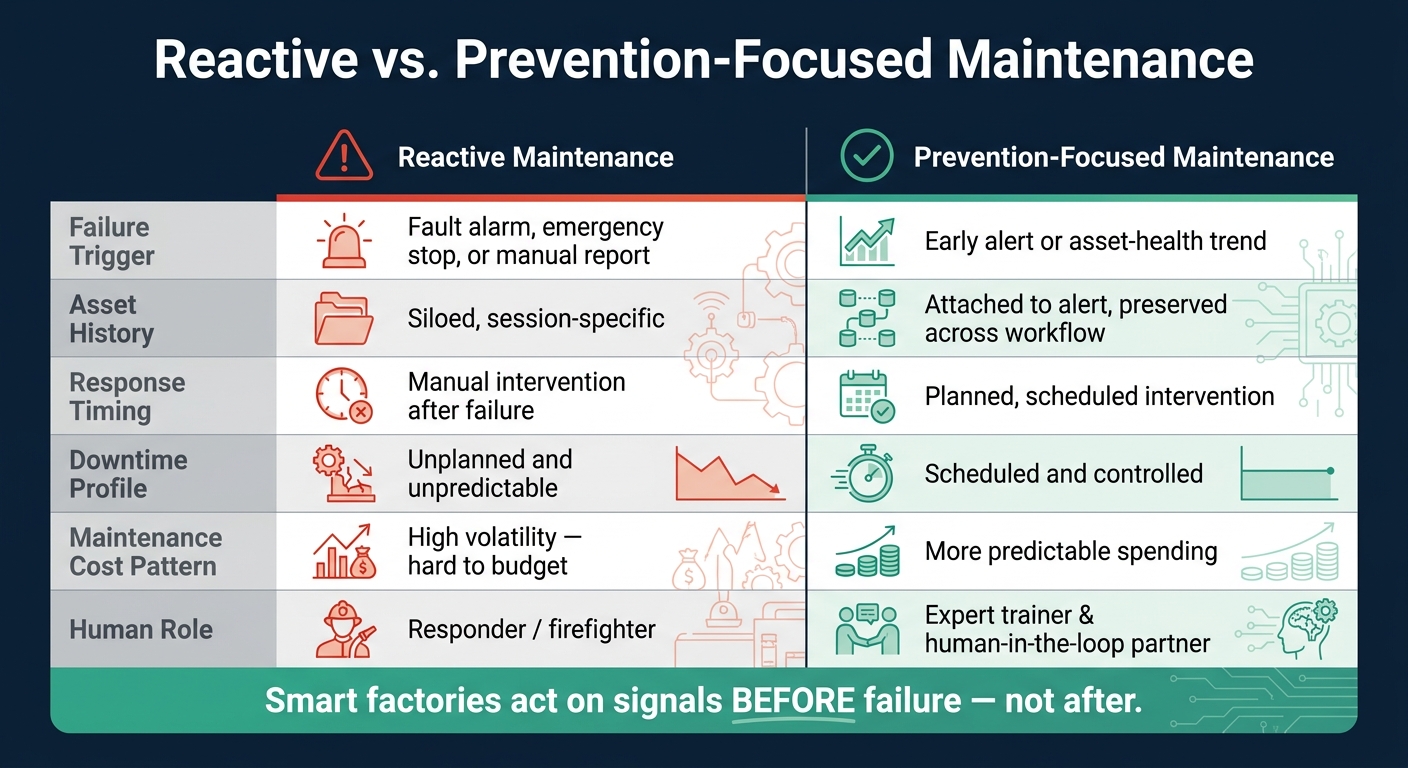
Reactive vs. Proactive Maintenance: Cost, Downtime & Control Compared
Once those workflows are in place, the gap becomes pretty clear. You see it in cost, uptime, and how much control the team actually has.
Failure trigger vs. early warning signal
In a reactive setup, the failure is the trigger. A machine stops, an alarm goes off, and the team has to rush in. At that point, production has already taken a hit.
Prevention-focused operations turn that around. Instead of waiting for a failure alarm, teams act on early alerts, asset-health trends, and scheduled work orders before a breakdown happens. That also means machine history and fault context stay tied to each alert. Reactive teams step in after the machine fails. Prevention-focused teams step in before downtime begins.
Unplanned downtime vs. scheduled maintenance windows
Unplanned downtime gets expensive fast, and not just because of the repair bill. When a line goes down, production stops and the whole team gets pushed into firefighting mode.
Prevention-focused teams can move that work into scheduled maintenance windows. That gives them more say over timing and causes less disruption to throughput. Put simply, the work happens in planned windows instead of stealing production time through surprise failures.
Emergency repair cost vs. planned maintenance spending
The cost gap between these two models goes beyond the repair itself. The bigger issue is predictability. Reactive maintenance leads to volatile spending that's tough to budget for. Prevention-focused maintenance shifts that pattern toward spending that's easier to plan for and easier to track.
| Cost Factor | Reactive | Prevention-Focused |
|---|---|---|
| Trigger | Failure alarm or manual prompt | Early alert or asset-health trend |
| Asset history | Siloed, session-specific | Attached to alert, preserved across workflow |
| Response timing | Manual intervention after failure | Planned, scheduled intervention |
| Downtime profile | Unplanned and unpredictable | Scheduled and controlled |
| Maintenance cost pattern | High volatility | More predictable spending |
| Human role | Responder or firefighter | Expert trainer and human-in-the-loop partner |
The more a workflow preserves asset history, surfaces alerts early, and keeps experts in the loop, the more control the team has over downtime, cost, and response timing.
Human-in-the-loop workflows for machines and robots in smart factories
Detection only helps when someone is responsible for what happens next. Sensors and predictive models don’t do much on their own. They matter when an alert leads to action.
Alerts, escalation rules, and remote intervention
A solid workflow assigns ownership as soon as an alert fires, keeps the asset context attached, sends it to the right lead, and escalates if no one responds in time. That tiered setup helps stop small problems from slipping through the cracks.
Robots need that same workflow too. If a robot runs into an obstacle, a layout change, or a task it can’t finish on its own, a remote operator can step in, guide it through the situation, and hand control back once the issue is fixed.
How Evlo.ai fits into prevention-focused factory operations

Evlo.ai closes the loop between alerting, intervention, and learning. It connects three layers that prevention-focused factories need: turning factory data into intelligence to feed better models, teleoperation that brings in a trained human when autonomous systems hit their limits, and unified monitoring that puts machine, robot, worker, and production signals into one view.
On the teleoperation side, vetted remote operators can step in when a robot can’t complete a task autonomously, guide it through the situation, and return control once resolved. Those sessions also create interaction data that helps retrain models, improve autonomy, and cut down on future interventions.
The Manufacturing Intelligence layer, or Manufacturing Brain, brings machine, robot, worker, and production data into one monitored view. Teams get a single place to see what’s happening across the facility and act before small issues turn into breakdowns.
Conclusion: moving from firefighting to reliable factory operations
When alerts, analytics, and escalation work together, the next step is pretty obvious. Reactive operations keep teams stuck in emergency mode and throw production off track. Smart factories get out of that loop by acting on signals before a machine fails.
The move here is simple: go from failure-driven response to signal-driven control. Spot issues earlier, send alerts to the right person faster, and leave human judgment for the edge cases that need it.
Key steps for making the transition
- Map the machines and robots that cause the most unplanned downtime. Start monitoring those first.
- Add sensors for the signals most linked to failure: temperature, vibration, current draw, and cycle-time drift.
- Assign every alert an owner, a response window, and an escalation path.
- Use automation for routine cases and human action for edge cases.
- Standardize the workflow so it runs the same way across shifts and production lines.
The result is straightforward: detect earlier, step in sooner, and keep production moving.
FAQs
How do I know which machines to monitor first?
Start with the machines that carry the most risk. Look at production data and pinpoint the equipment with the most unplanned downtime, along with the machines that create key bottlenecks.
Putting sensors and health monitoring on these high-impact assets first can improve reliability. It also helps direct proactive maintenance to the places where a failure would cause the biggest disruption.
What signals usually warn of a breakdown early?
Early warning signs often show up as small shifts in how a machine runs, such as:
- unusual vibrations
- abnormal temperature spikes
- irregular power consumption
- changes in acoustic signatures or mechanical wear
When smart factories track these signals all the time, they can spot performance drift early and send incident alerts before a breakdown throws production off track.
When should a human step in instead of automation?
A human should step in when AI-driven decisions affect people, safety, jobs, or any other high-stakes outcome. The same goes for cases where a prediction is uncertain and someone needs to validate it, approve it, and take responsibility before it goes live in production.
If a mistake wouldn’t cause meaningful harm, automation can move ahead on its own. But when it comes to critical alerts and escalations, human judgment should sign off before any action is taken.