Meet the Intelligence Layer That Never Sleeps on Your Factory Floor

Leela Yanamaddi
August 18, 2026
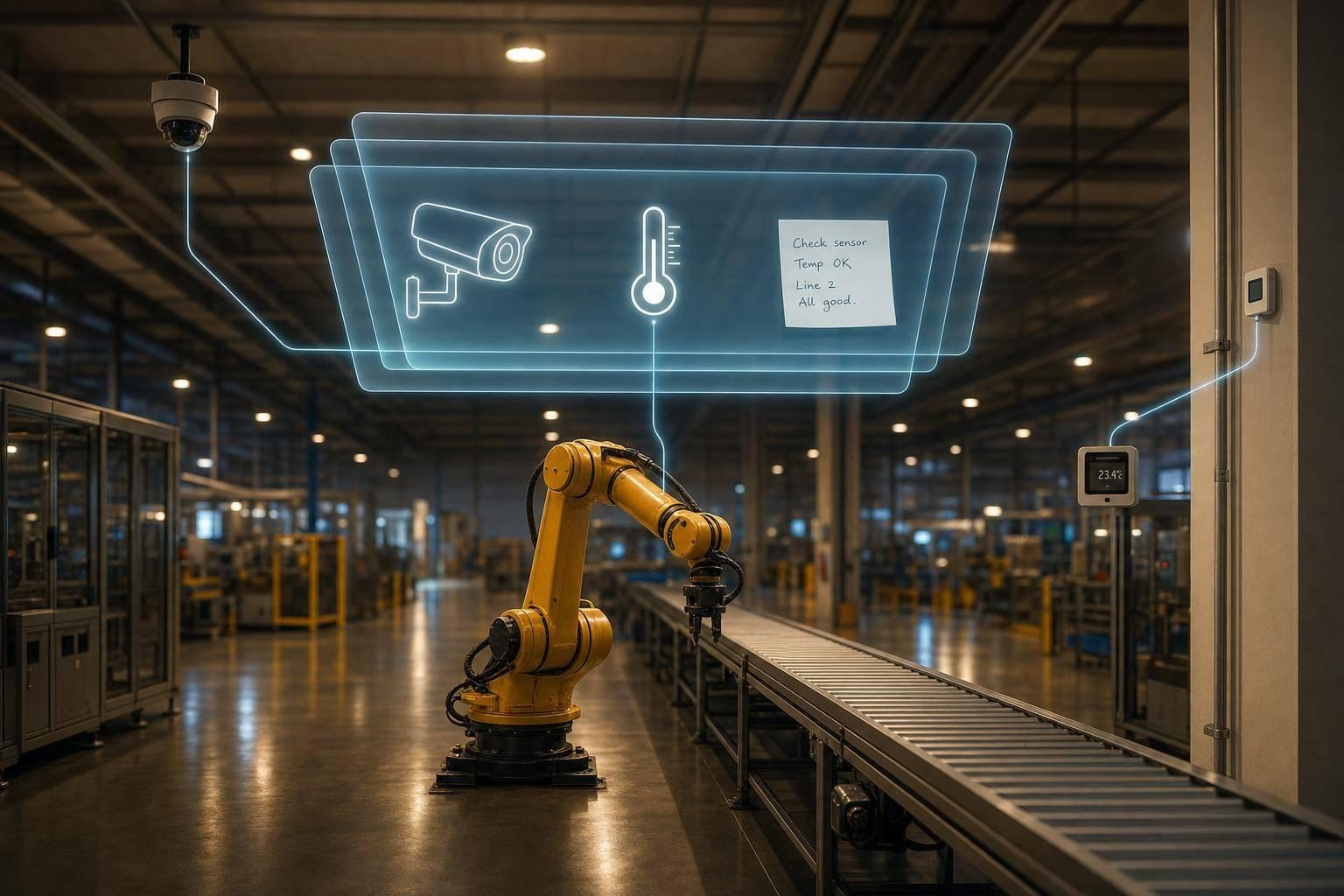
Most factory problems do not start with one alarm. They start with a pattern. A robot runs hot, a conveyor slows, output slips, and a note from the last shift gets missed. When those signals stay split across tools, teams often react too late.
I’d sum up the article like this: one live layer pulls robot data, machine signals, cameras, worker notes, and alerts into one view, then sends each issue to the right person. That means less guesswork, less downtime, and less time spent chasing raw fault codes.
Here’s the core idea in plain English:
- It is not just a dashboard. Dashboards show data. This layer links data to action.
- It connects many inputs at once. Robots, PLCs, CNCs, sensors, MES/ERP events, camera feeds, tickets, and shift notes.
- It looks for patterns, not just limit breaches. That helps teams spot trouble before a stop.
- It routes issues by type. A robot fault can go to a remote operator. Wear signs can go to maintenance. Throughput drops can go to a supervisor.
- It keeps one incident record across shifts. So teams do not lose time during handoff.
- It should start small. Most plants should begin with the assets tied to the most downtime, safety risk, or lost output.
A few numbers show why this matters: unplanned downtime can cost plants thousands of dollars per hour, and some studies put the cost far higher in heavy industry. At the same time, poor shift handoffs and siloed systems can slow response by minutes or hours, which is often enough to turn a small issue into a line stop.
What I like here is the simple workflow: ingest signals, spot odd behavior, classify the issue, and route it. <u>That is the main point of the whole piece.</u>
If you want the shortest version possible, it is this:
- One live record
- One response path
- One place to see what changed
- 24/7 coverage across people, machines, and robots
The rest of the article explains what data the layer connects, how it finds uptime, quality, flow, and safety issues, and how to put it in place without flooding teams with noise.
AI in Manufacturing | Plant Operating System With Claude AI
What the intelligence layer actually is
The intelligence layer is a live system that sits above factory assets and workflows. It pulls together robot telemetry, machine signals, camera feeds, worker input, and production alerts into one operational view. In plain English, it works like the factory’s coordination layer.
That only happens if it can connect the systems that keep production moving.
How it differs from dashboards and threshold alerts
A dashboard shows numbers. A threshold alert goes off when one sensor passes a set limit. Both help, but they don’t explain why something is happening or what the team should do next.
The intelligence layer does more than report events. It connects signals across assets and workflows at the same time. It links live signals with maintenance history, then sends the issue into the right path, whether that’s an alert, a work order, or an escalation. And it keeps doing that around the clock, across every shift.
Why it matters for robots, machines, and people together
Modern factories don’t run on one system at a time. They run robots, machines, and workers alongside control software all at once. That’s where things get tricky. A problem in production flow may show up as small anomalies across several systems, even when no single data source looks alarming on its own.
When teams can see those links across assets, worker activity, and safety states, they can respond faster and skip a lot of manual cross-checking.
Next, the question is what those connections actually include on the floor.
What the intelligence layer connects on the factory floor
The intelligence layer is only as useful as the signals it brings together. If the data sources are right, it becomes useful on the floor, not just in a dashboard.
Robots, machines, and control systems
It starts with the systems that keep production moving: robots, PLCs, CNC machines, sensors, and control systems. A good layer pulls in robot telemetry, machine status, fault codes, MES and ERP events, and maintenance logs so teams can see how each asset is behaving in real time.
Each source adds a different part of the story. Robot and machine signals show the current state. MES and ERP events show whether the issue is affecting output. Structured fault data helps teams trace a problem to a line, cell, or shift. When those signals sit in one place, reliability and operations teams can see not just what stopped, but what was building up before the stop.
Sensor readings add more context for predictive maintenance. Teams can catch drift, repeat faults, and unusual patterns before they turn into downtime.
Those signals show what the equipment is doing. They do not always show why.
Cameras, workers, and operational event streams
Machine data shows the fault. Floor context explains it. That’s where cameras, operator notes, shift handoffs, and safety alerts come in.
Camera feeds show what is happening at the point of work, while operator notes, shift handoffs, maintenance tickets, and safety alerts add the human context that sensors alone can’t provide. That context matters because it carries across shifts. A technician’s observation or a line supervisor’s note can explain why a machine started behaving differently hours earlier.
When a remote operator steps in, timestamp the session and link it to the robot or machine state. That record stays with the issue across shifts, so no one has to stop and re-explain the situation.
The goal is shared live context: one live record for floor teams, remote operators, and reliability engineers. Once those inputs are connected, the system can spot issues earlier and send them to the right response.
How the intelligence layer detects issues and turns alerts into action
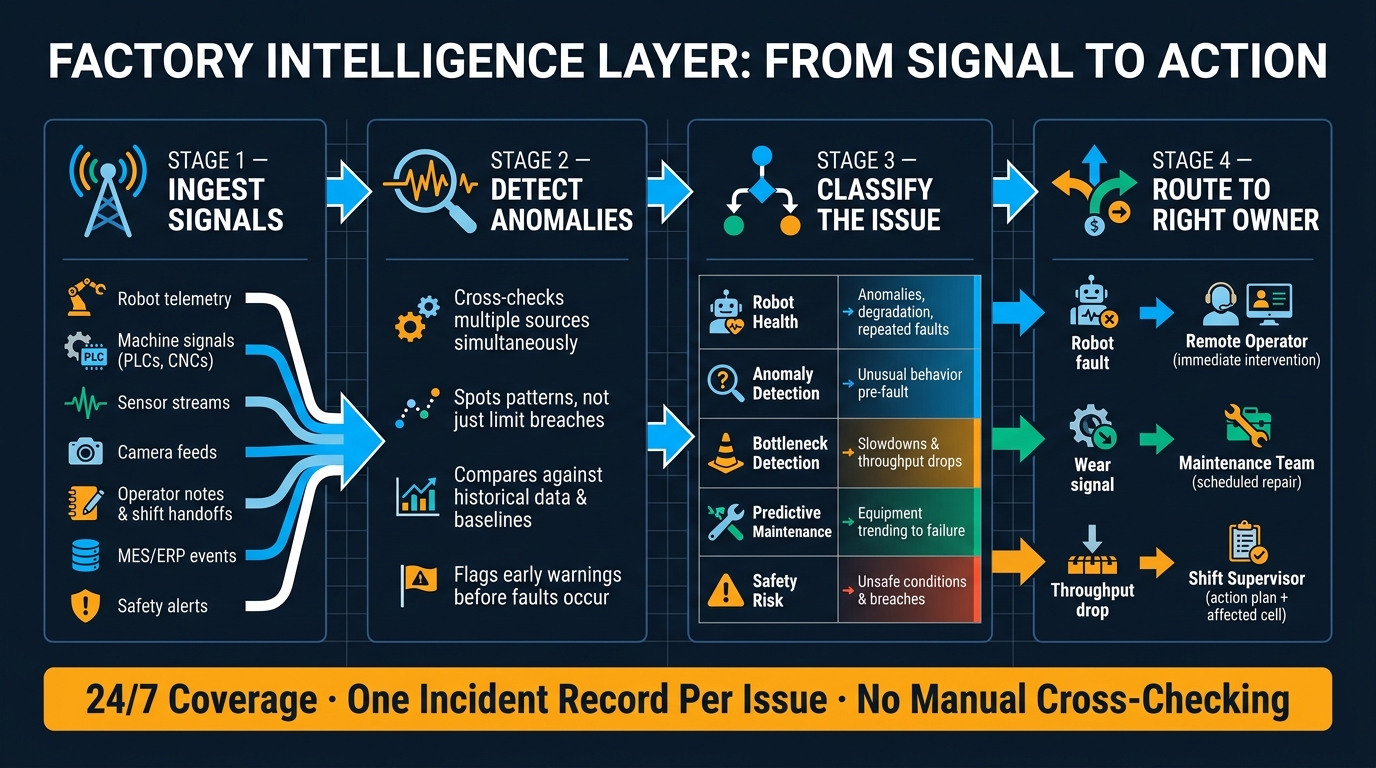
Factory Intelligence Layer: From Signal to Action
Always-on detection across uptime, quality, and flow
The loop is simple: ingest signals, detect anomalies, classify the issue, and send it to the right owner. And unlike a basic alarm, it checks signals across multiple sources before it alerts anyone.
| Capability | Signals Used | What It Detects | Triggered Action |
|---|---|---|---|
| Robot Health Monitoring | Robot telemetry, machine signals, sensor streams | Anomalies, degradation, repeated faults | Routes exceptions to a remote operator or maintenance tech |
| Anomaly Detection | Machine telemetry, operational event streams, historical data | Unusual behavior before a fault or process issue appears | Flags an early warning for reliability review |
| Bottleneck Detection | Throughput data, operational event streams, historical data | Bottlenecks and slowdowns | Sends supervisors a clear action plan |
| Predictive Maintenance | Sensor streams, maintenance logs | Equipment trending toward failure | Schedules maintenance before downtime |
| Safety Risk Classification | Camera feeds, worker reports, safety signals | Unsafe conditions and safety breaches | Routes the issue to safety and logs the incident |
This matters because a single alert, on its own, can be noisy. But when the system looks at telemetry, event streams, logs, and sensor data together, it has a better shot at spotting what’s wrong before people waste time chasing the wrong problem.
From alert to remote operator, maintenance team, or supervisor
Not every issue should land with the same person. If a robot throws an exception in the middle of a task, that can go straight to a remote operator who can step in right away. If a machine starts showing early wear, that can go to the maintenance team early enough to schedule a repair during a planned window. If a line drops below target throughput, that can go to the shift supervisor with the affected cell and time window already attached.
That changes the workflow in a simple but important way. Instead of handing a technician a raw fault code and forcing them to trace the cause from scratch, the intelligence layer sends over a classified issue with the context already attached. The team spends less time decoding and more time fixing.
Each escalation is also tracked as an incident record that stays with the issue until it’s resolved. So when the next shift comes in, they’re not piecing together what happened from scattered notes or half-finished handoffs.
Those incident records then become part of the operating input for the next shift. But this kind of routing only works if the right assets, owners, and response paths are already wired in.
How to put an intelligence layer in place at a real factory
Once the alert-to-action loop is clear, the next move is simple: pick a starting point.
Start with the highest-value assets and workflows
Begin with the assets that drive the most downtime, safety risk, or lost output. Rank them based on downtime risk, safety impact, and business value. Then move first on the assets that score highest across all three.
A tight first rollout across a small set of high-priority assets gives the team a live system to learn from before expanding across the plant. The aim is to get a 24/7 system running first on the assets that matter most.
Build the operating workflow, not just the data pipeline
Data by itself won't fix anything. Every alert needs an owner. Every escalation needs a clear route. Every shift needs a habit for checking what the system flagged. Without that setup, even a factory with strong instrumentation ends up with alerts that sit untouched.
Once the first assets are selected, spell out exactly who responds and what they do next. The rollout should mirror the path the team will follow every day on the floor.
Here’s a simple rollout sequence:
| Phase | Key Inputs | Key Outputs | Responsibility |
|---|---|---|---|
| 1. Asset Prioritization | Downtime logs, safety records, maintenance history | Prioritized asset and workflow map | Operations Manager |
| 2. Baseline Collection | Sensor streams, camera feeds, expert judgment | Reference specs for normal operating state | Lead Engineer |
| 3. Threshold Definition | Historical event data, compliance standards | Actionable alert thresholds per asset | Maintenance Supervisor |
| 4. Workflow Integration | Escalation paths, remote operator access, shift schedules | Live operating workflow with clear ownership | shift supervisor |
| 5. Continuous Refinement | Operator corrections, incident records, shift reviews | Tighter detection logic, fewer false alerts | Floor Team |
Before go-live, write down what “normal” looks like for each asset. If teams skip that step, they usually end up chasing alerts that aren't actual problems. And once that happens, trust in the system can fall apart fast.
This operating workflow is what turns detection into action across shifts. Send robot faults to remote operators. Route early wear signals to maintenance. Push throughput drops to the shift supervisor, along with the affected cell.
Conclusion: one live system for faster decisions on the floor
When rollout is tied to priorities, baselines, and clear ownership, the layer becomes something the floor can use day to day instead of an idea that stays on paper. That’s how raw factory data turns into faster decisions, fewer blind spots, and more reliable operations over time.
FAQs
How is this different from a dashboard?
A dashboard is passive. It shows data and waits for someone to look at it.
The intelligence layer does more than that. It stays on all the time, watching robot telemetry, machine signals, and camera feeds to spot problems and trigger real-time action.
That changes how the factory runs. Instead of depending on manual checks, teams move from reactive monitoring to automated manufacturing intelligence for robot health, predictive maintenance, and visibility into production bottlenecks.
What data does the intelligence layer need?
The intelligence layer needs one shared flow of factory-floor data, including:
- robot telemetry and machine signals
- camera feeds
- worker inputs and operational alerts
When these sources come together, the system gets a steady view of production. That makes it easier to spot anomalies in real time and act before small issues turn into bigger ones.
How do you start without overwhelming the team?
Start with one narrow, high-impact use case in human-in-the-loop mode so the team can review alerts and interventions before expanding.
Set clear goals and success metrics. Then pilot the setup on one line or one shift. Begin by connecting robot telemetry and just one other signal type first. After the team gains confidence in anomaly detection and escalation, add camera feeds and predictive maintenance.