Can You Legally Train on It? A Rights Checklist for Video Training Data

Leela Yanamaddi
November 3, 2026

I don’t treat a video purchase or download as permission to train AI. Before using footage, I check the rights for the exact files, planned use, and outputs - not just whether I can access them.
My checklist covers 5 checks:
- Ownership: Who owns the video, audio, labels, and edited clips?
- License scope: Does the agreement allow training, annotation, cloud processing, and customer sharing?
- People and privacy: Are notices, consent, biometric processing, and retention duties addressed?
- Third-party and site restrictions: Do screens, music, confidential factory details, or facility rules limit use?
- Approval records: Can I link each file to its permissions, restrictions, reviewer, and deletion duties?
I mark footage cleared, restricted, blocked, or in need of legal review. There’s no fixed percentage of a video that is automatically safe to use. My rule is simple: <u>clear the specific use before processing, and recheck when that use changes.</u>
This checklist supports rights review; it isn’t legal advice.
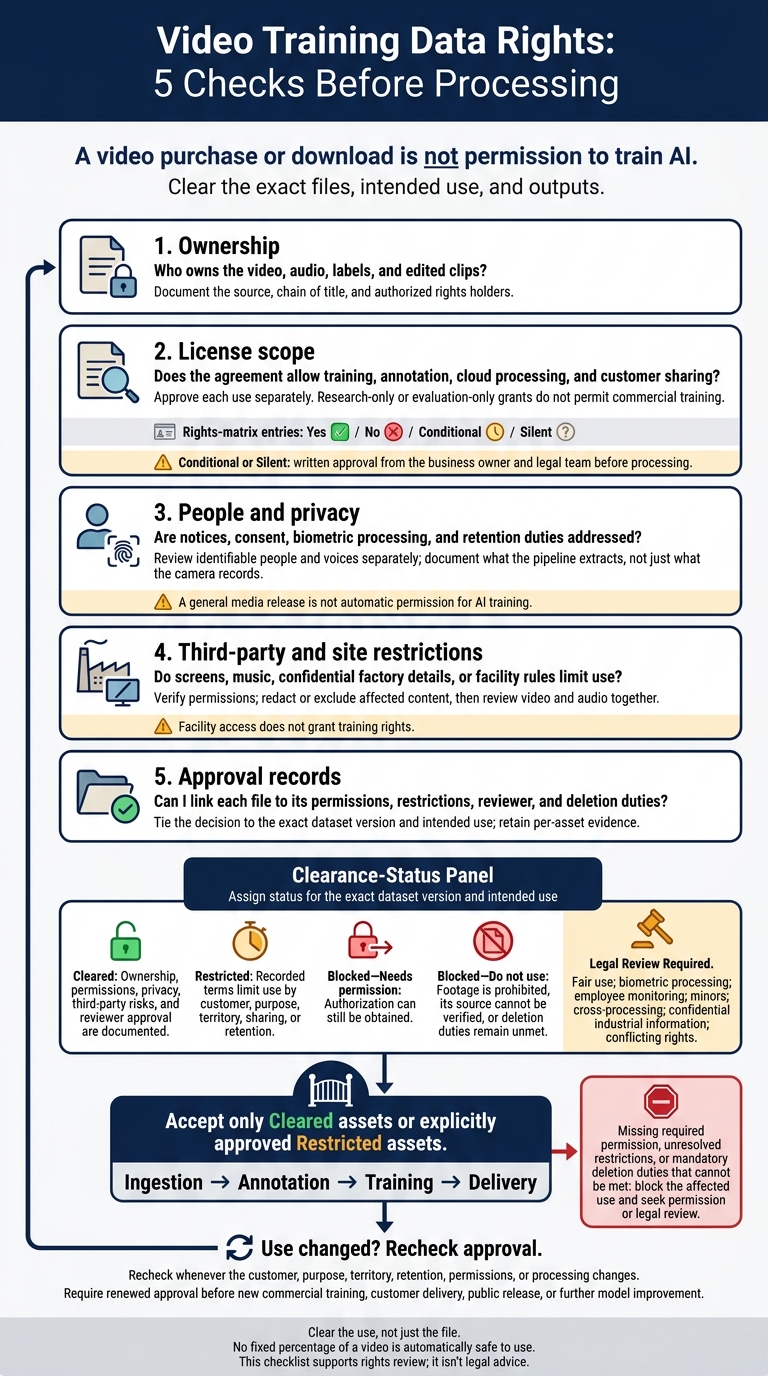
Video Training Data Rights: 5 Checks Before Processing
AI Training Is Copying. Is It Infringement? | Keith Kupferschmid, CEO Copyright Alliance
Check Training, Annotation, and Sharing Rights
Approve each use separately. Research-only or evaluation-only grants do not permit commercial training. Block commercial training until the licensor grants that permission in writing.
Build a Rights Matrix for Each Use
Review each intended use - not just the dataset as a whole. The matrix is a worksheet, not proof of permission.
For every row, record Yes, No, Conditional, or Silent, along with the exact clause, agreement version, and named approval owner. Check that permission covers video, audio, metadata, and labels. Any row marked Silent or Conditional needs written approval from the business owner and legal team before processing.
| Use | Status | Evidence | Restriction | Owner approval |
|---|---|---|---|---|
| Commercial training | Training grant | Approved products and purposes | ||
| Fine-tuning | Model-development scope | Model or project limits | ||
| Evaluation | Evaluation schedule | Testing only; no training | ||
| Validation | Validation scope | Approved models and users | ||
| Continuous improvement | Continued-use grant | Reuse and renewal limits | ||
| Annotation | Labeling and access terms | Vendor access; label ownership | ||
| Cropping and resizing | Modification permission | Retention of edited copies | ||
| Transformation | Blurring, transcoding, and normalization permission | Permitted transformations | ||
| Frame and clip sampling | Extraction permission | Storage and export limits | ||
| Audio-video synchronization | Video and audio grants | Coverage of both media | ||
| Derived datasets | Derivative-use grant | Combining, retaining, exporting | ||
| Cloud hosting and processing | Authorized-processor terms | Regions, security, flow-down duties | ||
| Transfer to vendors or affiliates | Recipient and transfer terms | Named entities and territories | ||
| Customer sharing or delivery | Distribution grant | Videos, frames, labels, embeddings | ||
| Sublicensing | Sublicense grant | Customer reuse rights | ||
| Hosted model or API access | External-service permission | External users; source exposure |
A factory-task video license that allows internal commercial training and evaluation but bars redistribution or sublicensing does not clear customer dataset delivery; frames, annotations, and hosted-model access need separate review.
Record Restrictions and End-of-License Duties
Record limits on resale, publication, demos, benchmarking, model release, and synthetic or derivative outputs. Link each limit to the exact artifact it covers. Also record territory, attribution, notice, confidentiality, audit, expiration, renewal, and termination terms. For annotation vendors and cloud processors, confirm that access is authorized and check all required downstream contract terms.
Turn withdrawal, deletion, and takedown clauses into assigned tasks with contractual deadlines. Map those tasks to originals, caches, backups, frames, annotations, derived datasets, embeddings, checkpoints, and trained models where the agreement requires it.
Use asset IDs to keep withdrawn clips out of future training. Flag whether trained models, checkpoints, embeddings, or derived datasets must be deleted or updated. If a required deletion or takedown cannot be completed, block the affected use and send it for legal review.
Training rights alone do not clear footage containing people, voices, or biometric identifiers. If people or voices are identifiable, move next to consent and privacy review.
Check Consent, Privacy, and Biometric Requirements
Match Notices and Consent to Each Use
Licensed footage can still fail privacy review if its notice or release doesn’t cover training. This matters especially for wearable-camera task demos and factory recordings. A general media release is not automatic permission for AI training. Check that permissions cover collection, recording, training, annotation, evaluation, improvement, access, sharing, cross-border transfers, and retention. Link each notice and acceptance record to the contributor, date, location, source ID, and footage version. Keep the exact language, acceptance method, purpose limits, and withdrawal terms.
Map recording locations, contributors’ jurisdictions, employment status, and processing destinations. Check workplace notices, collective-bargaining duties, voluntary participation rules, and audio-recording laws. State requirements can exceed the federal baseline. Verify required guardian authorization for minors and added safeguards in health or education settings. Block uses that lack required consent; send unclear legal issues to counsel.
The wearer’s consent doesn’t cover identifiable coworkers, visitors, or incidental voices, screens, badges, or conversations. Review other identifiable people separately before ingestion. Where allowed, redact incidental faces, badges, and voices. Quarantine footage when permission is missing or de-identification is uncertain. Being present at work does not establish consent.
If footage includes face, voice, or movement signatures, send it for biometric review before ingestion.
Review Biometric Processing and Deletion Controls
Document what the pipeline extracts - not just what the camera records. Ordinary footage may receive different legal treatment than face templates, voiceprints, gait signatures, persistent person-tracking IDs, or embeddings. Classification depends on the features, purpose, and jurisdiction. Person-level identifiers can make otherwise usable footage off-limits for training or sharing.
Illinois, for instance, regulates voiceprints and scans of face geometry and requires written notice, purpose and duration disclosures, and a written release before collection.
Send biometric, employee-monitoring, minor, and health- or education-setting issues to legal review before processing.
Keep a biometric assessment and retention schedule linked to each contributor and footage version. Record the purpose, data types, processing steps, storage locations, access roles, vendors, security controls, retention period, deletion method, backup handling, and suppression rules. Cover derived representations, not just source video. Don’t promise model-level deletion without a workable method. Block affected uses if mandatory duties cannot be met.
Use NIST’s voluntary AI Risk Management Framework to organize accountability and risk assessments, and FTC materials to assess security, harmful secondary uses, bias, and discrimination. Preserve testing methods and results from conditions closely matching the intended deployment environment and user population. These materials support controls but do not replace applicable law.
Then check whether screens, audio, people, or site rules add another layer of restriction.
Check Third-Party Content and Facility Rules
Review Screens, Audio, People, and Factory Details
Facility access does not grant training rights. For factory recordings and wearable-camera demos, this is the final rights check after ownership, consent, and biometric review. Confirm that site approval covers permitted areas, recording windows, equipment, approved recipients, training uses, retention, and sharing. Link customer permissions, NDAs, licenses, and releases to asset IDs and affected time codes - not just the recording session.
This check addresses site restrictions and third-party rights that consent review alone does not clear.
| Content type | Likely right implicated | Verification record | Mitigation |
|---|---|---|---|
| Screens and software interfaces | Copyright, confidentiality, privacy, trade secrets, contract restrictions | Screen or software owner; facility/customer approval; software terms; access authorization; review log | Crop or blur; remove credentials and personal data; exclude if context still reveals restricted information |
| Documents, labels, and drawings | Copyright, trade secrets, privacy, confidentiality, contract restrictions | Document owner; NDA; customer approval; data-classification review | Blur, crop, or exclude; verify that no readable text remains |
| Artwork and advertisements | Copyright, trademark, publicity, or trade-dress concerns | Owner permission or license covering the intended use | Crop, mask, or exclude |
| Music and television | Copyright and related media rights | Applicable music or broadcast permissions | Mute audio; remove visible television content |
| Background speech | Privacy, recording-consent laws, confidentiality | Speaker authorization; jurisdiction review; facility policy | Mute or exclude affected segments |
| Unreleased people | Privacy, publicity, biometric obligations | Applicable notice, release, or documented legal basis | Mask identifying details or exclude; reassess identification risk |
For factory footage, inventory customer products, prototypes, layouts, restricted processes, safety systems, uniforms, logos, trade dress, serial numbers, dashboards, recipes, and access-control details. Check that inventory against contracts, work orders, NDAs, and site rules.
Get approval from the party authorized to permit the intended training and disclosure. Employee access does not grant authority to approve either use.
Treat recording permissions and patent issues separately. When needed, send planned reproduction, operation, or testing to patent counsel.
If restricted content remains visible after redaction, keep it out of ingestion and send it for review.
Track Redactions and Unresolved Risks
Review redacted video and audio together. Check adjacent frames, reflections, subtitles, thumbnails, and metadata for disclosures that remain. Removing a logo does not clear underlying artwork, product design, confidential processes, personal information, or contract restrictions.
Link each output to its source and transformation record. Include source/output hashes, tool version, operator, review date, time ranges, settings, quality-control result, and approval. Retain originals only when lawful and consistent with contractual retention duties.
Keep unresolved segments out of ingestion. Record the missing permission, responsible owner, and required action. Then obtain approval, exclude the footage, or send it for legal review.
Assign Clearance Status and Keep Review Records
Mark Footage Cleared, Blocked, or for Legal Review
After completing the rights checks above, assign each asset a clearance status tied to the exact dataset version and intended use.
- Cleared: Ownership, permissions, privacy, third-party risks, and reviewer approval are documented.
- Restricted: Recorded terms limit use by customer, purpose, territory, sharing, or retention.
- Blocked - Needs permission: Authorization can still be obtained.
- Blocked - Do not use: Footage is prohibited, its source cannot be verified, or deletion duties remain unmet.
Mark fair use, biometric processing, employee monitoring, minors, cross-border processing, confidential industrial information, and conflicting rights as Legal Review Required.
At processing gates, accept only Cleared assets or explicitly approved Restricted assets. Approval for one issue does not resolve another.
Save Evidence and Recheck Changes in Use
Once you assign a status, keep records that support later audits and reuse decisions. Create a per-asset evidence file that links asset IDs and hashes to the source, version, chain of title, key parties, approvals, and restrictions.
Include the license scope, permitted uses, consent records, privacy and biometric assessments, third-party review, and retention or deletion duties. Record the accountable owner, reviewer, jurisdictions, decision, unresolved issues, and review date.
Require renewed approval before new commercial training, customer delivery, public release, or further model improvement. Recheck approval whenever the customer, purpose, territory, retention, permissions, or processing changes.
Link withdrawal and deletion duties to all affected copies, annotations, derivatives, and training runs. Assess whether applicable law or contracts also require model deletion or update.
Use these records to gate ingestion, annotation, training, and delivery. Earlier approval does not permit a new use.
Conclusion: Clear the Use, Not Just the File
Clear only the documented use. When evidence is missing, seek permission or legal review.
FAQs
Can fair use cover commercial AI training on video?
Fair use is not a blanket right to train commercial AI on video. It depends on the circumstances, and public access does not mean permission to train.
Document explicit rights for your planned commercial uses. Permission for research or evaluation does not automatically cover commercial deployment. Check permissions against records for each source rather than relying on fair use claims.
Who can authorize training on employee-recorded footage?
Confirm both contributor consent and facility approval before recording. Before their first session, each contributor must sign written consent allowing their footage to be used to train, evaluate, and commercially deploy AI models. Get written approval from the facility owner or management that specifies where recording is allowed and what work-related limits apply.
A contributor’s release does not cover coworkers’ privacy or confidential facility material. Document and verify permission for each separately.
What if consent is withdrawn after training?
Immediately restrict access to affected data, and quarantine or remove files without valid consent. Log the withdrawal, action taken, and removal date to support audits. Acknowledge requests within 3 business days and complete removal within 30 days.
Deleting source data does not prove that a model has deleted or unlearned it. Document model removal or retraining as a separate decision. For future training, release a new dataset version that excludes the retracted content.