How to Evaluate a Teleoperation Data Vendor

Leela Yanamaddi
September 26, 2026
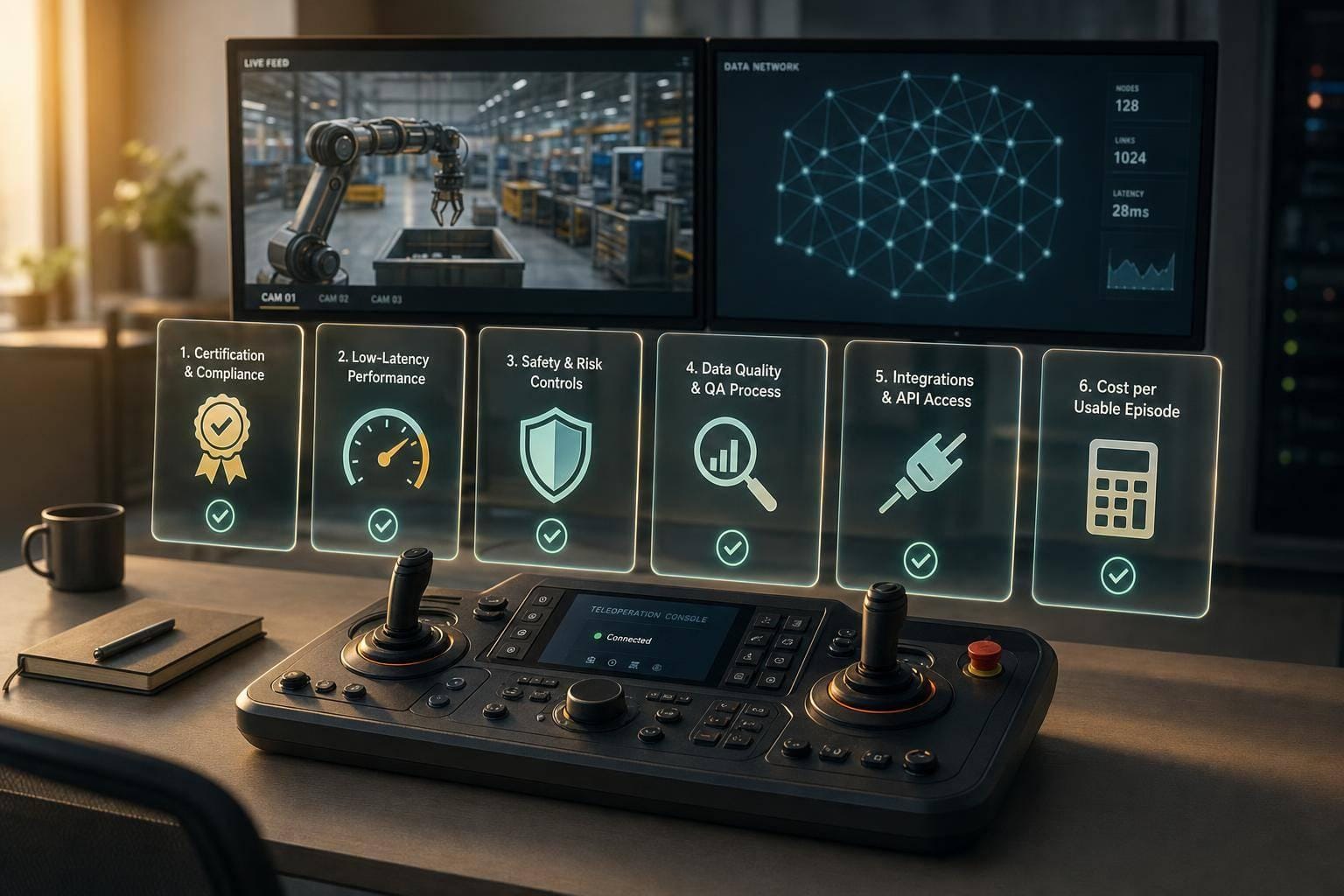
If I were picking a teleoperation data vendor, I’d judge them on five things first: fit for my robots and site, operator quality, latency and safety under bad network conditions, data quality, and total cost per accepted episode. A slick demo is not enough. I’d want proof that the vendor can recover robots, log the full event, label it well, and send data into my ML stack without cleanup.
Here’s the short version:
- I’d define my deployment first: robot model, firmware, sensors, control interface, site, shifts, and network limits.
- I’d separate live recovery from training data needs. Those are related, but not the same.
- I’d ask for proof of operator training, certification, supervision, and performance by task and shift.
- I’d test latency with p50, p95, and worst-case numbers on the same Wi-Fi or cellular setup I’ll use in the field.
- I’d run fault tests with packet loss, jitter, delay, and short outages combined.
- I’d inspect the data export: schema, timestamps, labels, replay support, privacy handling, and audit trail.
- I’d run a paid pilot with written pass/fail gates.
- I’d compare vendors on cost per accepted intervention and cost per usable episode, not just hourly price.
A few numbers stand out. The article notes degraded teleoperation at about 300 ms round-trip delay and near-infeasible control above 700 ms. It also suggests a starting target of 85%+ usable-hour yield and warns that a vendor charging $35 per episode can turn into $70 per accepted episode if only 50% of sessions pass QA.
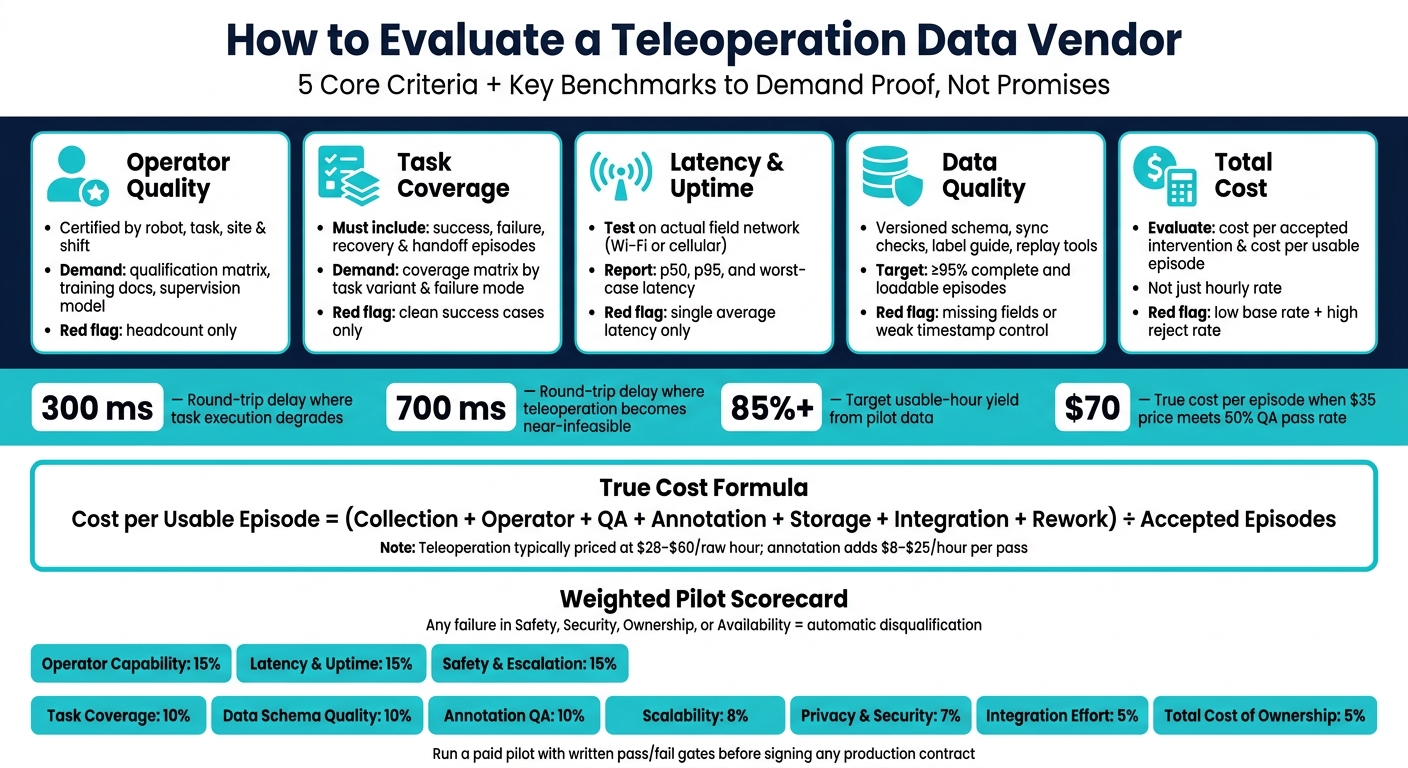
How to Evaluate a Teleoperation Data Vendor: Key Criteria & Benchmarks
Why robotics teleoperation data can't be scraped
Quick comparison
| What I’d check | What I’d ask for | What would worry me |
|---|---|---|
| Deployment fit | Robot, task, site, sensor, and network match | Generic claims with no task-level detail |
| Operators | Certification matrix, training docs, supervision model | Headcount only |
| Task coverage | Success, failure, handoff, and recovery episodes | Clean success cases only |
| Latency and uptime | p50/p95/worst-case metrics, SLA history, fault tests | Average latency only |
| Safety | Safe-state behavior, local e-stop, escalation path | No clear fail-safe mapping |
| Data quality | Versioned schema, sync checks, label guide, replay tools | Missing fields or weak timestamp control |
| Security and privacy | SOC 2/ISO 27001, access logs, deletion flow, PII handling | Paper claims with no test evidence |
| Integration | Export samples, API/webhooks, schema version policy | Manual cleanup needed |
| Cost | Itemized quote in U.S. dollars and usable-episode math | Low base rate, high reject rate |
My takeaway is simple: the right vendor is the one that can prove safe recovery, clean data, and stable delivery under your exact conditions. I’d use that standard from the first call to the pilot decision.
How to Evaluate Operator Quality and Task Coverage
Vendor sales decks love to lead with operator headcount. But that number, by itself, doesn't tell you much.
What counts is the number of operators certified for your robot, your task, your site, and your operating limits. That distinction matters. When operator qualification is weak, both robot recovery and training data get worse. You end up with poorer recovery behavior, noisier labels, and training data that does less for the model.
Review operator screening, training, and supervision
Ask for an operator qualification matrix. It should map each operator, or each operator cohort, to robot types, control interfaces, task families, site conditions, approved operating limits, languages supported, training completion, certification dates, recertification dates, and recent metrics like success rate, recovery rate, aborts, collisions, and escalations.
A vendor should also be able to show how operators are screened and qualified before they collect production data. Ask for the full screening and certification process, including:
- Recruiting criteria
- Identity and background checks, where legally appropriate
- Simulator screening
- Classroom or written safety training
- Supervised robot sessions
- Certification thresholds
- Ongoing coaching
- Recertification triggers
You should also ask for sample training materials, evaluation rubrics, and anonymized pass-rate data. Training needs to match the actual job: the robot, end effector, interface, site, and task. Recertification should happen after extended inactivity, major robot or interface changes, repeated quality failures, safety incidents, or assignment to a new task family.
Supervision matters just as much. Ask who supervises operators, how many operators each supervisor supports, which events need immediate review, and whether supervision is continuous or sampled. Supervision ratios should match task complexity, risk, autonomy level, and site conditions. A low-risk repetitive task may allow one supervisor to cover more operators. But mobile robots working near people, or manipulation tasks involving fragile or hazardous objects, may need dedicated oversight.
The vendor should also name a clear escalation owner for technical failures, unsafe conditions, ambiguous instructions, communication loss, and suspected operator error. Just as important, they should explain how supervisor findings feed back into retraining or suspension.
Check coverage across successful, failed, and recovery episodes
Clean success cases alone won't give you a useful training dataset. If a vendor only records smooth, completed tasks, they're leaving out the moments that matter most in deployment.
The dataset you want should include successful episodes, failed attempts, recovery actions, autonomy handoffs, interrupted runs, and safety-related exceptions.
Don't accept a dataset described only by session count or operator count. Ask for a coverage matrix that spans task variants, object shapes and materials, payloads, lighting, floor and shelf layouts, camera viewpoints, robot configurations, site conditions, shift times, and levels of autonomy.
You should also ask for sample intervention logs and session replays that show the full episode timeline:
- The initial robot or policy state
- The task objective
- The autonomy action
- What triggered the intervention
- The operator action
- Recovery steps or resets
- The final outcome
- The reason for termination
Each episode should be labeled as nominal success, success after intervention, failed attempt, safely aborted, or required human recovery. The dataset should also identify the failure mode, such as perception error, grasp failure, collision risk, localization loss, occlusion, object variation, or operator uncertainty.
Ask whether the vendor keeps pre-intervention context and sensor data. An isolated corrective motion, without the lead-up, is hard to interpret and hard to train on.
Recovery trajectories matter a lot because they show how errors get corrected, not just how ideal behavior looks. Put extra weight on tagged recovery episodes; in some training setups, fewer failures add more value than extra clean successes.
To check consistency, ask for inter-operator agreement and repeatability results from a controlled benchmark where multiple qualified operators perform the same task under comparable conditions. Useful metrics include task success rate, completion time, intervention count, trajectory smoothness, force or velocity violations, waypoint or subtask completion, recovery success, and variance in action sequences.
Ask for results broken down by operator, task variant, site, robot, and shift. Otherwise, averages can hide weak performers or hard conditions. A trajectory consistency coefficient of variation below 0.15 on calibration tasks signals consistency, while values above 0.30 suggest drift. These are operational heuristics, not universal standards.
| Evaluation Dimension | Weak Evidence | Strong Evidence |
|---|---|---|
| Operator scale | Total number of available operators | Qualified operators by task, site, robot, language, and shift |
| Training rigor | Completion certificates | Sample training materials, evaluation rubrics, and anonymized pass-rate data |
| Supervision | Generic staffing ratio | Documented supervision model with task-based coverage and named escalation owner |
| Episode coverage | Raw session count | Coverage matrix by task variant, outcome type, and failure mode |
| Consistency | Self-reported consistency | Benchmark results by operator, task, site, robot, and shift |
Once operator quality and episode coverage pass, test whether the vendor can maintain that level under live latency, uptime, and safety constraints.
How to Test Latency, Uptime, and Safety Under Real Conditions
Test performance on the actual network your robots will use, not a polished office demo. That means peak-hour Wi-Fi or cellular, with the same bandwidth the robot will have in the field. If the network changes the quality of intervention data, it also changes whether that data is useful for incident review, labeling, and model training. So you need to test both live performance and fail-safe behavior under the conditions you plan to deploy.
Focus on metrics that show what the operator and robot will feel in practice:
- Camera-to-screen latency
- Command round-trip latency
- Jitter
- Packet loss
- Time to first response
- Time to recovery
For each one, report p50, p95, and worst case. A single average can look fine while short spikes make the system hard to use.
A 2026 review reports degraded task execution at about 300 ms of round-trip delay and near-infeasible teleoperation above 700 ms. Use those figures as context, not acceptance criteria.
You should also run fault-injection tests. Slow the bandwidth. Add 1–5% packet loss. Introduce variable delay. Simulate a short network drop. And don't test these one at a time. Stack them together, because that's how bad network conditions often show up in the field: 150 ms added latency, 30 ms jitter, and a 10-second outage at the same time.
For uptime and service history, ask for at least 6 to 12 months of SLA reports. Those reports should include monthly availability, incident count, mean time to detect, mean time to recover, and service-credit history. An uptime target in a contract doesn't tell you much by itself. The postmortems behind the incidents tell you what the service is like when things go sideways.
Once latency tests clear the bar, move to fail-safe behavior. Safety can't depend on the remote operator being present, alert, or connected. The robot, or a local safety controller, should move into a defined safe state after a heartbeat timeout. It should also have a local, non-networked emergency stop.
Ask the vendor to tie each failure mode to a specific robot behavior. For example, video loss should pause teleoperation. Command-channel loss should stop motion. Stale commands should be dropped. Reconnection should require explicit operator reauthorization. Power restoration should not restart motion on its own.
Then ask for a synchronized session replay that includes camera views, operator input, command acknowledgments, network latency, safety events, and escalations. Review at least these cases:
- One successful intervention
- One failed intervention
- One degraded-network event
- One escalation
Those synchronized logs are the source record for incident review, labeling, and model training. If the replay can't separate operator delay from network delay or a safety interlock, the vendor's logging isn't good enough.
Use these artifacts to check that the results can be repeated, not just staged for a demo.
| Evidence to Request | What It Reveals | Red Flag |
|---|---|---|
| p50, p95, and worst-case latency by metric type | Whether performance holds under real load | Only a single average is provided |
| Fault-injection test results | Robot behavior under degraded network | Tests run only on ideal connections |
| 6–12 months of SLA incident reports | Actual reliability vs. contractual targets | Only uptime percentage is provided |
| Control-authority matrix | Which actions operators can and cannot take | No documented limits or enforcement method |
| Synchronized session replay with safety events | Whether logs support incident investigation | Replay does not synchronize camera, command, and safety data |
How to Audit Data Capture, QA, Compliance, and Integration
Once latency and safety checks pass, the next step is simpler: can you actually use the data? A vendor might have strong uptime and fast operators and still deliver recordings with missing fields, drift between streams, or exports that are a pain to load into your training stack. That’s why you should audit the data contract before you look at volume. If the files aren’t dependable, both training and incident review fall apart.
Verify schema, annotation process, and per-episode quality checks
Ask for a versioned schema document, not just a file format label. You need a full data dictionary that defines each field: name, data type, unit, coordinate frame, sampling rate, null behavior, and clock source. At a minimum, every episode should include synchronized video, calibration, robot state, operator commands, intervention metadata, outcomes, safety events, IDs, and the schema version. Without full schema coverage, a dataset can still be unusable for training or transfer.
For export, the vendor should support at least one documented format with clear field semantics and conversion rules. A format name by itself doesn’t prove interoperability.
You’ll also want task-specific sync limits. If episodes drift past those limits, reject them. Ask the vendor to show that dropped frames, timestamp drift, and partial episodes are caught automatically instead of turning into ugly surprises after ingestion.
For annotation, request the written guideline, the label taxonomy, and a sample set of raw episodes paired with labeled outputs. The workflow should spell out episode boundaries, outcome labels, failure categories, recovery labels, and intervention details. The main question is whether labels are reproducible, reviewable, and traceable. Ask how reviewer disagreements get resolved, and whether the system keeps both the original and corrected labels. Every correction should log the old value, new value, reviewer, timestamp, reason, and tool version.
| Criterion | Evidence to Request | Acceptance Test | Failure Consequence |
|---|---|---|---|
| Completeness | Field inventory and episode manifest | Required streams present; missingness below agreed threshold | Reject or classify episode as incomplete |
| Synchronization | Clock spec, timestamp samples, calibration procedure | Cross-stream skew within task-specific tolerance | Exclude from training or require reprocessing |
| Integrity | Checksums, file manifests, transfer logs | Files open, hashes match, no corrupted chunks | Re-download or reject episode |
| Label correctness | Annotation guide and reviewer records | Labels match replayed behavior; inter-reviewer agreement meets target | Return for correction |
| Provenance | Immutable episode ID and audit trail | Every derivative file maps to source episode, annotator, tool version, and transformation | Block release until lineage is restored |
| Replayability | Playback command or SDK | Buyer can reconstruct episode in a test environment | Treat as non-interoperable |
| Privacy filtering | Redaction policy and scan results | Faces, voices, screens, credentials, and other sensitive content are handled as contracted | Quarantine data pending remediation |
Review privacy, security, and production integration requirements
Once QA clears, lock down ownership, retention, and access.
Data ownership terms should be explicit. The contract should treat raw recordings, annotations, derived datasets, embeddings, and any vendor-built tooling as separate items. It should also say, in plain terms, whether the vendor can reuse your demonstrations for other customers. Get direct answers on retention periods, deletion propagation to backups and subprocessors, and the form of deletion certificate you’ll receive.
For U.S. deployments, document how the vendor finds and handles PII in video, including faces, voices, badges, license plates, and computer screens that show up in the robot’s camera feed. Consent and notice rules for operators and bystanders need to be written down, not left to guesswork.
On security, ask for a current SOC 2 report or ISO/IEC 27001 certificate, plus the vendor’s encryption standards for data in transit and at rest, role-based access controls, and immutable audit logs for downloads, label changes, and permission changes. Then push past the paperwork. Ask them to export access logs, revoke a test account, and produce the audit trail for a label correction. A certificate alone won’t tell you if the controls work in practice.
After that, check whether the vendor can move clean episodes into your ML pipeline without manual cleanup.
For integration, ask for architecture diagrams and working examples that show the full path from robot intervention to a usable dataset. That includes API documentation with command and state payloads, webhook specs for intervention start and end, safety events, upload completion, and episode rejection, along with storage choices like customer-owned S3-compatible buckets with region selection. For ML pipelines, ask for dataset manifests, train/validation/test split metadata, checksums, and SDK support for your target format.
That export path should work for both incident review and model training. Also pin down the schema-change policy: which changes are backward compatible, how much notice you get before a breaking change, and whether version pinning is allowed. A silent unit switch, like a position field moving from millimeters to meters, can wreck a training run without throwing any clear error.
Run a Paid Pilot and Score the Vendor Against Clear Decision Criteria
Once a vendor clears the paper review, the next step is simple: test the claims in a paid pilot under production-like conditions.
Put the pilot terms in writing before anything starts. Spell out the robots, tasks, acceptance thresholds, and exit criteria. That keeps the pilot from drifting into a polished demo where everything looks good for an hour but falls apart in normal use.
Set pilot metrics, acceptance thresholds, and total cost inputs
Track four areas: operations, data quality, delivery, and cost.
Operations should cover intervention success rate, recovery rate, response time from request to acknowledgment, and end-to-end latency at p50 and p95. Latency limits depend on the job. Dexterous manipulation usually needs p95 below 80 ms, while simpler tabletop tasks may have room up to 150 ms.
Data quality should include episode completeness, metadata completeness, timestamp synchronization, frame-drop rate, annotation accuracy, inter-rater agreement, and usable-hour yield. A good starting target is at least 85% usable-hour yield, then adjust based on task difficulty and model needs.
Delivery should measure on-time batch delivery and schema-validation pass rate.
After performance and data quality, look at unit economics.
Cost should focus on cost per accepted intervention and cost per usable episode, not just the hourly operator rate.
Teleoperation is often priced at $28–$60 per raw hour, and annotation may add $8–$25 per hour per pass. That means a price that looks cheap on the surface can get expensive fast. If a vendor charges $35 per episode but only 50% of episodes meet your acceptance bar, the actual cost becomes $70 per accepted episode before annotation and integration.
Ask for an itemized quote in U.S. dollars that breaks out:
- operator labor
- session fees
- supervision
- storage
- annotation
- API access
- rework charges
Then model at least three cases: expected volume, a slow ramp, and peak fleet demand.
Use the formula: cost per usable episode = (collection + operator + QA + annotation + storage + integration + rework) ÷ accepted episodes. This prevents a low hourly rate from masking poor yield or expensive rework.
Use a weighted scorecard and close with an evidence checklist
Build the scorecard before you watch any vendor demos. Otherwise, it’s too easy to grade on vibes.
The pilot should verify the same five claims: operator quality, task coverage, latency, safety, and usable data. Score each category on a 1–5 scale, then multiply by its weight. If a vendor fails any gate tied to safety, security, ownership, or availability, they should not move forward.
Use the same categories you already reviewed - operators, task coverage, latency, safety, data QA, and integration - but only score what the pilot actually proves.
| Evaluation Category | Weight | Required Evidence | Pilot Metric | Decision Threshold |
|---|---|---|---|---|
| Operator capability | 15% | Session replays, operator consistency results | Success rate, recovery rate, operator-to-operator variance | Meets task-specific success and recovery targets |
| Task coverage | 10% | Failed and recovery episodes, edge-case samples | Coverage of required task and failure classes | 100% of critical task classes represented |
| Latency and uptime | 15% | Monitoring dashboard, incident history | p50/p95 latency, availability | Meets task-specific latency and uptime gates |
| Safety and escalation | 15% | Escalation tree, incident examples | Response time, correct escalation, unresolved critical incidents | Zero unresolved critical safety incidents |
| Data schema quality | 10% | Example payloads, export test results | Completeness, synchronization, export success | At least 95% complete and loadable episodes |
| Annotation QA | 10% | Accepted, rejected, and borderline episodes with rejection reasons, audit samples | Accuracy, inter-rater agreement, rework rate | Meets agreed audit accuracy and rework limit |
| Scalability | 8% | Throughput and queue-time results by site | Throughput, queue time, performance by site | Supports forecast volume without material degradation |
| Privacy and security | 7% | Access-control audit, deletion-test result | Exceptions, audit findings, deletion-test result | No unresolved critical security or privacy gap |
| Integration effort | 5% | Export proof, time to first usable batch | Engineering hours, defects, time to first usable batch | Within agreed integration budget and schedule |
| Total cost of ownership | 5% | Itemized U.S.-dollar quote and assumptions | Cost per accepted intervention and usable episode | Within approved unit-cost range |
Use the pilot to collect the proof you need for a production decision. Before signing a production agreement, gather timestamped intervention requests, acknowledgments, control start and stop times, robot state, operator ID, task ID, and outcome. You’ll also want teleoperation session replays with synchronized video, commands, sensor data, and event markers.
From there, make sure the vendor can provide SLA reports with p50/p95 latency, uptime, incidents, and restoration times; accepted, rejected, and borderline episodes with rejection reasons; annotation guidelines, audit reports, and rework statistics; data-schema documentation, example payloads, versioning policy, and export procedures; plus security material covering access-control details, encryption standards, incident-response planning, and independent assessment results.
If a vendor can’t produce any item on that list, treat it as an unresolved risk before signing a production contract.
FAQs
How long should a paid pilot run?
A paid pilot should run for 30 to 90 days. That’s usually enough time for the team to set up an end-to-end loop and see what changes in the numbers.
Track results that matter, such as:
- decision latency
- overall equipment effectiveness
- defect reduction
- mean time to repair or detect
Keep the pilot tight. Pick one clear, measurable process so it’s easy to see whether it worked.
Which metrics matter most for my use case?
Prioritize the metrics that have the biggest effect on throughput and model training quality.
Start with downtime. Look closely at the source of each stop, especially how often micro-stops happen and how long they last. Then track time to resolution and note whether recovery required on-site help or could be handled through remote teleoperation.
For data quality, each session should log:
- reason codes
- failure clips
- escalation paths
It also helps to track decision latency, OEE, and MTTR. Those numbers make it much easier to see whether the vendor is helping you hit production targets or slowing things down.
What should be in a data export?
A good data export should include a structured, context-rich record of every intervention. That means teleoperation traces, failure clips, and multimodal data such as egocentric video, wearable-device recordings, and sensor streams.
Each session should also log approval, rejection, override, and correction actions. On top of that, it needs a reason code, synchronized timestamps, standardized event or downtime codes, and metadata linked to machine states, work orders, and shift details.