How AI Turns Equipment Data into Predictive Maintenance

Leela Yanamaddi
August 8, 2026
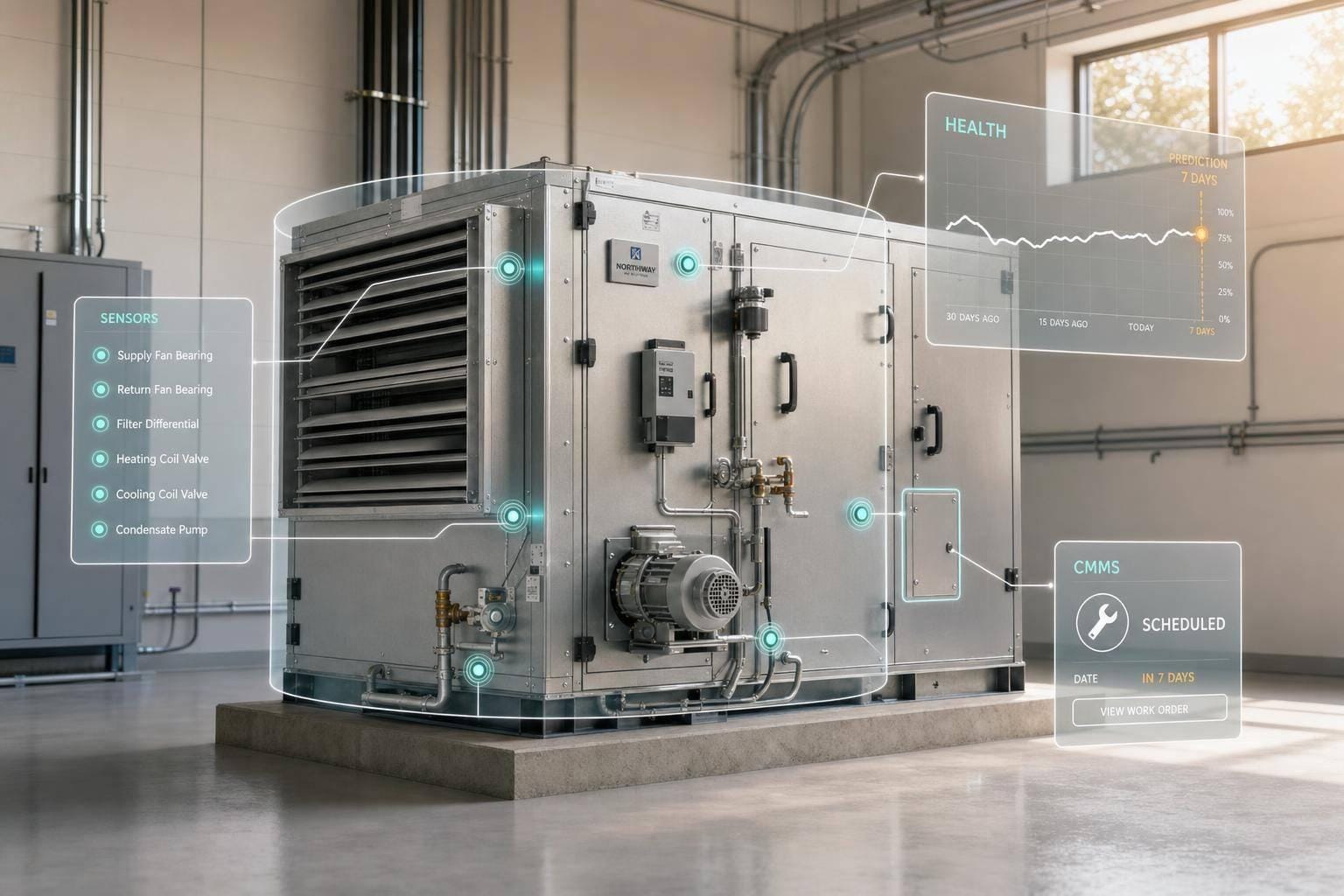
How AI Turns Equipment Data Into Predictive Maintenance Intelligence
Most maintenance organizations do not struggle because they lack effort. They struggle because they are trapped in the wrong operating model.
When teams spend their days reacting to breakdowns, chasing alarms, and dispatching technicians based on calendar schedules rather than real equipment behavior, maintenance becomes expensive, stressful, and hard to improve. The webinar How AI Turns Equipment Data into Predictive Maintenance focused on how facilities teams can move beyond that reactive cycle by using equipment data, analytics, and AI to make maintenance more timely and more strategic.
The most useful insight from the session is this: predictive maintenance is not a feature you switch on. It is a maturity journey. Organizations must first create trustworthy data, structured workflows, and clear operating priorities before AI can deliver reliable maintenance intelligence.
For Evlo.ai’s audience - teams building or operating Physical AI systems - this matters well beyond commercial buildings. The same principles apply to robot fleets, warehouse systems, industrial assets, and sensor-rich environments. The core challenge is universal: how do you convert raw operational signals into decisions that reduce downtime and improve asset performance?
Key Takeaways
- Predictive maintenance starts with maintenance discipline, not with AI. If work tracking, asset records, and preventive routines are weak, advanced models will underperform.
- Condition-based maintenance is often the most important leap because it shifts teams from calendar-driven work to maintenance triggered by actual equipment conditions.
- Not every alert should become a work order. Signal filtering, fault logic, and asset criticality are essential to prevent alarm overload.
- A centralized data layer matters when organizations operate multiple building, asset, or control systems across sites.
- Operational context is as important as telemetry. Occupancy patterns, site usage, equipment role, and business impact determine what data actually means.
- Predictive models need clean, structured data plus relationships between assets, spaces, schedules, and use cases.
- Generative AI should interpret and summarize, not replace physics or analytics. Statistical and rule-based models should detect issues; GenAI can help prioritize and explain them.
- Start where value is easiest to prove: life safety, compliance, operational continuity, high-cost assets, and recurring failure points.
- Measure progress with practical metrics, such as reactive vs. planned work, downtime, failure rates, and mean time between failures.
- People, process, and tools must evolve together. Technology alone will not move an organization out of firefighting mode.
Why Predictive Maintenance Is Really an Operations Strategy
A common mistake in AI discussions is to frame predictive maintenance as primarily a technology topic. The webinar did a good job showing that it is actually an operations transformation topic.
Most organizations sit somewhere on a spectrum:
- Corrective maintenance: fix it after it breaks
- Preventive maintenance: service it on a schedule
- Condition-based maintenance: act when equipment condition indicates a need
- Predictive maintenance: anticipate likely failure before the condition becomes critical
That hierarchy is well known. What is often underappreciated is that each stage changes not only the timing of maintenance, but also the economics of the operation.
In corrective mode, costs are volatile. Labor is rushed, parts are often expedited, downtime is harder to contain, and safety or continuity risk can rise quickly. Preventive maintenance improves planning, but it can still lead to over-servicing healthy assets and missing hidden degradation between scheduled checks. Condition-based and predictive maintenance aim to solve both problems by aligning interventions with actual risk.
For industrial enterprises, robotics operators, and warehouse teams, this same progression shows up in different language. A robot fleet operator might call it exception handling. A manufacturer might call it reliability engineering. A Physical AI team might call it closed-loop operational learning. But the question is the same: how early can you detect drift, and how confidently can you act on it?
The Real Foundation: Work Tracking, Asset Data, and Priorities
Before organizations talk about AI models, they need to answer a simpler question: what work are we actually doing, and why?
The webinar stressed the importance of foundational maintenance data, including:
- Asset lists
- Work histories
- Categorization of work
- Reasons for service
- Preventive maintenance schedules
- Staff workflows
- Compliance requirements
This may sound basic, but it is where many predictive maintenance efforts quietly fail. If a site cannot distinguish between user error, recurring failure, inspection work, cosmetic issues, and safety-related repairs, then any model trained on that history will inherit those ambiguities.
For Evlo.ai-relevant environments, the same lesson applies to robots and industrial systems. If a fleet event log does not distinguish between autonomy failure, human override, environmental obstruction, battery anomaly, and network interruption, then downstream intelligence becomes noisy. Structured labels are not administrative overhead; they are the substrate for useful AI.
The speakers also emphasized prioritization. Not every asset deserves the same maturity level on day one. A sensible order of operations is:
1. Life safety
Assets tied to occupant protection, hazardous environments, or critical shutdowns should come first.
2. Legal and compliance requirements
Any failure that creates regulatory exposure belongs near the top of the list.
3. Operational continuity
Focus next on equipment whose failure disrupts production, service delivery, or business function.
4. Chronic pain points
Recurring issues, even if not mission-critical, often produce fast ROI because they consume disproportionate labor.
That sequence is highly transferable to manufacturing and robotics. For example, a warehouse may prioritize safety interlocks and charging systems before optimizing lower-impact subsystems. A humanoid robotics company may focus first on actuators, manipulators, or sensors that frequently trigger human intervention.
The Biggest Leap: From Preventive to Condition-Based Maintenance
One of the clearest arguments in the webinar was that the move from preventive maintenance to condition-based maintenance is often the hardest and most important transition.
Calendar-based maintenance is relatively simple. Teams define recurring tasks and assign them on fixed intervals. It provides consistency, but not necessarily precision.
Condition-based maintenance introduces a different discipline. Instead of asking, "Is it the third Thursday?" teams ask, "Is this asset showing evidence that service is needed?"
That requires several new capabilities:
- Sensors or control system data
- Inspection records or meter readings
- Threshold definitions
- Rules for exception handling
- Training so staff can interpret signals correctly
The webinar described a higher education example where annual manual inspections of terminal boxes were reduced by using control system data to verify whether dampers and valves were functioning properly. The deeper lesson is not the specific building example. It is the concept of exception-based maintenance: stop spending equal labor on all assets when data can identify the subset that actually needs attention.
For warehouse operators and robotics teams, this principle is powerful. If every robot or subsystem receives the same manual inspection cadence regardless of stress, usage, or anomaly history, maintenance labor scales poorly. A condition-based approach can direct technicians to the machines showing thermal drift, abnormal current draw, repeated task retries, or unusual vibration signatures.
In other words, condition-based maintenance is where data begins to save labor, not just record activity.
Alarm Noise vs. True Maintenance Intelligence
A strong section of the webinar distinguished basic alarms from richer fault detection and diagnostics.
That distinction matters because many facilities and industrial teams mistake "having alerts" for "having intelligence." They are not the same.
Alarms
Traditional alarms are threshold-based and binary. A value crosses a limit, and the system generates an alert.
Strengths:
- Fast
- Familiar
- Useful for urgent conditions
Weaknesses:
- Often noisy
- Poor at expressing context
- May trigger repeatedly for the same underlying issue
Fault detection and diagnostics
Fault logic looks for patterns, anomalies, or relationships across multiple conditions. Rather than simply flagging a limit breach, it identifies operational deficiencies, drift, or emerging problems.
Strengths:
- More nuanced than threshold alarms
- Better at surfacing early-stage inefficiencies
- Can detect hidden issues before hard failures occur
Weaknesses:
- Requires cleaner data and stronger configuration
- Needs interpretation and prioritization
- Can still overwhelm teams if not operationalized well
The webinar cited a useful rule of thumb from field experience: only a small fraction of alarms are truly worth turning into work orders. Whether the exact percentage varies by environment, the operational point stands: unfiltered alerts create a false sense of visibility while burying teams in noise.
This is directly relevant to Physical AI operations. Robot fleets, industrial IoT systems, and autonomous equipment also generate alert storms. Without ranking by asset criticality, recurrence, dependency, and business impact, operators become desensitized. AI does not fix that automatically. In many cases, it amplifies the problem unless there is a clear event ontology and escalation logic.
Why Context Matters More Than Raw Data
One of the best insights from the discussion was that telemetry alone is not enough. Maintenance intelligence depends on operational context.
A conference room with low average occupancy might look underutilized in the data. But if people briefly use it to avoid disturbing nearby coworkers, the room may be serving a real function that simplistic metrics miss. The broader message is that data without site knowledge can mislead.
The same is true for assets:
- A camera offline may be minor in one location and critical in another
- An exhaust fan failure may be routine in one setting and high-risk in a lab
- Occupancy changes may justify different HVAC schedules
- Equipment run hours mean different things depending on climate, building use, and workload
For AI labs, manufacturers, and robotics operators, this is especially important. A motor running hotter than normal is not inherently a maintenance emergency. It becomes meaningful only when paired with context like task intensity, ambient conditions, duty cycle, shift pattern, or production schedule.
This is why data models and ontologies matter. The webinar referenced schemas and standards such as Brick, Project Haystack, and ASHRAE 223P as ways to structure relationships between assets, spaces, schedules, and systems. Even if organizations do not adopt those exact standards, the underlying need is clear: AI performs better when equipment data is connected to the real-world role of that equipment.
Predictive Maintenance Requires a Common Data Layer
Another practical point from the session: many organizations already operate multiple building or control systems across their portfolios. The issue is not lack of data. It is fragmentation.
To move toward predictive maintenance, teams often need an independent, centralized data layer that can ingest signals from:
- Building management systems
- IoT sensors
- Meters
- Maintenance systems
- IT systems
- Possibly HR, finance, or occupancy systems
The terminology may differ across industries, but the architecture is familiar. In robotics and manufacturing, this may take the form of a unified telemetry backbone, operations data platform, or digital thread. The purpose is the same: create a trusted place where data can be normalized, joined, and analyzed across assets and sites.
This matters for two reasons.
1. Prediction needs history
Models require historical trends, not just live snapshots.
2. Decisions need integration
If an insight cannot connect to workflows - such as a CMMS, ticketing system, or teleoperation interface - it remains an observation instead of an intervention.
The webinar’s answer to a common question was practical: organizations do not necessarily need entirely new infrastructure. Existing systems can often be used if data can be extracted through open protocols and integrated into a common layer. For many enterprises, this is encouraging because it shifts the challenge from wholesale replacement to interoperability.
What Predictive Maintenance Adds Beyond Condition-Based Maintenance
Condition-based maintenance tells you something is happening. Predictive maintenance aims to tell you what is likely to happen next.
That is a subtle but important shift.
In condition-based maintenance, an alert might fire once a threshold is crossed or a fault pattern is detected. In predictive maintenance, the model estimates that a bearing, tube, valve, or component is likely to fail within a future window based on usage history, failure patterns, and operating conditions.
The webinar gave the example of chiller modeling using warranty data, historical failures, climate context, and run hours to estimate component failure windows and useful life. Whether applied to chillers, conveyors, AMRs, robotic arms, or pumps, the logic is the same:
- Aggregate failure history
- Normalize equipment usage
- Adjust for environmental and operating context
- Identify statistical precursors
- Forecast probable failure timing
- Turn that forecast into scheduled action
The practical value is not just fewer surprises. It is better coordination. Teams can schedule maintenance during lower-impact periods, combine labor with other service tasks, align parts procurement, and reduce emergency vendor dependency.
For Physical AI systems, predictive maintenance has another advantage: it can become part of a broader autonomy stack. When a robot system can anticipate likely degradation, it can adjust task allocation, route around weak components, or escalate human oversight before a breakdown interrupts operations.
The Emerging Role of AI: Pattern Recognition, Explanation, and Action
The webinar made an important distinction between different types of AI.
Predictive or machine learning models
Best for:
- Pattern recognition
- Forecasting
- Statistical estimation
- Failure likelihood analysis
Generative AI
Best for:
- Summarization
- Interpretation
- Converting technical output into usable language
- Drafting recommendations or reports
Agentic AI
Emerging role:
- Coordinating across tools and workflows
- Opening work orders
- Producing reports
- Triggering supervised actions
This framework is useful because it avoids a common mistake: asking generative AI to do jobs it is not well suited for. As the speakers noted, language models should not be the core engine for physics-based prediction or mathematical reliability modeling. They are stronger when paired with structured analytics and used to explain, prioritize, and operationalize results.
That is especially relevant for enterprise robotics and industrial AI. A large language model should not invent root causes from raw telemetry. But it can help an operator understand what a proven anomaly detector found, why it matters, which assets are affected, and what maintenance manual or SOP is most relevant.
The best architecture is often layered:
- Sensors and system telemetry create raw signals
- Rule-based or statistical models detect meaningful issues
- Context models connect the issue to asset function and criticality
- Generative AI translates results into human-ready recommendations
- Workflow systems route the right action to the right team
That is far more robust than a chatbot sitting on top of unstructured equipment data.
From Monitoring to Conditional Autonomy
One of the more forward-looking ideas in the session was the move from passive monitoring toward supervised system action.
The example used occupancy-aware cooling adjustments: instead of waiting for complaints and then manually overriding settings, an AI layer can recognize abnormal occupancy, adjust pre-cooling, and then dynamically return systems to normal schedules later. The maintenance benefit is indirect but meaningful: assets avoid unnecessary run hours, which supports longer life and lower wear.
For Evlo.ai’s audience, this idea maps neatly to conditional autonomy in physical operations. A smart system does not just report state. It helps decide or act within approved bounds.
Examples outside building HVAC might include:
- A robot fleet slowing or reassigning tasks when a component shows likely degradation
- A warehouse system scheduling inspections in underutilized zones based on usage forecasts
- A manufacturing environment adjusting machine duty cycles to avoid compounding failure risk
- A teleoperation layer escalating only when confidence drops below defined thresholds
The article-worthy insight here is that predictive maintenance and operational autonomy are converging. The better a system can predict failure risk, the more intelligently it can adapt operations before failure occurs.
How to Measure Whether the Strategy Is Working
AI programs often fail because they are evaluated in vague terms. The webinar rightly brought the discussion back to metrics.
Useful measures include:
- Percentage of reactive vs. planned work
- Asset downtime
- Failure rates
- Maintenance cost trends
- Mean time between failures
- Mean time to repair
- Share of maintenance triggered by predictive insights
- Accuracy of failure predictions over time
The right metric mix depends on maturity. Early-stage teams may focus on reducing reactive work and improving visibility. More mature programs may emphasize prediction accuracy, downtime avoidance, or labor redeployment.
For robotics companies and industrial operators, an additional layer of metrics may be needed, such as:
- Human intervention rate
- Autonomous task completion rate
- Escalation frequency
- Spare parts lead-time avoidance
- Service window adherence
None of those extra examples were specified in the video, but they reflect the same measurement philosophy: if predictive maintenance is real, it should show up in operational outcomes, not just dashboard sophistication.
A Practical Roadmap for Organizations Getting Started
The most practical way to interpret the webinar is as a phased implementation model.
Phase 1: Stabilize the basics
- Build or clean asset inventory
- Track work consistently
- Classify maintenance reasons
- Establish preventive schedules
- Identify high-priority assets
Phase 2: Introduce condition monitoring
- Connect key sensors, meters, or control systems
- Define thresholds and fault logic
- Train staff to interpret outputs
- Filter signal noise before work order creation
Phase 3: Centralize and structure data
- Aggregate data from existing systems
- Normalize naming and relationships
- Add context such as occupancy, schedules, and asset dependencies
- Connect outputs to CMMS or operational workflows
Phase 4: Deploy predictive models on targeted assets
- Start with expensive, failure-prone, or operationally critical equipment
- Use historical failure and run-hour data
- Validate predictions against actual maintenance outcomes
- Refine models before scaling
Phase 5: Layer in AI assistance
- Use GenAI to summarize issues and recommend next steps
- Create operator-facing explanations
- Support maintenance planning and reporting
- Explore supervised automated actions where governance allows
This sequence is slower than a vendor demo might imply, but far more credible in real-world operations.
The Bigger Lesson for Physical AI and Industrial Operations
Although the webinar focused on facilities and building systems, its broader lesson applies directly to Physical AI.
Any organization operating machines in dynamic environments faces the same fundamental problem: there is too much raw data and too little actionable intelligence. The solution is not to collect everything indiscriminately. The solution is to structure data, connect it to context, prioritize by operational impact, and use AI where it is strongest.
That makes predictive maintenance less about futuristic automation and more about disciplined decision architecture.
A memorable point from the discussion was that people, process, and tools must function together like a stable three-legged stool. That may sound simple, but it is exactly right. Too many AI initiatives emphasize the tool and neglect the workflow and workforce changes required to use it well.
In practice, the organizations that benefit most from predictive maintenance are not always those with the most advanced models. They are often the ones that best understand:
- what matters,
- which signals are trustworthy,
- how to turn insight into action,
- and how to measure improvement over time.
Conclusion
AI can absolutely turn equipment data into predictive maintenance intelligence - but only when the surrounding system is ready for it.
The webinar’s strongest contribution was not hype about algorithms. It was the operational realism behind the message. Predictive maintenance depends on clean data, structured workflows, connected systems, and contextual understanding. It also depends on restraint: not every alarm matters, not every asset needs equal sophistication, and not every AI capability should make decisions on its own.
For facilities teams, the path forward starts with better maintenance foundations and smarter use of existing building data. For robotics companies, manufacturers, and warehouse operators, the same model applies at larger scale: unify telemetry, classify failure modes, prioritize by criticality, and use AI to close the gap between detection and action.
The end goal is not simply fewer breakdowns. It is a more intelligent operating environment - one where equipment, software, and human teams work together to prevent failure before it disrupts the mission.
Source: "How AI Turns Equipment Data into Predictive Maintenance Intelligence" - International Facility Management Association (IFMA), YouTube, Jun 18, 2026 - https://www.youtube.com/watch?v=GblZ_uZAv5U