Egocentric vs Third-Person Data for Robot Training

Leela Yanamaddi
September 15, 2026
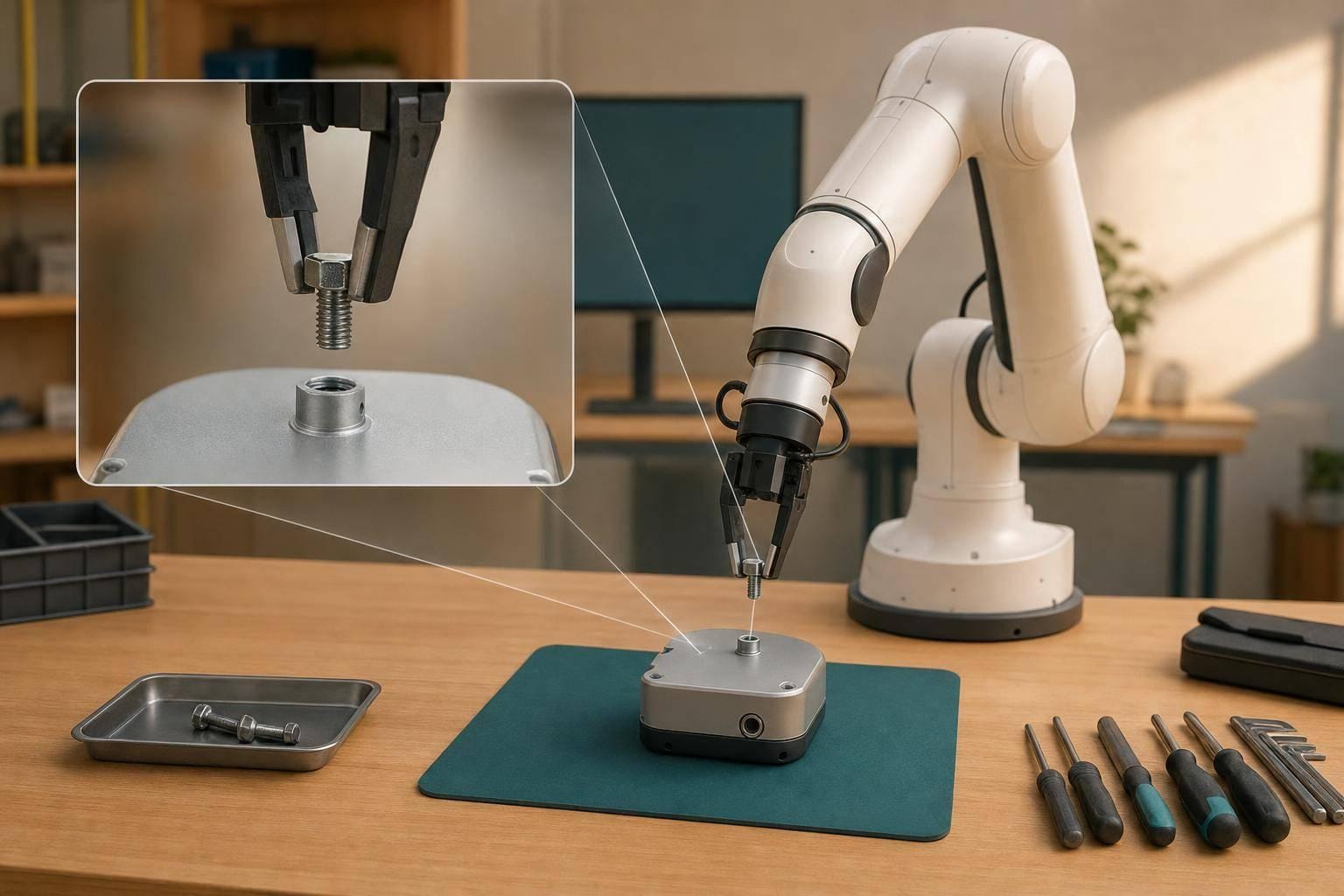
If I need a robot to grasp, turn, press, or place with precision, I’d train it with egocentric video first. If I need it to move through space, track motion, or supervise a full work cell, I’d lean on third-person video. The camera view changes what the model can learn, what I can label, and how well training matches deployment.
Here’s the short version:
- Egocentric data shows hand-object contact, grip approach, local cues, and task intent.
- Third-person data shows room layout, paths, full-scene motion, and system-level task progress.
- Egocentric data fits onboard robot vision better, so it cuts view mismatch at deployment.
- Third-person data is easier to review at scale, but it misses small contact details.
- Using both views together is often the best setup for teleoperation, bimanual work, and tasks that need both precision and scene awareness.
- Time sync matters: even 50 ms of offset can hurt the training signal.
- In one cited result, pretraining on 20,000+ hours of human egocentric video improved success rate by 54% for a 22-DOF robotic hand.
- Human data collection has limits too: many operators top out at about 3–4 hours per day of high-quality egocentric footage before fatigue hurts data quality.
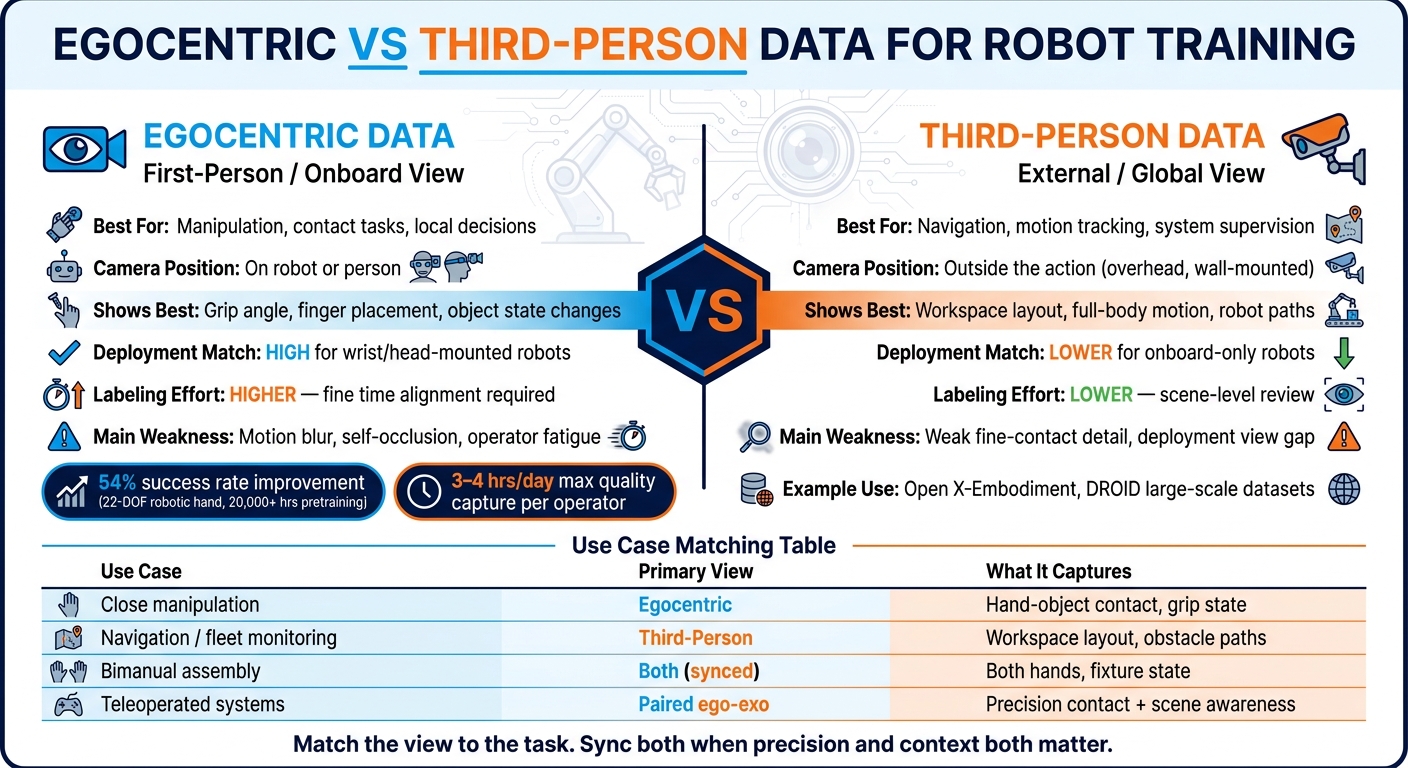
Egocentric vs Third-Person Robot Training Data: Key Differences
Ego2Robot: Scalable Robot Data Synthesis from Egocentric Human Data (Aug 2026)
Quick Comparison
| Criteria | Egocentric Data | Third-Person Data |
|---|---|---|
| Best for | Manipulation, contact, local decisions | Navigation, tracking, supervision |
| Camera position | On robot or person | Outside the action |
| What it shows best | Grip angle, finger placement, object state change | Workspace layout, full-body motion, robot paths |
| Deployment match | High for wrist/head-mounted robots | Lower for onboard-only robots |
| Labeling effort | Higher, with fine time alignment | Lower for scene-level review |
| Main weakness | Blur, self-occlusion, operator fatigue | Weak fine-contact detail |
| Teleoperation use | Precise contact view | Full-scene monitoring |
| Best use pattern | Fine action learning | Global context learning |
So if you’re choosing one view, I’d match it to the task. If you need both precision and context, I’d sync both streams and train with each where it helps most.
Egocentric Data: Better for Manipulation, Local Decisions, and Task Intent
Egocentric data shows the task from the robot’s first-person view. That matters a lot for contact-heavy manipulation because it exposes the approach angle, how a grasp takes shape, and the exact moment contact happens.
What egocentric data shows best
First-person video keeps hands, tools, and contact states large in the frame. That makes it much easier to learn fine manipulation through Physical AI, including grasp formation, finger placement, tool contact, and object changes like a drawer opening.
It also picks up short-horizon navigation cues, like the edge of a shelf or a door frame just ahead. Those near-range details matter for agent-centric spatial relationships and short-horizon control decisions. On top of that, gaze and head motion can signal task intent and visual attention.
There’s another big plus here: the viewpoint matches the robot’s onboard sensors at deployment. So the model doesn’t have to learn from one perspective and act from another, which cuts down the training-deployment gap.
"Egocentric data removes a translation step that third-person footage forces the model to make: converting an outside view into a first-person decision." - Vineeth Velmurugan, Robotic Learning Lead, Encord
NVIDIA’s EgoScale research found something similar. Pretraining a Vision-Language-Action (VLA) model on more than 20,000 hours of action-labeled human egocentric video improved the average success rate of a 22-DOF robotic hand by 54% compared with a no-pretraining baseline.
That close-up view helps the model, but it also makes data capture and labeling tougher.
Where egocentric data is harder to use
The same proximity that helps learning can create messy footage. Motion blur shows up often during fast head or wrist movement, and self-occlusion can hide the object right at the moment of contact.
Annotation is tougher too. Labels need tight time alignment, and reviewers have to mark contact states and action boundaries with care. That’s slow, detail-heavy work.
There’s also a human limit in the data collection process. Operators often produce only 3–4 hours of high-quality egocentric footage per day before fatigue starts to hurt movement quality. If a team ignores that, the dataset can slip in quality fast. Teams collecting this data need to plan around those limits from day one.
Third-Person Data: Better for Scene Layout, Motion Tracking, and Supervision
Egocentric video gets you close to the action. Third-person video pulls back and shows the whole scene.
External cameras - mounted overhead, fixed to walls, or placed around a robot cell - record the full workspace from a stable global frame of reference. If egocentric footage shows local contact, third-person footage shows everything around it. That wider view helps a model learn scene structure, movement through space, and task-level coordination. As a result, it tends to work better for navigation, motion tracking, and system-level supervision.
What third-person data shows best
Third-person cameras are especially good at recording workspace layout and full-scene motion. An overhead warehouse camera can track robot paths and aisle traffic. A fixed station camera can show full-body pose and multi-robot coordination. That makes this type of data useful for robots that move through shared spaces, not just robots that pick things up.
It also works well for safety review, quality assurance, and reward-model scoring, because those jobs depend on seeing the full scene.
"It is better for learning what the task looks like at a system level - a human supervisor or a reward model evaluating task completion is typically working from a third-person perspective."
- Chris Pham, DataX Power
Large multi-robot datasets such as Open X-Embodiment and DROID show how external cameras can scale across skills, scenes, and trajectories.
That broad view helps with supervision, but there’s a tradeoff: you lose some fine contact detail.
Where third-person data is weaker
The farther the camera sits from the action, the less detail it can pick up. A grasp from far away may take up only a few pixels. That’s often not enough to teach finger placement, gripper alignment, or the exact instant when an object changes state. External cameras also miss intent signals like gaze. So while third-person data is strong on context, it is weaker on the contact cues needed for precision manipulation.
"A robot with a wrist camera will see the cup from approximately the same perspective as the egocentric human demonstrator. It will not see the third-person view - that viewpoint does not exist during deployment."
- Chris Pham, DataX Power
That leads to a deployment gap: a robot with onboard cameras does not see the same external view used during training. Those tradeoffs shape the next choice - whether to use third-person data by itself or pair it with egocentric footage.
Egocentric vs Third-Person Data: Tradeoffs in Training, Annotation, and Use
The choice between these views isn't about taste. It comes down to where the robot needs to act.
Manipulation, navigation, and task understanding
For grasping and tool use, egocentric data is usually the better match because it lines up with what the robot actually sees. If the training view doesn't match the robot's camera, even a small field-of-view mismatch can shift how big or where an object appears. And that can throw off precision manipulation.
First-person footage also shows details that matter in close-up action: gaze direction, hand motion, and the local cues behind a grasp or reach. Those signals help explain why a movement happened, not just what happened.
Third-person data is better suited to scene-level planning and coordination. It gives a clearer view of the whole setup, which helps when the goal is to understand whether the task worked overall rather than how each hand movement was executed.
Annotation cost, generalization, and teleoperation fit
The view that makes learning easier can also make labeling more expensive. Third-person data is often labeled with bounding boxes and global trajectories. Egocentric data usually asks for much finer detail, such as per-joint hand poses, contact points, and sub-action segmentation like reach, pre-grasp, and lift. That means stricter quality control and more annotation work.
Camera geometry also plays a big role. Field of view and mounting angle are key quality checks because they shape how well the data transfers to the robot used at deployment. Egocentric data tends to transfer well to robots with wrist-mounted or head-mounted cameras, but it starts to fail when the training view drifts too far from the robot's actual sensor setup.
Third-person data fits scene-level tasks and navigation more naturally, but it usually needs a view-conversion step before it can produce first-person action plans. In teleoperation, the split is pretty practical:
- Third-person views help operators monitor the full scene and avoid obstacles.
- Egocentric views help with precise contact and fine-grained grasping.
The strongest pipelines don't force a one-or-the-other choice. They use both views where each one does its best work.
How to Use Both in a Strong Physical AI Pipeline
Best data mix for each use case
Once the tradeoffs are clear, the next step is simple: pick the camera setup that fits the job.
The best starting point is to match the view to the task:
| Use Case | Primary View | Capture |
|---|---|---|
| Close manipulation | Egocentric / wrist-mounted | Hand-object contact, grip state, object state |
| Navigation / fleet monitoring | Third-person / overhead | Workspace layout, obstacle paths, global context |
| Bimanual assembly | Synchronized egocentric + third-person | Both hands, fixture state, time-synced streams |
| Teleoperated systems | Paired ego-exo | Precision contact (ego) + scene awareness (exo) |
In practice, ego and exo views work best together. Egocentric footage helps with contact precision. Third-person footage shows the scene around the robot. One view often misses what the other sees.
That setup only works if the streams stay aligned in time. Sync every stream to one clock. Even a 50 ms offset can corrupt the training signal.
Conclusion: Match the view to the task, then link both
The strongest pipelines treat egocentric and third-person data as complementary inputs, not rival options.
Reusable multi-view datasets need synchronized clocks, matched field of view, and tighter annotation. That extra work pays off across tasks. The same recordings can support pretraining, teleoperation, reward modeling, and continuous learning data.
Match the view to the task, then pair both when precision and context matter.
FAQs
How do I choose the right view for my robot task?
Start with the failure you need to fix, not the hardware. If the problem lives in fine contact details, use egocentric data. That includes hand-object interaction, gaze, affordances, and near-gripper occlusion.
Use third-person data when the job depends on workspace context. That covers path planning, body pose, safety review, and multi-robot coordination.
For tasks that mix navigation and manipulation, synchronized ego-exo captures can help. In every case, match the camera geometry to the robot’s deployment view to cut distribution shift during inference.
When should I combine egocentric and third-person data?
Combine egocentric and third-person data when a robot needs both close-up manipulation signals and global workspace or body context in the same task episode. This setup fits jobs like mobile manipulation, bimanual assembly, warehouse picking, and recovery from occlusion.
Use time-synced, calibrated paired capture with QA checks for clock drift and dropped frames. That pairing ties intent from egocentric views to geometry from third-person views.
What causes egocentric or third-person data to fail in training?
Egocentric data can fall apart fast when motion blur kicks in, the camera swings and loses the object, or the person blocks the view with their own body. Since the camera moves with the actor, you also lose a steady global frame. That makes the workspace and the task setup much harder to read.
Things can also go wrong when the cameras used in training and deployment don't line up in position, field of view, or angle. That mismatch creates a distribution gap. And it doesn’t take much: even small sensor-sync errors, like a 50-millisecond offset, can break the link between vision and motion.