What Is a Dataset Spec? All You Need to Know About

Leela Yanamaddi
November 9, 2026

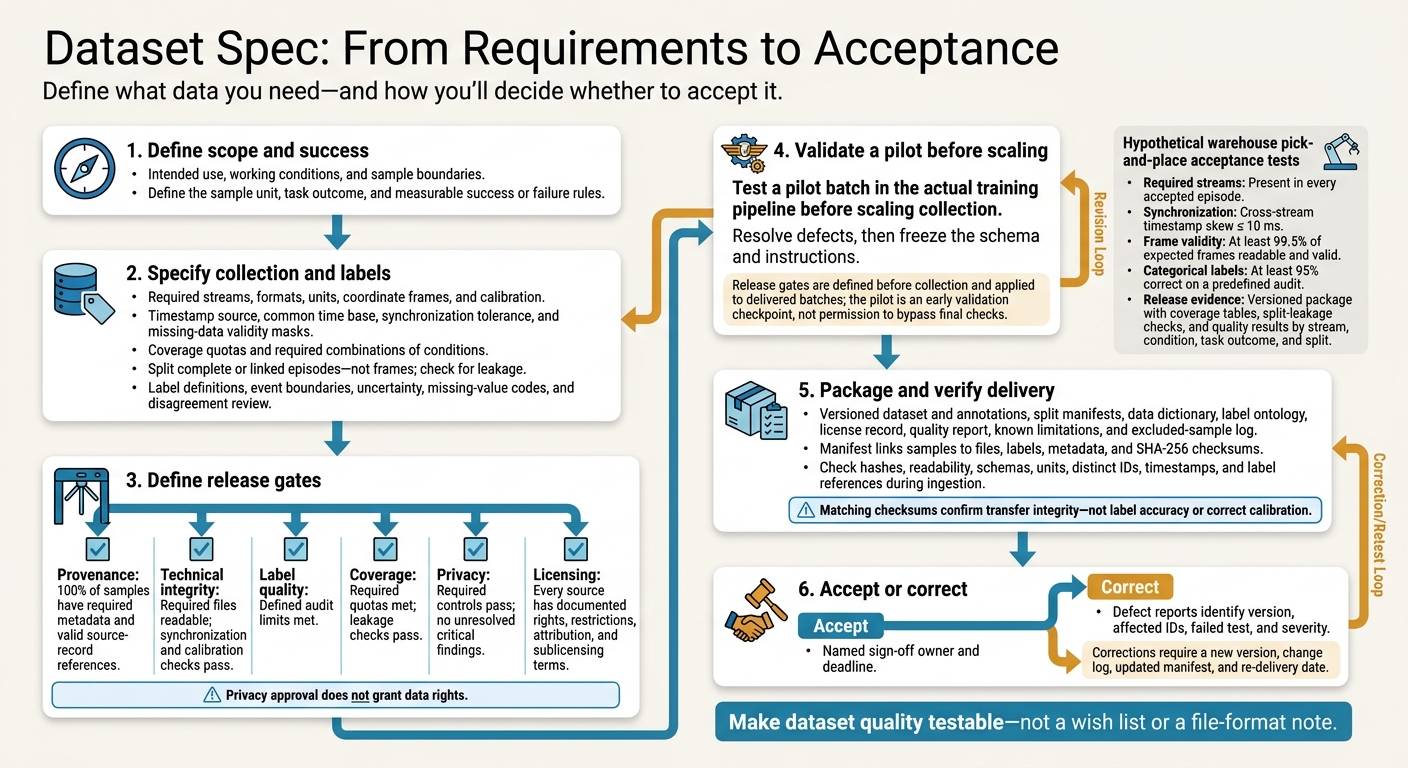
A dataset spec is a written agreement that defines what data you need and how you’ll decide whether to accept it. I start with the model’s task, then set testable rules before collection begins.
Here’s what I include:
- Scope: The intended use, working conditions, sample boundaries, and success or failure rules.
- Data and labels: Required sensor streams, formats, timing limits, coverage targets, annotation rules, and dataset splits.
- Release checks: Source records, quality tests, privacy controls, and documented usage rights.
- Delivery: Versioned files, manifests, validation steps, a sign-off owner, and a correction process.
The key is to replace “good data” with measurable requirements. For example, a robotics project might require at least 95% label accuracy on a defined audit - not as a universal standard, but as a task-specific target.
My final check: <u>test a pilot batch in the training pipeline before scaling collection</u>.
Dataset Spec: From Requirements to Acceptance
Ep: 2 Data Collection Best Practices
Set Collection and Labeling Requirements
Once the sample unit and task outcome are defined, spell out what to record, how to label it, and how to split the data.
Data Types, File Formats, and Sensor Alignment
Specify every required stream: RGB video, depth, point clouds, robot state, actions, force-torque readings, and text instructions. For each, record the resolution, sampling rate, compression, units, coordinate frames, and calibration requirements. Declare one storage format: HDF5 or Zarr for episode arrays, RLDS for stepwise episodes, or ROS 2 bags for raw recordings. State whether raw data must stay alongside processed files.
Make synchronization measurable. Define the timestamp source, common time base, clock-offset records, matching tolerance, and resampling method. Base the tolerance on sensor rates and task speed - not convenience. Require reports of unmatched measurements, duplicate timestamps, and clock drift. Specify which gaps invalidate an episode and which can remain with validity masks. Never treat zero-filled or interpolated readings as measured data; mark missing readings with validity masks.
Sampling Targets, Coverage, and Dataset Splits
A record count is not a coverage plan. Set minimum counts and acceptable imbalance across contributors, operators, robots, sites, objects, tasks, lighting, viewpoints, obstacles, outcomes, and recovery attempts. Define required combinations, too. Collecting low-light scenes and transparent objects separately does not establish coverage of transparent objects in low light.
Split data by complete episodes or linked episodes, never by frame. Hold out operators, sites, objects, or tasks when testing generalization to them. Check identifiers, timestamps, hashes, and near-duplicate imagery for leakage.
Label Definitions and Annotation Rules
Match each label to its level: frame-level pose, visibility, and contact; segment-level task phases; episode-level outcomes; and trajectory-level actions and event labels for slip, collision, and recovery. Give every field an allowed vocabulary, units where relevant, an uncertainty field, and a missing-value code.
Define event boundaries and separate permitted contact from unintended collision. Provide positive and negative examples, have two annotators label a subset, and send unresolved disagreements to a reviewer. Keep the decision, reason, annotator IDs, and guideline version rather than silently overwriting labels.
The annotation guide should spell out how to judge the task:
For the hypothetical instruction “place the cup on the plate,” the guide could require the cup’s base center to finish within 1 inch of the plate center, its axis within 10 degrees of vertical, its handle within an allowed 45-degree direction range, and stability for 2 seconds after release. Define the handle’s reference direction and how stability is measured. Label handle occlusion, slip, rim contact, and recovery separately. These thresholds convert a vague instruction into testable annotation and evaluation criteria.
Set Metadata, Quality, Privacy, and Licensing Requirements
Treat each requirement as a release gate. Set thresholds based on the model, sensors, task, and deployment risk. Record known limitations alongside test results.
Once labeling rules are set, require provenance, quality, privacy, and rights checks before release. These gates turn the dataset specification into an enforceable release decision - not a single quality score.
| Requirement | Acceptance test |
|---|---|
| Provenance | 100% of samples have required metadata and valid source-record references |
| Technical integrity | All required files are readable; synchronization and calibration checks pass |
| Label quality | Audit meets defined limits for completeness, accuracy, agreement, temporal consistency, and pose or segmentation error |
| Coverage | Every required site, condition, class, and split quota is met; leakage checks pass |
| Privacy | Required redaction, consent, access, retention, and deletion checks pass; no unresolved critical findings |
| Licensing | Every source maps to documented rights, restrictions, attribution, and sublicensing terms |
Data Provenance and Quality Checks
Require stable sample IDs, site IDs, pseudonymous contributor IDs, ISO 8601 timestamps with time zones, hardware and firmware versions, calibration records, and collection conditions. Record the annotation-tool, labeling-guideline, and dataset versions, along with every processing step. Every delivered sample must trace back to its capture record, so teams can audit defects, label changes, and sensor issues.
Before collection starts, define the audit sample size, selection method, reviewer qualifications, adjudication owner, and escalation procedure. Sample across sites and difficult conditions. Don’t let an overall score hide failures in a critical subgroup, and record adjudication decisions.
Reject samples with missing required streams or invalid calibration. Send correctable labels back for revision, preserving the original, correction reason, reviewer, timestamp, new version, and retest result.
Privacy Controls and Data Usage Rights
Specify the legal basis, permitted purposes, and handling rules for faces, voices, badges, shipping labels, and other personal data. Set retention periods, deletion procedures, encryption, and role-based access for both raw and processed data.
Link permission records to collection sessions, and define how applicable withdrawal requests reach affected samples. Review applicable U.S. legal, contractual, and sector-specific requirements; don’t assume one nationwide rule covers every dataset. If the intended use changes materially, conduct a new privacy and legal review rather than automatically relying on the original consent.
Maintain a rights matrix covering ownership, acquisition authority, training, commercial use, modification, redistribution, geographic restrictions, attribution, and sublicensing. Confirm that agreements cover derived annotations as well as recordings. Privacy approval does not grant data rights. Block delivery until every asset has documented ownership, restrictions, attribution, and sublicensing terms. Once these gates pass, move to packaging and acceptance.
Deliver and Validate the Dataset
After quality, privacy, and rights pass review, package the dataset so teams can repeat ingestion and sign-off. Set the deliverables, validation milestones, acceptance owner, and correction process. For custom multimodal datasets or managed collection, specify sensor, environment, volume, label, and reporting requirements in the statement of work.
Delivery Package and Acceptance Process
Require stable episode IDs and consistent stream folders, such as rgb_wrist, rgb_overhead, depth, robot_state, actions, and annotations. Set naming rules and machine-readable schemas. Include versioned dataset and annotation files, split manifests, a data dictionary, label ontology, license record, quality report, known limitations, and an excluded-sample log. The manifest should link samples to their files, labels, metadata, and SHA-256 checksums.
Specify encrypted transfer, approved recipients, access expiration, retention, and deletion rules. During ingestion, check hashes, file readability, schemas, units, distinct IDs, timestamps, and label references. Matching checksums confirm transfer integrity - not label accuracy or correct calibration.
State who signs off and the deadline. Defect reports must identify the version, affected IDs, failed test, and severity. Each correction needs a new version, change log, updated manifest, and re-delivery date.
Example: Warehouse Pick-and-Place Dataset Spec
This robotics example shows how acceptance rules work in practice.
Hypothetical scope: Capture packaged goods moving from bins into totes using synchronized wrist and overhead RGB, depth, joint positions and velocities, gripper state, force, actions, and task instructions. Vary packaging, lighting, bin layouts, viewpoints, robot configurations, and successful and failed attempts. Label approach, grasp, lift, transport, place, and release, plus failures such as missed grasps, collisions, and dropped items. Record robot and sensor IDs, calibration, setting, software versions, and collection time.
These are hypothetical acceptance tests for this task, not universal standards.
Requirement Task-specific acceptance test Required streams Present in every accepted episode Synchronization Cross-stream timestamp skew ≤ 10 ms Frame validity At least 99.5% of expected frames readable and valid Categorical labels At least 95% correct on a predefined audit Release evidence Versioned package with coverage tables, split-leakage checks, and quality results by stream, condition, task outcome, and split
Conclusion: Make Dataset Quality Testable
Approve a pilot batch in the actual training pipeline before scaling. Resolve defects, then freeze the schema and instructions. Treat the dataset spec as a working agreement that makes quality testable - not a wish list or a file-format note.
FAQs
How is a dataset spec different from a data schema?
A dataset spec sets the requirements for the whole project: collection goals, privacy rules, and measurable pass/fail acceptance tests.
A data schema is the technical part of that spec. It defines how the data is structured, including field names, data types, units, and naming conventions.
The schema keeps data consistent and readable by your pipelines. The dataset spec checks whether the full delivery meets quality, legal, and day-to-day workflow requirements.
How do I choose realistic data quality thresholds?
Start with a 100–200-sample pilot to test how you define success, failure, and edge cases. Before full-scale collection, set measurable thresholds in your statement of work.
For annotation, aim for Cohen’s kappa ≥ 0.80 as a starting target, with boundary accuracy of ±2–5 frames, depending on the frame rate.
Treat critical and non-critical failures differently. Reject clips if task-critical hands or objects are obscured, but allow minor metadata fixes or repairs to non-critical labels.
When should I update my dataset spec?
Update your dataset spec when pilot runs, sample reviews, or quality checks reveal unclear labels, weak category boundaries, or inconsistent annotations. If training failures expose missing objects, scenes, or task stages, update both the spec and collection briefs. Revisit requirements when camera hardware, operator behavior, or task protocols change.
Never modify an existing release in place. Issue a new semantic version tag so previous releases stay unchanged.