UMI Handheld Grippers Explained: When Cheap Capture Beats Real Robot Episodes

Leela Yanamaddi
November 12, 2026
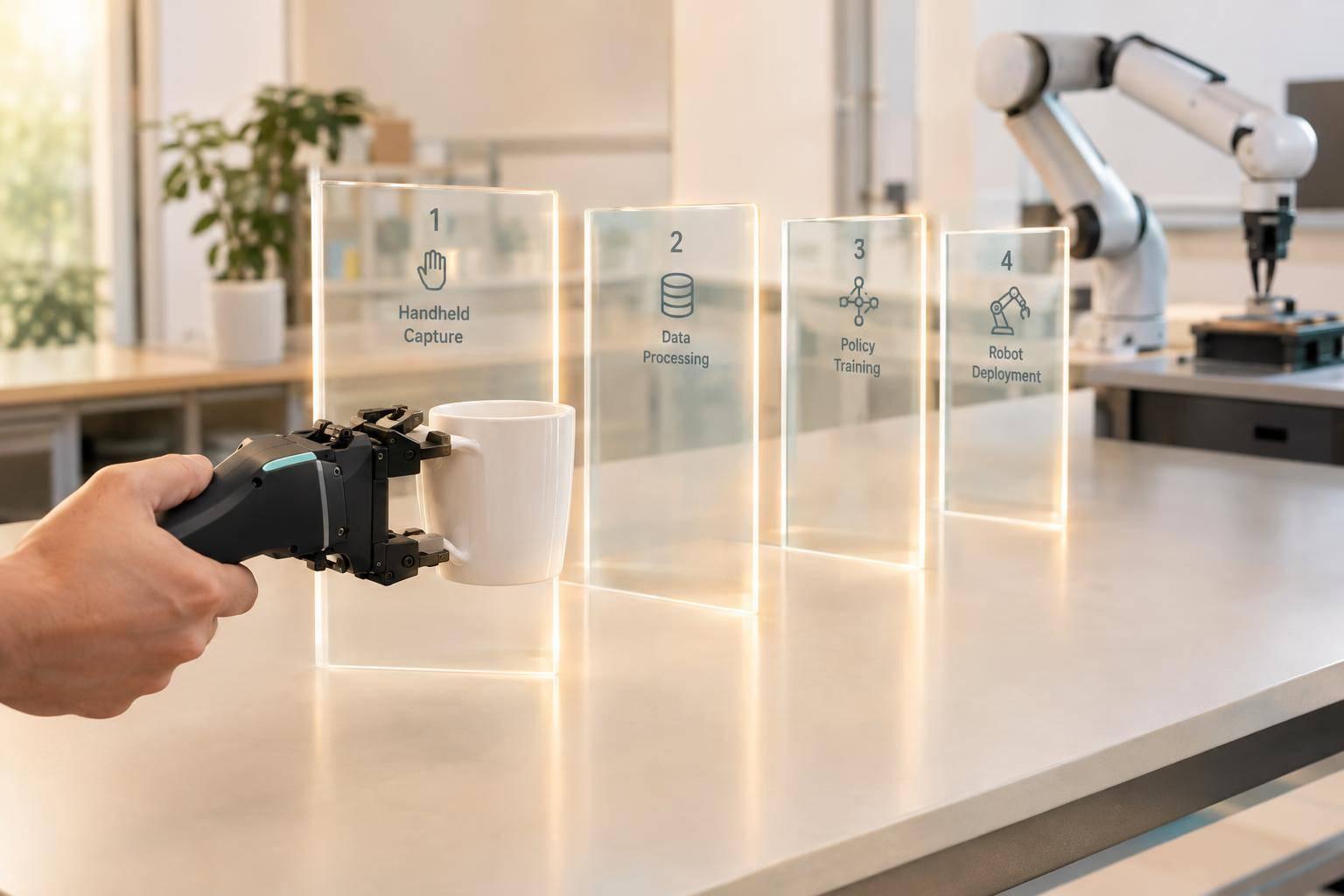
UMI handheld grippers can cut data collection costs - but only if the data works on the target robot. In one cup-arrangement benchmark, UMI collected 111 demonstrations per hour versus 35 with robot teleoperation, about 3.2× as many. That result is task-specific, not a promise for every setup.
UMI uses a handheld gripper and mounted camera to record demonstrations without occupying a robot. It suits pick-and-place, sorting, and object rearrangement. Target-robot episodes are the better starting point when success depends on forces, tight fits, controller timing, or joint limits.
Quick Comparison
| Comparison | UMI handheld demonstrations | Target-robot episodes |
|---|---|---|
| Cost | About $371 for the original gripper setup, plus processing and validation | Robot, workcell, teleoperation, maintenance, and supervision |
| Throughput | Collection without robot access; tracking and cleanup add time | Limited by robot access, resets, and safety checks |
| Recorded data | Reconstructed gripper pose and opening; no direct force measurements | Robot state and controller response; contact data if sensors are installed |
| Best fit | Visually guided object movement | Contact-heavy tasks and robot-specific constraints |
| Main risk | Recorded motions may not transfer | Higher collection cost and robot occupancy |
Before scaling UMI collection, check hardware fit, tracking quality, motion transfer, and independent robot testing. Compare cost per accepted, transfer-tested episode - including labor, failed recordings, calibration, processing, and validation - not recording counts alone. Use handheld data for scale and robot episodes to address gaps found during testing.
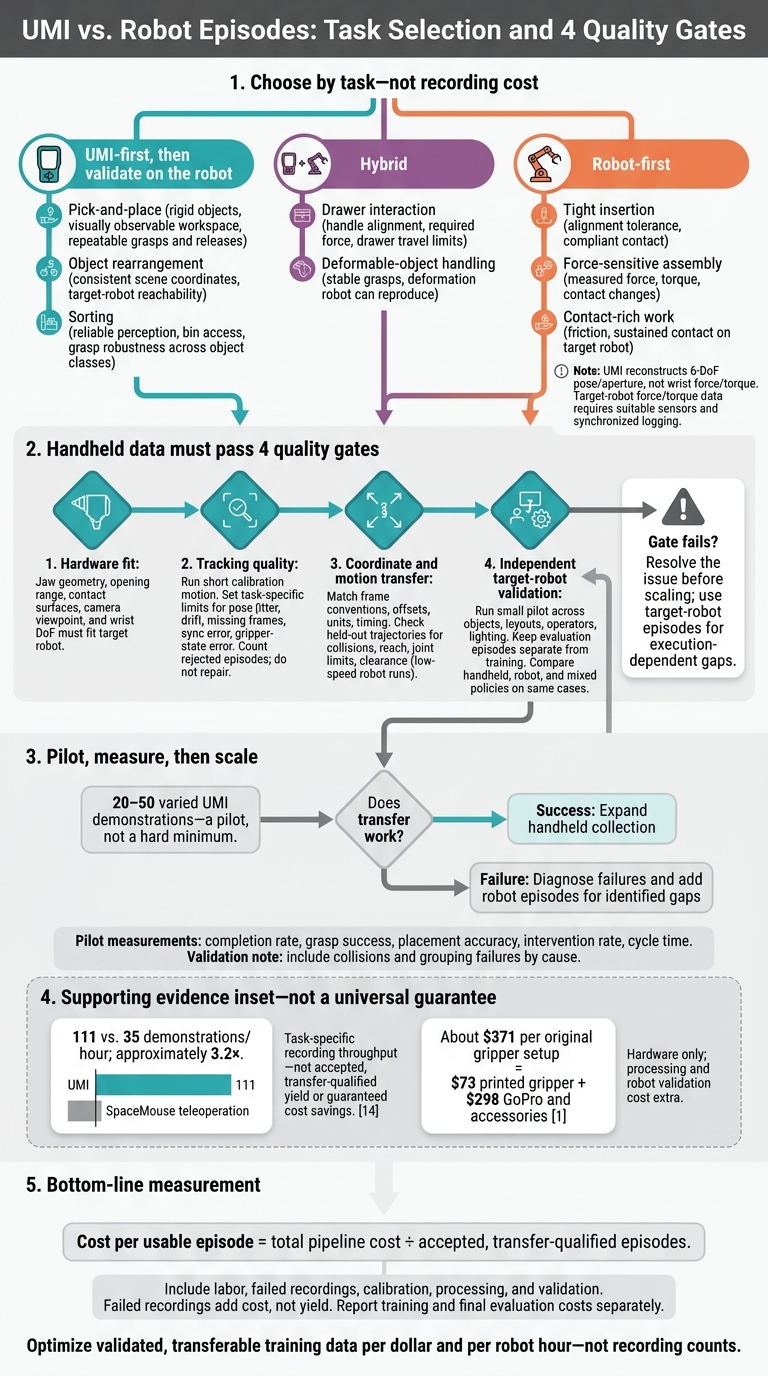
UMI vs. Robot Episodes: Task Selection and 4 Quality Gates
1. UMI Handheld Demonstrations
Cost per Usable Episode
The original UMI hardware costs about $371 per gripper setup: $73 for the printed gripper and $298 for the GoPro and accessories. But hardware price alone doesn't tell you what usable data costs.
Define cost per usable episode as total pipeline cost divided by accepted, transfer-qualified episodes. Include failed recordings in the cost, not the yield, and report training and final evaluation costs separately.
| Cost category | UMI handheld capture | Target-robot capture |
|---|---|---|
| Hardware | Gripper, camera, batteries, calibration targets | Robot, end effector, teleoperation interface, safety equipment |
| Labor | Recording, resets, SLAM reconstruction, synchronization, trimming | Operation, resets, supervision, log review, maintenance |
| Failures and validation | Failed tracking, re-recording, retargeting, robot-side validation | Failed trials, re-recording, quality checks, execution validation |
Collection Throughput
In the reported cup-arrangement benchmark, UMI reached 111 demonstrations per hour versus 35 with SpaceMouse-based robot teleoperation - roughly a 3.2× difference. Those numbers apply to that task, not every collection setup.
Compare accepted, transfer-qualified episodes per operator-hour, including resets and manual processing. Log why episodes were rejected, and report automated processing time separately. Fast recording can still leave a reconstruction backlog.
Sensor and Action Fidelity
UMI reconstructs 6-DoF gripper pose and aperture from camera and inertial data through offline SLAM and gripper-width detection. Before accepting an episode, check for pose jumps, dropped frames, timestamp misalignment, jaw-aperture dropouts, and camera-gripper calibration errors.
Target-robot logs provide robot state and controller response more directly, though external video still needs synchronization. Basic UMI does not directly measure wrist force/torque or contact forces. Robot episodes include those channels only when suitable sensors are installed.
Task Transfer and Execution Limits
For pick-and-place, cup arrangement, and sorting, match jaw geometry, opening range, camera mounting, and wrist frames. Check reachability, collision clearance, speed, and timing before testing a representative subset on the robot.
A human can move the tool through poses the robot can't reach or sustain. If success depends on wiping with controlled normal force, tight peg insertion, or contact-induced drift, collect target-robot episodes for those phases. The next section shows what target-robot episodes record when these limits matter.
Universal Manipulation Interface: In-The-Wild Robot Teaching Without In-The-Wild Robots
2. Target-Robot Demonstration Episodes
When handheld data can’t verify execution on the target robot, robot episodes fill the gap. Robot collection occupies a workcell, not just an operator. Budget for floor space, power, calibrated cameras, stable lighting, access control, and emergency-stop hardware. Track reset time and robot occupancy separately from recording time.
The controller affects execution through smoothing, acceleration limits, joint-limit stops, and latency. Log the controller mode, sampling rate, synchronization method, and end-to-end delay. Report the fraction of episodes affected by dropped commands or safety stops - not just completed recordings. These details determine what each method can document.
| Evidence | UMI handheld capture | Target-robot episodes |
|---|---|---|
| Motion | Reconstructed handheld path; robot execution unverified | Logged commands and measured joint and end-effector states, if logged |
| Timing | Handheld timing does not measure robot delay | Command-to-motion delay measured through synchronized logs |
| Contact | Visible contact cues; forces unmeasured on the target robot | Force/torque or tactile data with suitable sensors and synchronized logging |
The same task label doesn’t mean the same execution problem. Finger friction, compliance, closure speed, payload, reach, and clearance can all affect whether the policy works on the robot.
Use robot episodes to test difficult object orientations, workspace boundaries, constrained releases, and failure recovery. Record transfer success, intervention rate, failure causes, and recovery behavior.
Choose by Task, Then Check 4 Data-Quality Gates
Start with what makes the task succeed - not recording cost alone. Then use these four gates to decide whether handheld data is worth keeping.
| Task | Starting point | Condition to verify |
|---|---|---|
| Pick-and-place | UMI-first, then validate on the robot | Rigid objects, visually observable workspace, repeatable grasps and releases |
| Object rearrangement | UMI-first, then validate on the robot | Consistent scene coordinates and target-robot reachability |
| Sorting | UMI-first, then validate on the robot | Reliable perception, bin access, and grasp robustness across object classes |
| Drawer interaction | Hybrid | Handle alignment, required force, and drawer travel limits |
| Deformable-object handling | Hybrid | Stable grasps and deformation the robot can reproduce |
| Tight insertion | Robot-first | Alignment tolerance and compliant contact |
| Force-sensitive assembly | Robot-first | Measured force, torque, and contact changes |
| Contact-rich work | Robot-first | Friction and sustained contact on the target robot |
Gate 1 - Hardware fit. Check jaw geometry, opening range, contact surfaces, camera viewpoint, and wrist degrees of freedom against the target robot.
Gate 2 - Tracking quality. Before collecting data, run a short calibration motion. Set task-specific limits for pose jitter, drift, missing frames, sync error, and gripper-state error. Count rejected episodes rather than repairing them.
Gate 3 - Coordinate and motion transfer. Check that frame conventions, offsets, units, and timing match the target robot. Test held-out trajectories with collision checking and low-speed robot runs. Reject paths that exceed reach or joint limits, or fail clearance checks.
Gate 4 - Independent target-robot validation. Run a small pilot across objects, layouts, operators, and lighting conditions. Keep evaluation episodes separate from training and tuning. Compare handheld-only, robot-only, and mixed-data policies on the same held-out cases.
Measure task success, completion time, collisions, and interventions, and group failures by cause. Assess savings using cost per usable episode, including processing, rejected episodes, and robot corrections.
The next section weighs the scale advantage against robot fidelity.
Pros and Cons: Collection Scale vs. Robot Fidelity
The choice comes down to collection scale versus execution fidelity. Handheld capture shifts costs from robot access to offline processing. Robot episodes require setup, resets, maintenance, and safety supervision.
Use this split to decide where handheld data stops and robot data starts.
| Trade-off | Handheld UMI capture | Target-robot episodes |
|---|---|---|
| Main advantage | Portable collection across people, objects, and environments | Direct evidence of the target robot’s mechanics and execution |
| Main disadvantage | Tracking losses, embodiment mismatch, and extra transfer work | Collection limited by robot availability, workspace setup, resets, and safety controls |
| Best-fit conditions | Visually guided tasks where broad scene coverage matters most | Tasks where friction, tight fits, timing, or robot-specific limits determine success |
Hardware price is only part of the bill. Labor, compute, calibration, spares, and robot validation account for most of the total cost.
Robot episodes reveal delays, actuator limits, grip failures, and contact transitions that handheld video cannot measure. Keep independent target-robot validation separate from both collection streams.
Conclusion: Scale Handheld Data and Use Robots to Fill Gaps
Choose UMI when data volume holds back progress and the task transfers cleanly to the target robot. Use robot episodes when success depends on contact mechanics or execution constraints. Combine both when handheld data covers normal behavior but the robot needs data for corrections.
Once all four gates pass, test transfer with 20–50 varied UMI demonstrations - a pilot, not a hard minimum - before scaling collection. Track completion rate, grasp success, placement accuracy, intervention rate, and cycle time. Expand handheld collection only after transfer works. Add robot episodes only for failure modes found during testing.
Measure validated, transferable training data per dollar and per robot hour, not the number of recordings. Use handheld capture for scale and robot episodes where validation shows transfer gaps.
FAQs
How do I estimate UMI's break-even collection cost?
Calculate UMI’s total cost per usable, deployment-ready episode by dividing all project costs by the number of usable episodes. Include hardware, labor, resets, supervision, annotation, processing, storage, rejected episodes, adaptation, and target-robot validation.
Then compare that figure with direct robot teleoperation. UMI breaks even when collection savings equal adaptation and validation overhead. If that overhead exceeds the savings, teleoperation costs less.
Record actual costs in USD, keeping collection-only costs separate from adaptation and validation costs.
Can I reuse UMI data across different robots?
Reusing UMI data across robots is difficult because each robot has different kinematics, joint limits, grippers, sensor placement, and control frequencies. Pooling recordings alone doesn’t guarantee successful transfer.
Actions usually need to be retargeted to fit the target robot’s constraints, then checked through closed-loop validation on that robot. For tasks that depend on precise contact, force, or latency, collecting data directly on the target hardware is often more cost-effective than fixing failures when transferring handheld data.
How much robot data should I mix with UMI demonstrations?
There’s no fixed ratio. Use cost per accepted episode as your baseline, then add robot data to address failures you’ve measured. For new tasks, labs often aim for about 5% to 10% teleoperation data.
Start with 30 to 50 robot episodes to benchmark performance. Use UMI demonstrations to cover broad variation and task intent. Add robot episodes to address issues with contact, force, latency, compliance, tactile feedback, or recovery.