Human-in-the-Loop Robotics in 2026: Where It's Actually Deployed

Leela Yanamaddi
November 10, 2026
My takeaway: buy for a proven task, not a robot demo. As of November 10, 2026, the supplied sources support production use at Plus One Robotics and GXO, while BMW’s Figure program remains a pilot. Before buying, I’d ask who handles failures, how often people step in, and what support costs.
I compare five cases below. <u>Task counts alone don’t prove reliability or labor savings.</u>
Quick Comparison
| Case | Status supported by supplied sources | Task and reported results | Human support |
|---|---|---|---|
| Plus One Robotics | Production | Warehouse picking; 250 million picks in a vendor-reported sample | Remote assistance on about 1.5% of picks; site staffing not disclosed |
| Digit at GXO | Commercial deployment | Warehouse box movement; 100,000+ boxes reported | Support model and intervention rate not disclosed |
| Digit at Toyota | Not verified | Task and results not established | Not established |
| Figure at BMW | Pilot | Sheet-metal placement; 90,000+ components moved | Staffing and intervention details not disclosed |
| Digit at Amazon | Not verified by supplied sources | Empty-tote testing not established | Not established |
The distinction I focus on is simple: remote guidance isn’t the same as steering a robot - or fixing it on-site. I compare task limits, human roles, staffing, recovery, results, and costs so you can see what’s documented and what still needs an answer.
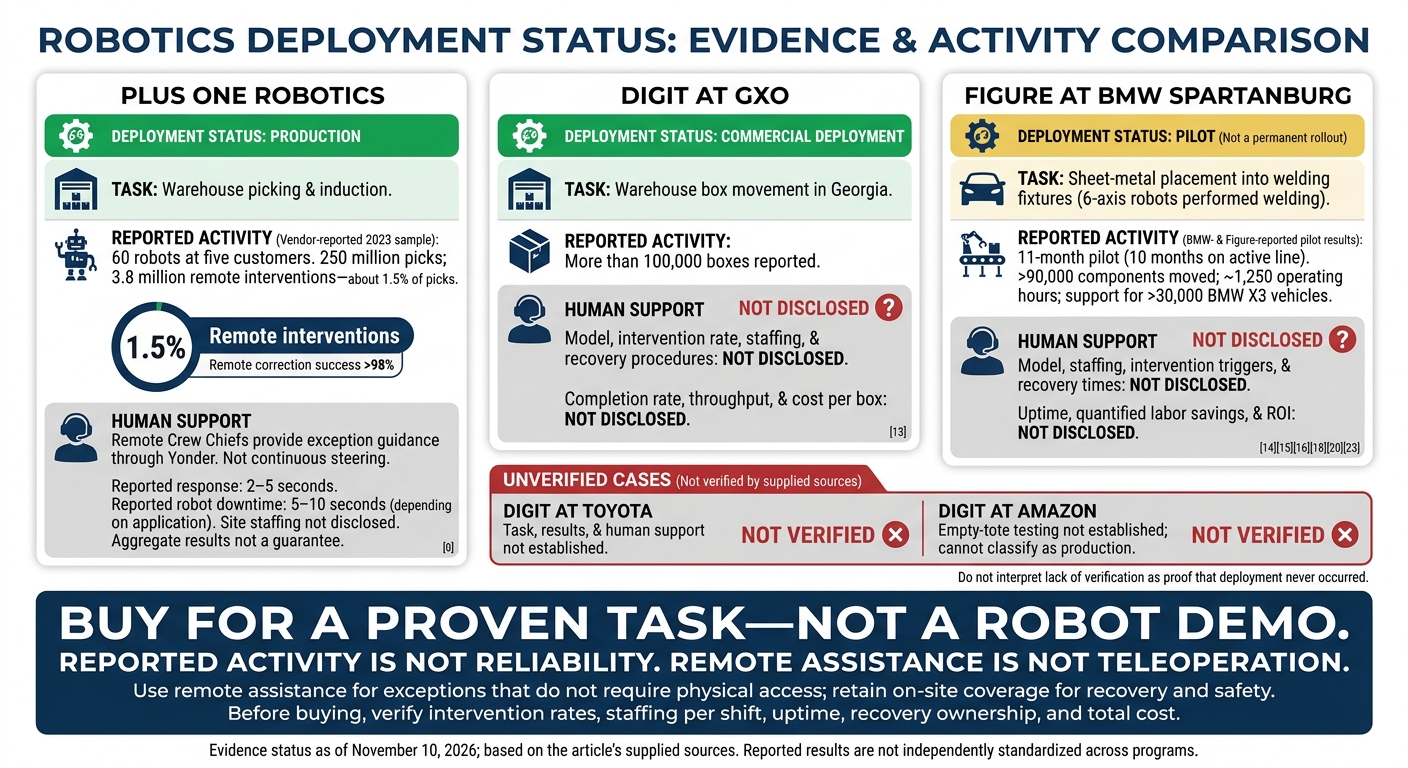
Human-in-the-Loop Robotics: 2026 Deployment Evidence
1. Plus One Robotics: Warehouse Picking With Remote Assistance
Deployment Status and Tasks
Production deployment: Plus One Robotics reports production use of its PickOne perception and robotic picking systems in fulfillment and logistics operations, including a 2019 MSC Industrial deployment in Harrisburg, Pennsylvania.
The robot works within a recurring warehouse workflow, with people stepping in for exceptions. PickOne handles warehouse picking and induction, including randomly oriented parcels in totes and mixed pallets. The MSC example does not establish the fleet size or operating schedule in 2026.
Human Roles and Intervention Triggers
PickOne handles routine picks; remote Crew Chiefs handle exceptions through Yonder. When confidence is too low, a Crew Chief reviews the scene and provides a pick point or corrective action. They don't continuously steer every motion with a joystick.
Help requests can follow failed grasps, uncertain pick points, unpickable items, or placement errors that need repositioning. A failed grasp may call for guidance or another attempt - not necessarily someone on-site.
Staffing and Recovery Steps
When an exception triggers a help request, a Crew Chief reviews the scene, sends guidance, and verifies the pick before automatic operation resumes. Plus One reports 2–5 seconds to respond and 5–10 seconds of robot downtime, depending on the application.
The company says one Crew Chief can support dozens of robots. That's a supervision model, not a guaranteed staffing ratio. Teams still need a local escalation plan for exceptions that remote guidance can't resolve. Plus One therefore relies on remote assistance rather than frequent teleoperation.
Results and Costs
Vendor-reported operating sample: In a 2023 sample of 60 robots at five customers, Plus One reported 250 million picks and 3.8 million remote interventions - about 1.5% of picks - and remote correction succeeded more than 98% of the time.
These aggregate results are not a guarantee for any single site.
Plus One also models the cost of 300,000 interventions at $15 million on-site versus $750,000 remotely. This is an illustrative estimate, not published pricing or a full comparison of ownership costs.
2. Agility Robotics Digit at GXO: Commercial Tote Movement
Deployment Status and Tasks
Unlike the previous case, GXO reports task volume but does not explain how people support the robot. Digit moves boxes at a Georgia warehouse in what GXO describes as a commercial deployment. Public details are limited, with no identified workflow or operating period.
Human Roles and Intervention Triggers
Public disclosures do not explain which box-moving steps Digit performs on its own or when people need to step in. They also do not say whether support comes remotely, on-site, or through safety supervision. No staffing ratio or restart procedure has been disclosed.
Results and Costs
Digit reportedly handled more than 100,000 boxes at the Georgia warehouse. But the disclosure included no completion rate, intervention frequency, or cost per box. The box count alone does not establish throughput, intervention rate, or labor savings.
Why Human-in-the-Loop Robotics Is the Future | Erik Nieves, Plus One Robotics
3. Agility Robotics Digit at Toyota: Intralogistics Pilot
The supplied material does not verify a Toyota-specific Digit deployment. It provides no facility name, dates, task scope, human role, staffing model, or operating results.
Without those details, this case does not meet the article’s evidence standard and is excluded from the verified deployment comparison. The next case returns to that comparison with a factory material-handling trial.
4. Figure at BMW Spartanburg: Factory Material-Handling Trial
Deployment Status and Tasks
BMW and Figure described the work at Plant Spartanburg, South Carolina, as a pilot, not a permanent rollout. Later reporting put the pilot at 11 months, including 10 months of operation on an active assembly line. Figure 02 retrieved sheet-metal parts from racks or bins and placed them into welding fixtures. Six-axis industrial robots handled the welding.
BMW is one of the clearest public examples of a factory pilot with disclosed output data, though details about human support remain limited.
Human Roles and Intervention Triggers
The task is clear; the intervention model is not. BMW said production IT, occupational safety, process management, and shop-floor logistics needed to be involved early. Figure tracked interventions, but public reporting did not explain what caused them. The sources do not establish whether the pilot used continuous teleoperation or remote support, or how many robots each operator supported.
Staffing and Recovery Steps
BMW did not publish staffing levels, recovery times, or how responsibilities were split between local and remote teams.
Results and Costs
BMW and Figure reported more than 90,000 components moved, about 1,250 operating hours, and support for more than 30,000 BMW X3 vehicles.
They did not publish results against cycle-time, placement-accuracy, or intervention targets. Uptime, quantified labor savings, robot pricing, integration costs, and ROI also went unreported, leaving staffing and cost conclusions tentative.
5. Agility Robotics Digit at Amazon: Empty-Tote Testing
This final candidate case does not meet the article’s evidence standard. Available sources do not verify that Amazon deployed Digit for empty-tote testing, so it cannot be classified as a production deployment.
No Digit-specific data on human roles, staffing, recovery, performance, or costs is publicly verified. Task limits, human roles, and intervention triggers therefore remain the comparison points across the verified deployments.
Task Limits, Human Roles, and Intervention Triggers
The matrix below compares verified deployments by task boundary, human role, and intervention trigger. It shows where sources document human support and which tasks stay within bounded workflows.
Use only the status established by the sources. Treat anything else as not specified.
| Program | Supported status | Repeatability and boundaries | Documented human role | Triggers and remote/local responsibility |
|---|---|---|---|---|
| Plus One Robotics | Production | Repeated picking within warehouse cells | Remote assistance | Low-confidence picks, failed grasps, and hardware/tooling exceptions |
| GXO / Digit | Production | Bounded warehouse box movement; workflow details not specified | Not specified | Specific triggers and remote/local responsibilities not established |
| BMW / Figure | Pilot | Repeated sheet-metal placement into welding fixtures | Not specified | Specific triggers and remote/local responsibilities not established |
Remote assistance is not teleoperation. These roles are planning categories, not fixed staffing assignments.
The distinction here is role, not brand. Monitoring, intervention, teleoperation, safety supervision, and recovery are separate support modes for warehouse exceptions, bounded tote movement, and factory material handling.
| Role | Skills | Response need | Physical presence | Suitable tasks | Main risk |
|---|---|---|---|---|---|
| Monitoring | Dashboard and telemetry literacy | Low (passive) | Remote or local | Fleet health, throughput tracking | Low |
| Intervention | Exception handling and waypoint drawing | Medium | Remote | Navigation stalls, blocked routes | Medium |
| Teleoperation | Real-time 6-DOF control | High | Remote | Failed grasps, novel SKU handling | High |
| Safety supervision | E-stop and boundary knowledge | Immediate | On-site | Shared-space monitoring | Critical |
| Recovery | Mechanical or physical repair | Medium | On-site | Spills, hardware faults, jams | Medium |
These are example exception classes, not a complete failure list. A blocked route or navigation stall may allow remote intervention. A jam or hardware fault may require local recovery. For failed grasps, set a retry limit and an escalation rule.
For each exception class, assign the safe-stop owner, alert path, local-recovery threshold, and restart approver. Do not use operator response time as the safety mechanism.
Staffing, Recovery, Results, and Costs
This comparison focuses on the operating burden: who supports the robot, how often they step in, and what the sources actually measure.
Reported activity is not reliability. “Not disclosed” means the source does not provide that metric.
| Program / status | Staffing | Intervention frequency | Response / recovery | Uptime / throughput | Completion rate | Safety reporting | Source strength |
|---|---|---|---|---|---|---|---|
| Plus One Robotics / production | Shared remote assistance; site staffing not disclosed | 3.8 million interventions across 250 million picks | 2–5 seconds response; 5–10 seconds robot downtime | Not disclosed | Over 98% correction rate; end-to-end completion not disclosed | Not disclosed | Company-reported sample |
| GXO / Digit / commercial deployment | Not disclosed | Not disclosed | Not disclosed | Over 100,000 boxes; throughput not disclosed | Not disclosed | Not disclosed | Reported task count; limited operating detail |
| BMW / Figure / pilot | Not disclosed | Not disclosed | Not disclosed | About 1,250 operating hours; throughput and uptime not disclosed | Not disclosed | Not disclosed | BMW- and Figure-reported pilot results |
Plus One’s intervention share is about 1.5%, but the source does not define a common reporting period or metric across cases.
The next question is what these support models cost to staff and maintain.
Remote assistance works only when teams know who owns escalation and restart. Map every handoff - alert, review, remote control, local escalation, restart, and logging - and assign one owner to each.
For shift planning, measure peak concurrent alerts and handling time, not just daily averages. Budget for breaks, handovers, local recovery coverage, and maintenance. Test connectivity loss and latency under load, and define safe behavior for times when remote support is unavailable.
Validate WMS/MES task reconciliation so recovery cannot create duplicate or missing work. Compatibility with incumbent systems can determine whether adoption moves forward. Set separate permissions for viewing, control, task changes, and restart.
These are the staffing choices behind the deployment data:
| Support model | Pros | Costs / constraints |
|---|---|---|
| Shared remote | Pools exception handling across cells | Alert queues, connectivity, local backup |
| Dedicated on-site | Provides physical access for inspection and recovery | Shift coverage, training, break relief |
| Remote + local escalation | Separates remote decisions from physical repairs | Handoffs, permissions, restart ownership |
The illustration uses $50 per intervention on-site versus $2.50 remotely. Across 300,000 interventions, that comes to $15 million versus $750,000. The math works, but the business case does not establish measured savings: it supplies neither a comparable reporting period nor a defined cost boundary. Check whether the rates include supervision, idle coverage, integration, maintenance, network service, and local recovery.
Conclusion: Match Human Support to the Task
The verified deployments show repeated warehouse use at Plus One Robotics and GXO. BMW remains a limited factory pilot - not proof of general-purpose autonomy. Buy for the task the robot has performed in operation, not broader claims about what it can do.
Use remote assistance for exceptions that don’t require physical access. Keep on-site staff for recovery, safety, and worker coordination. Match human support to the task’s limits and how it can fail, not the robot brand.
Before buying, require site references, deployment duration, intervention rates, staffing per shift, uptime, recovery procedures, safety ownership, and total cost. Confirm who handles each alert, review, remote intervention, local recovery, and restart. Treat missing operating data as a deal risk - not proof that human support isn’t needed.
FAQs
How can I verify a robot is production-ready?
Check for repeatable performance under normal operating conditions - not just in demos. Require documentation of robot IDs, sites, recurring tasks, and human-support models.
Test network reliability and workflow integration, and confirm that safety functions work without remote connections. Log every intervention, tracking frequency, recovery time, and peak concurrent alerts. Run repeated trials - ideally 30 to 100 - under production load to set baselines for latency, failover, and recovery. Base approval on your logs and recovery tests, not vendor claims.
How do I estimate staffing for peak intervention demand?
Start with exception rate × average handling time to estimate staffing needs. Then factor in concurrent incidents, response latency, travel time, breaks, and safety coverage. Don’t rely on fixed operator-to-robot ratios: staffing needs vary with task complexity and system maturity.
Use tiered escalation. Local operators handle simple stops, technicians address recurring faults, and remote teleoperators resolve complex edge cases. Plan for peak concurrent alerts, not just average demand: intervention rates can increase by 300%–400% during peak periods or layout changes.
How do I calculate costs beyond the robot’s price?
Treat human support as a permanent operating expense. Budget for it alongside integration, facility changes, safety validation, connectivity, tooling, power, spare parts, and downtime.
To estimate staffing needs, multiply the exception rate by the average handling time. Then add buffers for response delays, travel, breaks, and overlapping incidents.
Include the cost of teleoperators, supervisors, maintenance technicians, monitoring tools, intervention software, and safety training. Use intervention logs and recovery times to forecast recurring costs and lost throughput.