Teleoperation Data vs Egocentric Data vs Synthetic Data

Leela Yanamaddi
October 5, 2026
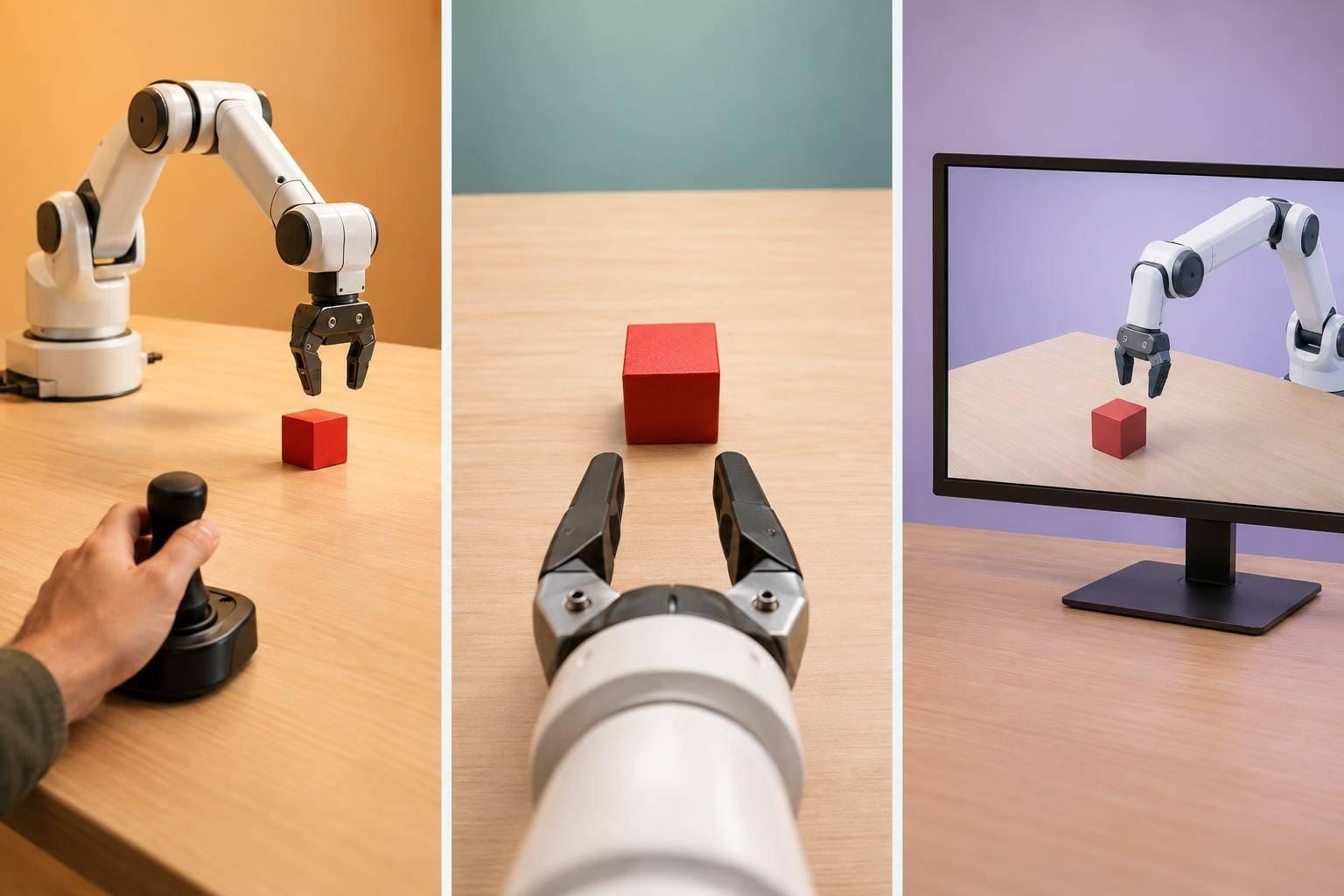
I’d choose robot training data by the signals you need - not the number of recordings. Start with 1–2 deployment tasks: use teleoperation for robot actions, egocentric data for human task steps, and synthetic data for controlled variation.
Here’s how I’d weigh the three:
- Teleoperation: Logs robot observations and human commands. It fits the target hardware, but requires operators, robot access, and physical resets.
- Egocentric: Records first-person human tasks without tying up a robot. It supports task understanding, but robot action labels usually require extra work, and human motion does not map directly to robot motion.
- Synthetic: Generates simulated scenes, actions, and labels at scale after setup. It supports failure testing, but its physics and images may not match physical conditions.
Quick Comparison
| Criterion | Teleoperation | Egocentric | Synthetic |
|---|---|---|---|
| Robot action labels | Logged commands | Usually missing | Generated in simulation |
| Main costs | Hardware, labor, resets | Recording, annotation, privacy review | Simulator setup, compute, validation |
| Scale | Limited by robot and operator time | Video collection scales well | Generation scales after setup |
| Transfer risk | Overfitting to collection conditions | Human-to-robot differences | Simulation-to-physical differences |
| Best starting use | Robot control | Task understanding | Controlled scene and failure variation |
My next step would be a 30–50-episode pilot to check missing signals, synchronization, consent, and acceptance rules. For mixed training, I’d keep each source’s labels separate and compare results against a robot-only baseline on the same held-out physical tests.
<u>Scale what fixes a measured failure.</u> Track task success, recovery, interventions, safety, and completion time - not dataset size alone. If you need managed collection through Evlo.ai, confirm scope and availability first; teleoperation and intervention learning are listed as planned capabilities.
What Each Data Source Records
Teleoperation: Robot Observations and Commands
Picking setup: A human controls a six-degree-of-freedom arm to move a cup into a bin. Record synchronized external and wrist-camera images, joint positions and velocities, end-effector pose, gripper opening, commands, timestamps, and outcomes. Separate commands from executed state: a grip command does not prove the cup was secured. These observation-action pairs support imitation learning. Preserve failed grasps and corrective moves, such as reopening the gripper after a failed grasp, for recovery training.
Collecting this data takes hardware access, trained operators, calibrated camera-robot coordinates, and safety limits. Check timestamps against visible contact to confirm that recordings line up.
Use multiple trained operators and vary object positions so the robot doesn’t learn just one person’s approach or grasp style. Teleoperation provides the most direct robot action labels.
Egocentric Data: First-Person Human Tasks
Assembly recording: A wearable camera captures a worker’s parts, work surface, hand-object interactions, and task order. Those signals support visual representation learning, task-step segmentation, and intermediate-goal recognition - not direct robot control. Audio, hand tracking, camera pose estimates, and instrumented tools add context. Robot actions and contact forces require extra measurement or explicit inference.
Turning hand motion into robot commands means accounting for reach, joint limits, and gripper geometry. Validate candidate trajectories before running them on physical hardware. Hands can block the contact region, and a moving head-mounted camera produces a different view than a robot’s fixed or wrist camera.
Before recording, get worker consent and set rules for access, retention, redaction, and handling bystanders. Turn on audio only when it’s needed and permitted. Simulation can supply robot actions at scale where first-person recordings fall short.
Synthetic Data: Simulated Robot Interactions
By contrast, grasping simulation generates interactions from configured object shapes, placement, mass, friction, lighting, and camera poses. Record rendered images, robot actions, joint states, object poses, depth, segmentation, contacts, rewards, and outcomes. These labels support perception training, policy learning, and safe testing of missed grasps or collisions. Their value depends on the simulator’s assets, physics, sensors, and success criteria.
Simulation lets you vary conditions without physical resets, but building assets and running compute still take time and money. Errors in contact models and rendering artifacts can teach the wrong behavior.
Save simulator settings with each dataset and compare simulated outcomes with physical trials. Keep privileged state out of deployment inputs unless the robot can measure it.
Ego2Robot: Scalable Robot Data Synthesis from Egocentric Human Data (Aug 2026)
Compare Labels, Cost, Scale, and Transfer
Compare each source with your training goal - not just dataset size. Focus on whether it provides the labels and embodiment your model needs. The ratings below show relative strengths, not absolute scores.
| Criterion | Teleoperation data | Egocentric data | Synthetic data |
|---|---|---|---|
| Observations | Robot cameras and state | First-person human tasks | Rendered scenes and simulated state |
| Robot action labels | High; directly logged | Low; usually missing | High; simulation-generated |
| Embodiment alignment | High; same robot | Low; human embodiment | High; modeled robot only |
| Human-task breadth | Medium; robot and operator limits | High; diverse human tasks | Medium; modeled-task limits |
| Annotation effort | Medium; outcome review | High; inference and annotation | Low; generated labels |
| Setup costs | High; hardware and safety systems | Low; cameras and recording protocols | High; assets and simulator engineering |
| Recurring costs | Labor, maintenance, resets | Recording, privacy review, annotation | Compute, asset updates, validation |
| Collection speed | Medium; physical resets | High; video recording | High; after setup |
| Scene control | Medium; physical constraints | Low; uncontrolled variation | High; configurable conditions |
| Failure coverage | Medium; costly physical failures | Low; robot-specific labels missing | High; modeled failures only |
| Collection safety | Physical safeguards required | Workplace and privacy safeguards | No physical robot exposure |
| Physical fidelity | Real robot interactions | Real human interactions | Model-dependent interactions |
| Best uses | Physical AI action learning and fine-tuning | Task understanding and pretraining | Scale, coverage, and policy initialization |
Recorded, Inferred, and Missing Labels
Where labels come from matters. First-person video does not directly supervise robot actions. Simulated ground truth describes only the simulated world. Mark each label as measured, inferred, manually assigned, or generated - these sources differ in reliability.
| Signal | Teleoperation | Egocentric data | Synthetic data |
|---|---|---|---|
| Robot commands | Directly logged | Missing without synchronized robot logs | Directly generated |
| Executed robot motion | Measured from encoders | Usually missing | Available in simulation |
| Human hand trajectories | Optional tracker measurements | Inferred from video | Simulated avatars only |
| Object states | Measured or inferred | Inferred from video | Exact simulated state |
| Contact events | Measured or inferred | Usually inferred | Modeled contacts |
| Task phases | Marked or inferred | Annotated or inferred | Generated from task logic |
| Success labels | Operator review or task checks | Usually annotated | Defined goal conditions |
| Robot action | Logged; synchronization-dependent | Missing; translation required | Available for simulated robot |
Collection Costs and Scaling Limits
Compare cost per accepted episode. Base acceptance on the training objective, including failures that help train recovery.
| Cost category | Teleoperation: setup → recurring | Egocentric: setup → recurring | Synthetic: setup → recurring |
|---|---|---|---|
| Operator labor | Training → demonstrations and resets | Recording training → recording and annotation | Scenario design → expert review |
| Robot access | Hardware → maintenance and downtime | No recording robot → robot validation | Model calibration → physical validation |
| Wearable equipment | Optional trackers → upkeep | Cameras → upkeep | Usually unnecessary |
| Annotation | Logging schema → label review | Label definitions → annotation | Label logic → checks |
| Simulation assets | Not required | Not required | Models → updates |
| Compute | Pipeline → processing and storage | Pipeline → processing and storage | Infrastructure → simulation runs |
| Quality control | Rules → synchronization and safety | Rules → visibility and privacy | Rules → physics and relevance |
Use one acceptance rule per task. Report discarded data, reset time, and review time alongside throughput. For any U.S. dollar estimate, state labor rates, robot hours, accepted output, compute, and amortization. The supplied sources do not establish a universal cost per episode.
Transfer to Deployment: Risks and Mitigations
Label quality matters only if the policy transfers to the target robot.
| Source | Transfer strength | Mitigation |
|---|---|---|
| Teleoperation | Robot alignment; may overfit collection conditions | Vary operators and conditions; test unseen scenes |
| Egocentric | Broad task knowledge; requires retargeting | Learn goals and phases; align with robot-labeled data |
| Synthetic | Controlled scale; simulation may not match reality | Calibrate, randomize plausible conditions, and fine-tune on physical data |
Judge transfer through held-out physical tests with unseen environments, objects, materials, camera conditions, and failures. Track task success, recovery success, interventions, safety violations, and completion time. Compare single-source and mixed-data policies under the same conditions.
Domain randomization does not prove transfer. Use observed failures to decide what to collect next, targeting data that improves deployment success and safety.
Choose and Combine Data for Your Robot
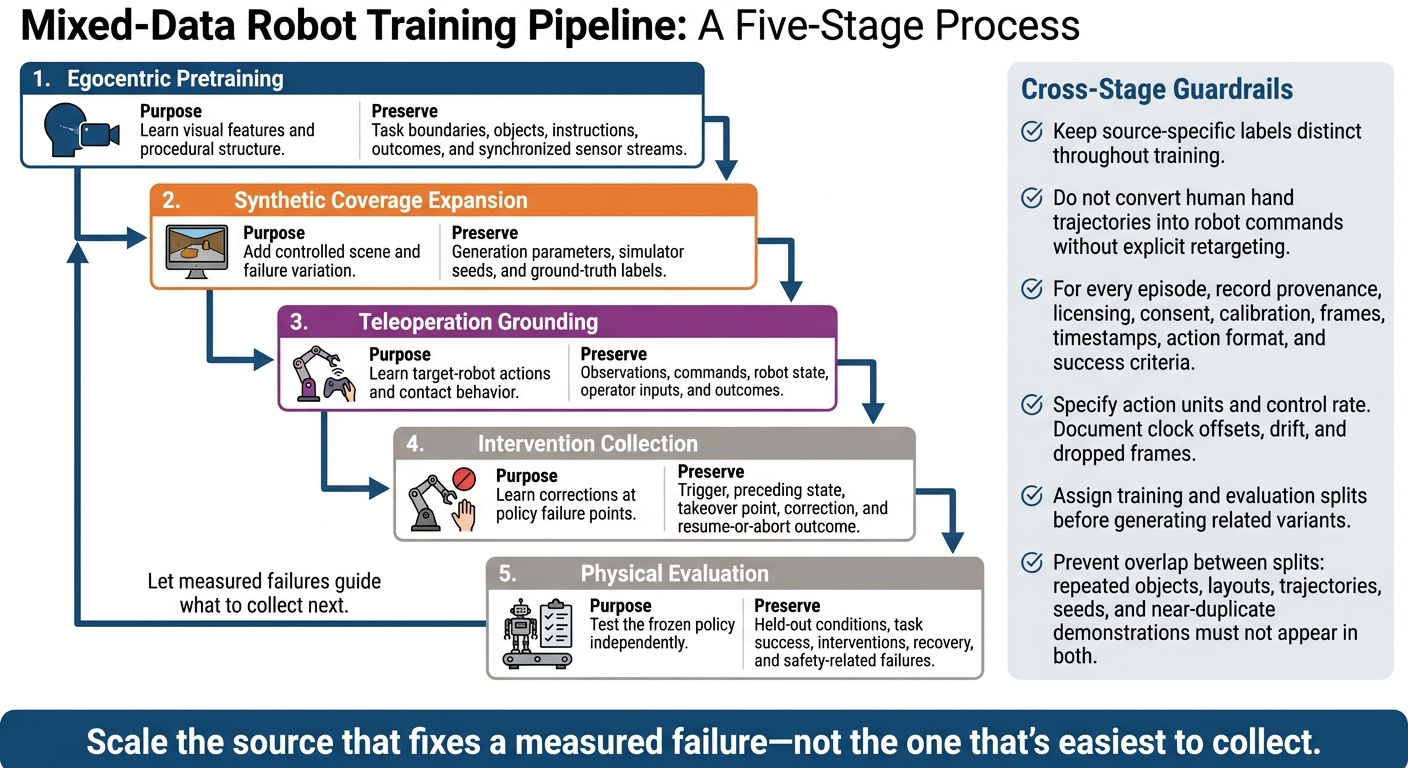
Robot Training: A Mixed-Data Pipeline
After comparing labels, cost, and transfer, choose the data mix that addresses your main bottleneck.
Match Data to the Training Goal
Match collection to the deployed camera, gripper, controller, workspace, and safety limits. If operator time is tight, focus on contact-rich actions and recovery. A 30–50-episode pilot can reveal missing signals and collection bottlenecks before full rollout.
Use teleoperation for action labels, egocentric data for task understanding, and synthetic data for scale and rare cases.
| Training goal | Start with | Add when needed |
|---|---|---|
| Perception and procedural pretraining | Egocentric data for objects, task phases, and human interactions | Robot-view images to address viewpoint differences |
| Controlled variation and rare-condition testing | Synthetic data for repeatable scene changes and generated labels | Physical measurements to check simulation assumptions |
| Target-robot policy learning | Teleoperation with the deployed action space | Broader visual coverage |
| Recovery training | Teleoperation and operator interventions | Simulated perturbations to test failures without physical exposure |
Combine sources when the robot needs both broad task understanding and precise control. Let the missing label, viewpoint, or action space guide your choice. Then keep each source’s labels separate throughout training.
Build a Mixed-Data Training Pipeline
Use the sequence below as your default pipeline. Keep source-specific labels distinct, and do not convert human hand trajectories into robot commands without explicit retargeting.
| Stage | Purpose | Preserve |
|---|---|---|
| Egocentric pretraining | Learn visual features and procedural structure | Task boundaries, objects, instructions, outcomes, and synchronized sensor streams |
| Synthetic coverage expansion | Add controlled scene and failure variation | Generation parameters, simulator seeds, and ground-truth labels |
| Teleoperation grounding | Learn target-robot actions and contact behavior | Observations, commands, robot state, operator inputs, and outcomes |
| Intervention collection | Learn corrections at policy failure points | Trigger, preceding state, takeover point, correction, and resume-or-abort outcome |
| Physical evaluation | Test the frozen policy independently | Held-out conditions, task success, interventions, recovery, and safety-related failures |
For every episode, record provenance, licensing, consent, calibration, frames, timestamps, action format, and success criteria. Specify action units and control rate. Document clock offsets, drift, and dropped frames.
Assign training and evaluation splits before generating related variants. Prevent overlap between the splits: repeated objects, layouts, trajectories, seeds, and near-duplicate demonstrations should not appear in both.
Use this structure to decide what to collect next while keeping the datasets separate.
Plan Data Collection With Evlo.ai
For managed collection through Evlo.ai, turn the pipeline into a scoped brief covering priority tasks, environments, participant consent, required signals, annotations, and acceptance criteria.
Define synchronization, privacy requirements, and success criteria before recording. Request a scoped quote based on participants, hours, modalities, annotation depth, licensing, and quality checks - not raw recording hours alone.
Robotic teleoperation and intervention learning are planned roadmap capabilities, so confirm availability separately if your project depends on them. Budget simulation and physical validation separately.
Conclusion: Balance Task Breadth, Simulation, and Robot Data
These sources complement each other; they aren’t interchangeable. After comparing labels, cost, scale, and transfer, use egocentric data for task breadth, synthetic data for controlled variation, and teleoperation for target-robot action labels.
Start with one or two deployment tasks and clear physical acceptance criteria. Test the smallest data mix that can answer your training question, using the target robot, workspace, and evaluation loop. Then compare it against a robot-only baseline model on the same physical test set. Keep the model architecture and evaluation protocol fixed. That way, changes in success rate, recovery success, operator interventions, and cycle time show what the added data contributes.
Let physical test results guide which source you add next. Scale the source that fixes a measured failure - not the one that’s easiest to collect. Poor robot control points to action alignment or a need for more teleoperation data. Poor generalization calls for targeted task or scene variation from egocentric or synthetic data. Expand only when repeated physical trials show clear gains. More data can’t replace compatible labels, quality checks, or deployment validation.
FAQs
How do I choose the right data mix on a tight budget?
Start with a clear target output, not more data. Use egocentric human video to understand tasks and workflows, and teleoperation logs for robot-native control, recovery, and measured feedback. Label failures and interventions as recovery. Mask missing action labels instead of inventing them.
Pilot 30–50 episodes per task variant, with strict synchronization and calibration checks. Scale only when gains in robot trials justify the cost per usable episode. Don’t pool data from mismatched embodiments, and validate on the robot you’ll deploy.
How can I tell whether synthetic data hurts real-world performance?
Compare performance in actual use with the benchmark from your first successful run. Watch for more frequent interventions, trouble recovering from slips or pose drift, and performance drops when lighting or surfaces change.
Change one factor at a time to isolate the impact of synthetic data. If performance stays poor, prioritize high-fidelity teleoperation data for motor-command ground truth. Treat uncertain results as inconclusive: apparent gains may mask declines in safety or reliability.
When is egocentric pretraining worth the extra effort?
Egocentric pretraining is worth the extra effort when your model needs to learn task structure, long-horizon behavior, or object affordances that are hard to encode with rules alone. It’s especially useful for building scene understanding and perception before the model learns robot control.
It supports cost-effective visual learning across varied settings, but doesn’t provide direct motor commands. For precision tasks like grasping, you’ll need to account for differences between human and robot bodies.