Teleoperation Data vs Egocentric Data vs Synthetic Data

Leela Yanamaddi
November 7, 2026

I’d choose robot training data by what the robot needs to learn - not by how many hours I can collect. Start with teleoperation for robot actions, egocentric human video for task steps, and synthetic data for controlled variation.
Here’s how I’d use the 3 sources:
- Teleoperation: Teach motion and contact through robot observations, commands, and outcomes. The tradeoff: robot access, operator time, and resets cost money.
- Egocentric video: Teach workflows and hand-object interactions. The tradeoff: human motion needs extra labels and mapping before a robot can use it.
- Synthetic data: Generate scenes, actions, and labels in simulation. The tradeoff: simulated physics and sensors may not match the physical robot.
Quick Comparison
| Criterion | Teleoperation | Egocentric video | Synthetic data |
|---|---|---|---|
| Labels | Robot commands and resulting states | Human task sequences; robot actions usually missing | Simulated states, actions, and outcomes |
| Robot match | Close when using the target robot | Requires human-to-robot mapping | Depends on the robot model |
| Physical realism | Physical robot contacts and failures | Physical human interactions, not robot contacts | Depends on physics and sensor models |
| Cost and scale | Limited by hardware and operator hours | Less robot time; added labeling work | Setup and compute costs; scales after setup |
| Main transfer risk | Narrow coverage or hardware mismatch | Missing robot action labels | Simulation-to-hardware mismatch |
My starting point: one robot, one task family, and a small pilot. I’d compare cost per usable episode, then add the source that addresses the largest measured failure - not follow a fixed data ratio.
More data is not the finish line. <u>Test on physical robots using held-out tasks and conditions</u>, and track success, recovery, interventions, cycle time, and safety before scaling.
Ego2Robot: Scalable Robot Data Synthesis from Egocentric Human Data (Aug 2026)
What Each Data Source Provides
These sources differ in who supplies the labels, how observations are recorded, and how closely the data matches deployment conditions. They can also overlap: a teleoperated robot in simulation produces both teleoperation data and synthetic data.
The comparison below explains what each source teaches best, what it leaves out, and when that learning carries over to a physical robot.
Teleoperation: Robot Observations and Actions
Physical teleoperation pairs timestamped sensor observations with joint positions, velocities, gripper state, end-effector pose, operator commands, and outcomes to train robot actions. Commands are not the executed motion: latency, controller limits, and contact can change what the robot does. Log both the command and the resulting state, and define which action representation behavioral cloning should predict. Force or torque measurements are available only if the setup records them.
Grasp demonstrations teach approach direction, wrist orientation, gripper timing, and contact correction. How well they work depends on operator consistency and hardware compatibility. Collection costs include robot access, operator time, safety procedures, maintenance, and resets. Log failed and aborted episodes, too. Check timing, collisions, grasp stability, and recovery behavior; successful demonstrations alone leave gaps around rare failures.
When robot-native actions cost too much to collect, first-person video is the best source for workflow structure.
Egocentric Video: Human Tasks and Workflows
Wearable video, sometimes paired with audio or other sensors, records task order, hand-object interactions, and workspace context without requiring robot access for every recording. It supports visual pretraining, task segmentation, and affordance learning - recognizing where and how objects can be used.
Training a robot policy requires extra labels: object tracks, contact labels, goals, and a mapping to the robot’s reach and gripper. Occlusion, camera differences, and missing force measurements limit what footage can reveal. Test annotation reliability before scaling collection, and set consent, redaction, and secure-storage rules for faces, speech, and package labels.
Simulation fills gaps in physical data collection when you need controlled variation and dense labels.
Synthetic Data: Simulated Scenes and Actions
Scripts, motion planners, reinforcement learning, or simulated teleoperation generate scenes and trajectories while controlling object placement, clutter, lighting, camera angles, and friction. The system logs images, depth, segmentation, states, actions, contacts, and outcomes. These labels are exact within the simulation - not proof of accuracy on a physical robot.
Once assets and tools exist, generation has a low marginal cost, but modeling and compute still cost money. Poor contact physics, sensor models, or timing can teach simulator-specific habits. Calibrate against physical measurements and use failures from real robots to add new simulated cases.
Teleoperation vs Egocentric vs Synthetic Data
Labels, Robot Alignment, Realism, Cost, and Transfer
Compare supervision and robot alignment - not just dataset size - when choosing data for transfer to physical robots. Teleoperation on the target robot supports action learning. Egocentric human video supports workflow understanding. Simulation provides controlled variation at scale. How well each source works depends on data quality, embodiment match, and simulator fidelity.
The key difference is how directly each source teaches a robot what to do.
| Criterion | Teleoperation data | Egocentric human video | Synthetic data |
|---|---|---|---|
| Recorded supervision | Robot commands and outcomes | Human task sequences and hand-object interactions | Simulated states, actions, and labels |
| Action supervision | Direct robot commands, joint or end-effector actions, gripper state, and timing | Usually implicit human hand motion; robot actions must be inferred or retargeted | Explicit simulated actions, poses, contacts, rewards, and success labels |
| Embodiment alignment | High when the demonstrator and target robot match; lower across different robots | Low to moderate because human anatomy and robot kinematics differ | High within the simulator if the robot model matches; uncertain on hardware |
| Physical realism | Physical-world appearance, contact, and failure behavior | Realistic human workflows, but not robot interactions | Controllable appearance and physics; contact dynamics may be inaccurate |
| Collection cost | High upfront hardware, operator, safety, and reset costs; marginal cost increases with robot time | Lower hardware cost, but annotation and retargeting can be expensive | High simulator-development cost; low marginal cost after setup |
| Scalability | Limited by physical operating hours and wear | Scales across people, environments, and tasks, subject to privacy and labeling constraints | Very high through procedural variation and parallel simulation |
| Main transfer risk | Demonstrator bias, limited coverage, and mismatch between recorded and deployed conditions | Human-to-robot embodiment gap and missing action labels | Sim-to-real gap in appearance, dynamics, contacts, and sensor behavior |
| Best-fit training stage | Action-policy learning, imitation, recovery, and robot-specific fine-tuning | Workflow understanding, task decomposition, and pretraining | Representation pretraining, controlled variation, planning, and policy initialization |
Compare sources by cost per usable, task-relevant episode, not recording hours. Include equipment, labor, annotation, maintenance, and quality control (QC).
Strengths, Limits, and Suitable Tasks
Match each source to the training stage it supports, using these tradeoffs.
| Source and training outcome | Principal strength | Principal limitation | Suitable task |
|---|---|---|---|
| Teleoperation: action learning and recovery | Direct, synchronized robot observations and actions; records real contacts and recovery behavior | Expensive, slow, embodiment-specific, and difficult to scale across environments | Target-robot grasping, manipulation imitation, failure recovery, and deployment-specific fine-tuning |
| Egocentric video: workflow understanding and pretraining | Broad coverage of human workflows, task sequences, and object interactions | Lacks direct robot action supervision and has a human-to-robot embodiment gap | Workflow understanding, task decomposition, affordance learning, and representation pretraining |
| Synthetic data: variation, planning, and initialization | Explicit labels, repeatable experiments, rare-event generation, and large-scale controlled variation | Simulator assumptions may produce unrealistic physics, appearance, or sensor behavior | Manipulation pretraining, scene diversity, planning, benchmarking, and policy initialization |
Use human video for task-level learning. Retarget it before treating it as robot action data.
Synthetic data helps only when friction, compliance, latency, and collision response match the real robot. Visual realism alone does not ensure transfer.
Choose and Combine Data for Your Robot
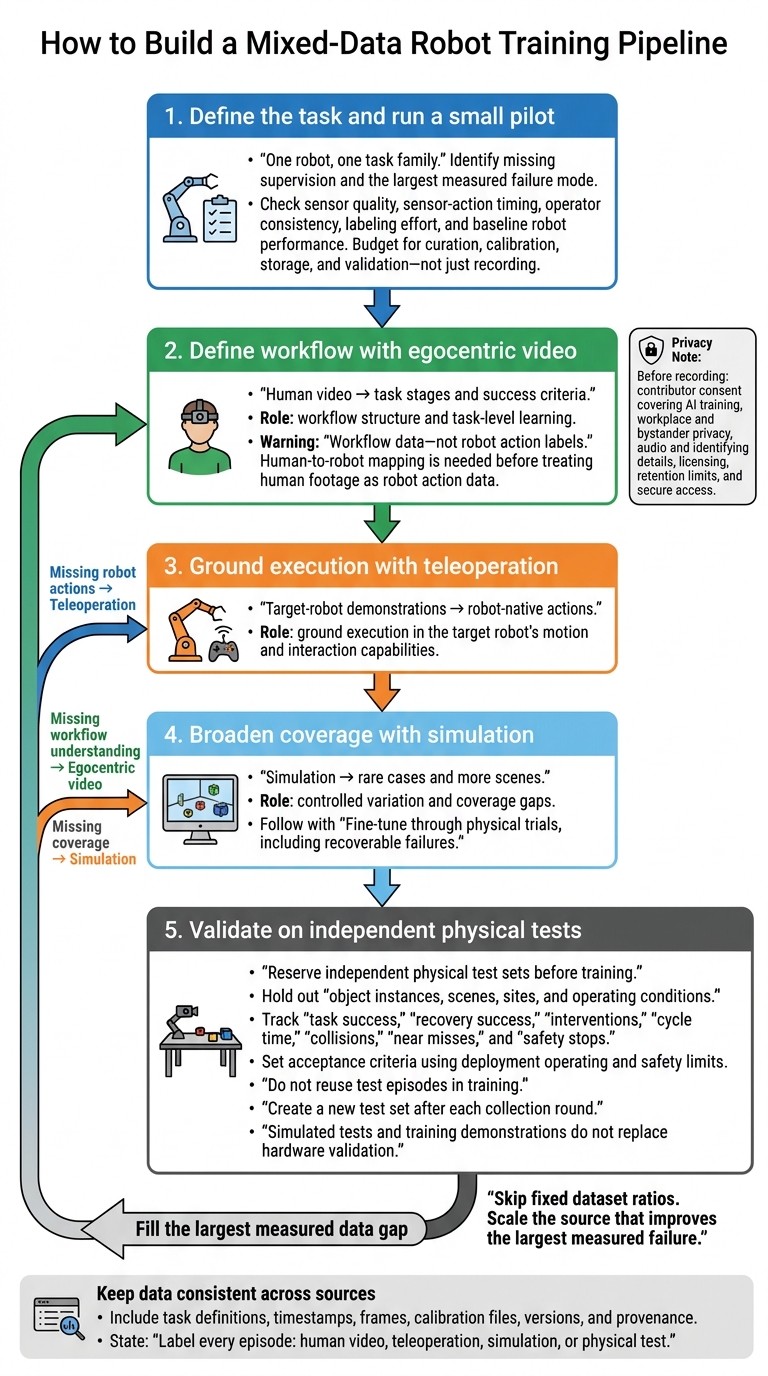
How to Build a Mixed-Data Robot Training Pipeline
Match Data to the Training Goal
After weighing source tradeoffs, identify the supervision your dataset lacks. Use teleoperation for robot-native actions, egocentric video for workflow structure, and synthetic data for controlled variation. Set the balance based on task complexity and deployment needs. Contact-rich industrial tasks need more evidence from target hardware than an early research prototype. Skip fixed dataset ratios; fund the source that addresses the largest measured failure mode.
Start with the smallest dataset that addresses that failure mode. Add more only when a pilot shows it improves performance. Smaller teams should begin with one robot and one task family before expanding collection. Check sensor quality, sensor-action timing, operator consistency, labeling effort, and baseline robot performance. Budget for curation, calibration, storage, and validation - not just recording. Scale when the pilot shows which added data improves performance per dollar and collection hour.
Build a Mixed-Data Training Pipeline
Give each source a clear role: define the task, ground execution, broaden coverage, then validate. Use human video to define task stages and success criteria, followed by target-robot demonstrations to ground execution. Use simulation to cover rare cases and more scenes, then fine-tune through physical trials that include recoverable failures. Keep task definitions, timestamps, frames, calibration files, versions, and provenance consistent across sources. Label every episode by source: human video, teleoperation, simulation, or physical test.
Managed human collection provides workflow data - not robot action labels or a replacement for robot demonstrations. Before recording, secure contributor consent that covers AI training, workplace privacy protections, licensing, retention limits, and secure access. Also plan for bystander privacy, audio recording, and identifying details.
Test on Physical Robots Before Deployment
Keep evaluation separate from training so physical test results remain reliable. Reserve independent physical test sets before training, holding out object instances, scenes, sites, and operating conditions. Track task success, recovery success, interventions, cycle time, collisions, near misses, and safety stops. Set acceptance criteria based on the deployment’s operating and safety limits.
Do not reuse test episodes in training, and create a new test set after each collection round. Use failure categories to determine whether the next data gap involves robot actions, human workflows, or simulation coverage. Simulated tests and training demonstrations do not replace hardware validation.
Conclusion: Match Supervision, Then Fill Data Gaps
Comparing labels, alignment, realism, cost, and transfer points to a clear priority: choose supervision and embodiment alignment before dataset size. For robot-specific control, start with teleoperation on the target robot or a close match. Use egocentric video to add workflow context and synthetic data to fill coverage gaps - not to replace robot supervision.
Run a small pilot with clear thresholds for label quality, held-out task success, and safety. Then test the choice on hardware by comparing the mixed-data policy with a teleoperation-only baseline on physical robots.
Judge value by usable supervision and on-robot performance, not recording cost alone. Include the costs of curation, simulation calibration, and failed trials. Scale the source that improves the weakest measured result - not the one that generates the most hours or frames.
FAQs
How can I tell which data source will fix my robot’s failures?
Use physical test logs to find the root cause. For failures in motor control, contact behavior, or recovery, prioritize high-quality teleoperation data. If the system struggles across different scenes or tasks, use egocentric video to help it understand workflows, or synthetic data to test controlled variations and rare edge cases.
Measure progress with held-out physical tests. Track task success, recovery rates, and how often a person needs to intervene - not just dataset volume.
Can I reuse training data across different robots?
Robots differ in joint limits, grippers, sensor placement, control frequencies, and kinematics. This embodiment mismatch makes training data hard to reuse. Simply pooling recordings doesn’t guarantee that learning will transfer between robots.
High-quality, synchronized data that includes commands, robot state, and intervention markers is easier to reuse. Actions often need explicit retargeting to fit the target robot’s constraints. When combining data sources, keep source-specific labels distinct to prevent negative transfer.
How do I know when I have enough training data?
You have enough training data when your model consistently meets defined physical acceptance criteria on held-out tests. Focus on data quality, synchronization, and task coverage - not just volume.
Start with 30–50 episodes per task variant. Collect more only when physical trials show higher success rates, better recovery, or fewer operator interventions. Let deployment failures guide what you collect next, so new data improves safety and performance rather than just adding episodes.