Building an In-House Data Collection Team vs Buying Collections

Leela Yanamaddi
October 13, 2026
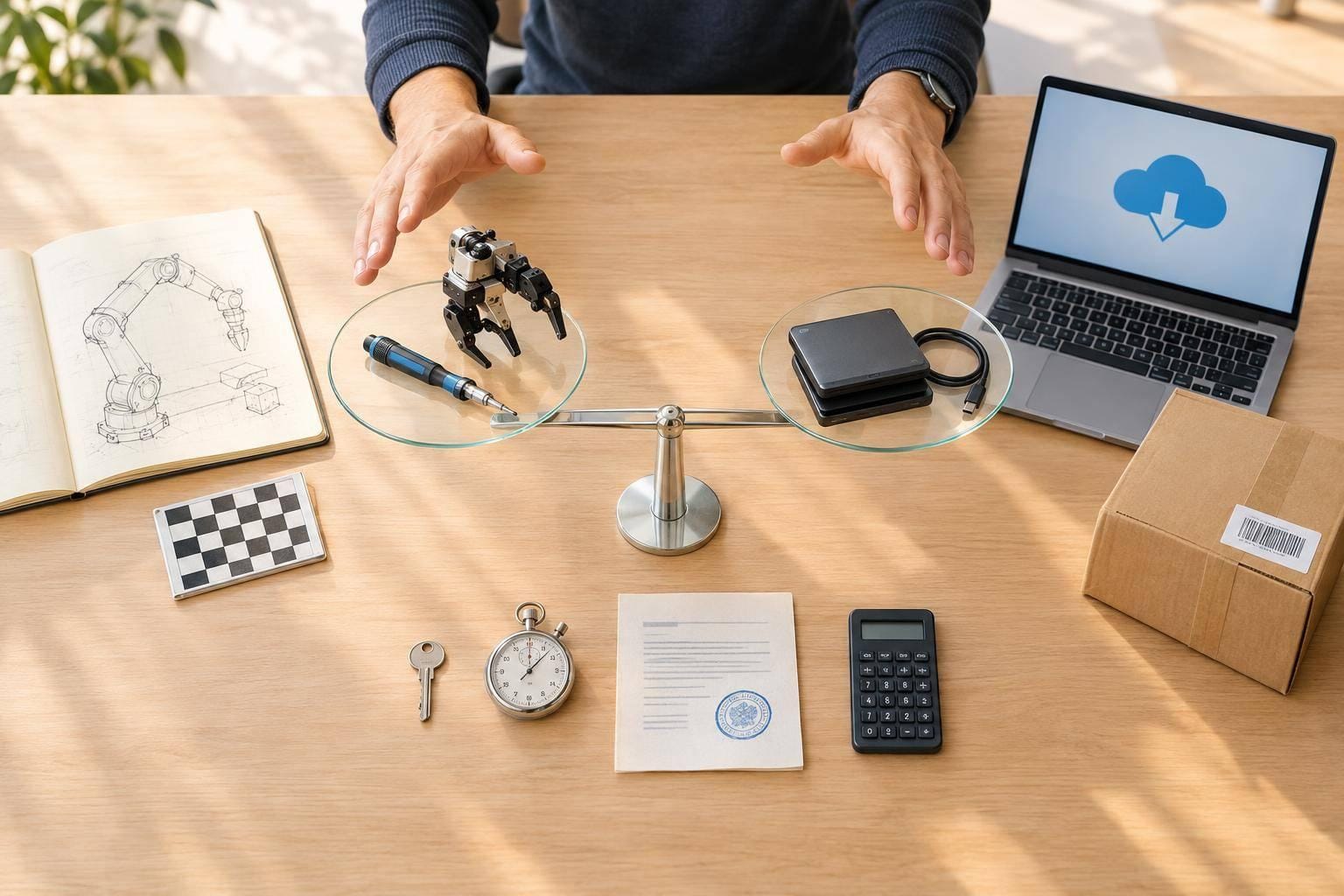
I’d build in-house for control, buy data for speed, and use a hybrid approach when I need both. Before committing, I’d test about 100 demonstrations through preprocessing and a small validation run - not judge a collection by recording volume alone.
Here’s how I’d compare the options:
- In-house: I manage staff, equipment, training, and quality checks. This fits confidential work, frequent protocol changes, and repeat demand.
- Licensed datasets: I buy existing recordings when the tasks, sensors, formats, and usage rights match my needs.
- Custom external collection: I specify the robot, sensors, tasks, and acceptance rules while a provider handles collection.
- Hybrid: I keep protocol design, safety, privacy, and final review internal, then use outside teams for extra volume or task variation.
Quick Comparison
| Criterion | In-house | Licensed datasets | Custom external | Hybrid |
|---|---|---|---|---|
| Control | Direct control | Limited to existing data | Set through the contract | Internal rules, shared collection |
| Task fit | Built to my requirements | Must check available coverage | Built to agreed requirements | Internal core plus outside variation |
| Time to usable data | Hiring and setup first | Fast if files and rights pass | Scoping and pilot first | Can start with purchased data |
| Cost structure | Staff, equipment, and upkeep | License plus review and integration | Project fees plus review | Internal costs plus outside fees |
| Quality and rights | I manage and document them | I verify them | I define and verify them | Same checks across sources |
My deciding measure is <u>total cost per accepted demonstration</u>, including review, legal work, integration, and re-collection. Cheap recordings aren’t cheap training data if I can’t use them. I’d require task fit, quality, consent, rights, safety, and security to pass before scaling.
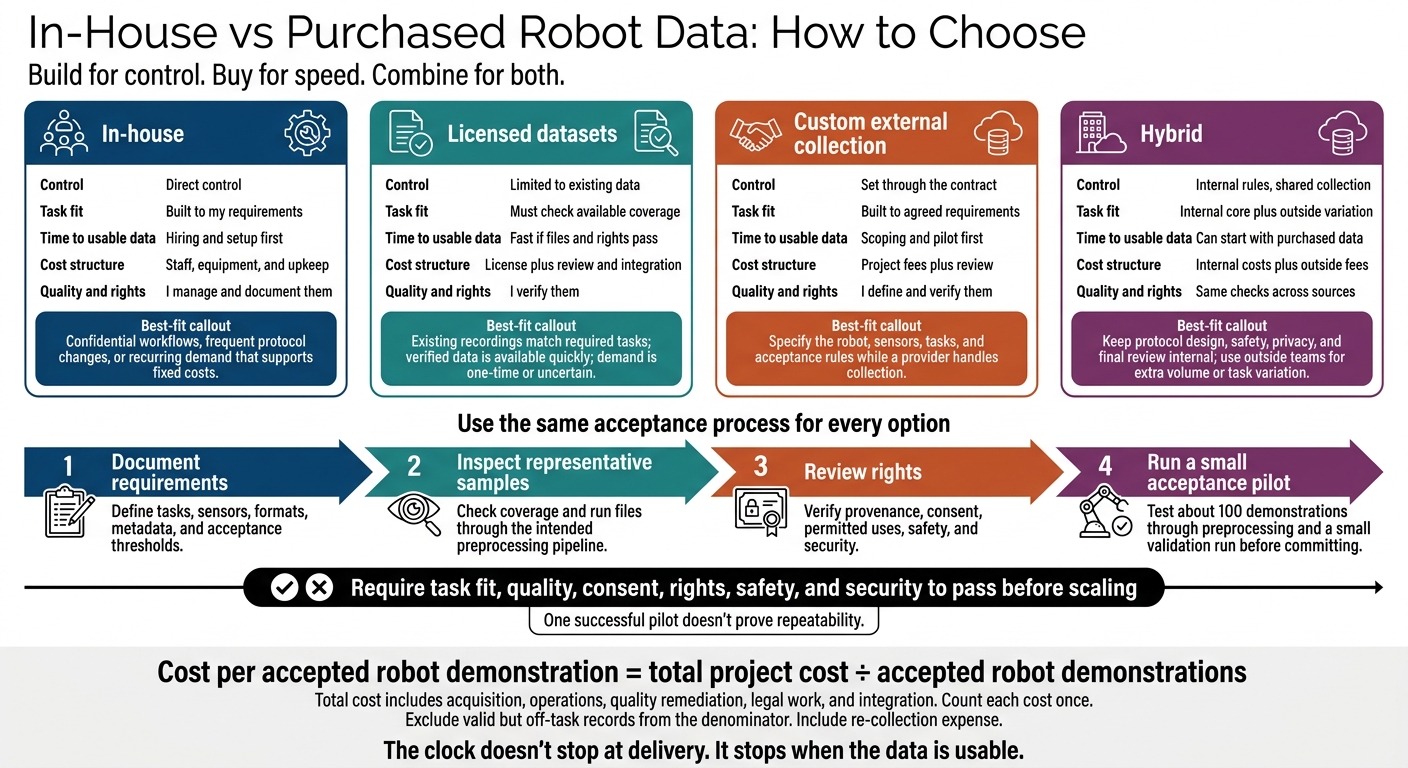
In-House vs Purchased Robot Data: How to Choose
Ep: 1 Data Collection Best Practices
Compare Collection Responsibilities and Control
Assign an owner to every collection responsibility before committing. An outside provider can handle collection, but your team still owns data fit, privacy, and acceptance. Start with ownership, then check quality and rights.
| Responsibility | In-house collection | Licensed datasets | Custom external collection |
|---|---|---|---|
| Staffing | You recruit and manage contributors, engineers, annotators, and reviewers | Provider handles collection; you handle evaluation and integration | Provider manages collection staff; you assign a project owner and acceptance reviewers |
| Equipment | You purchase, calibrate, maintain, and secure the capture setup | Verify sensor setup and documentation against requirements | Agree on equipment specifications and who supplies it |
| Workflow control | You directly control protocols, review queues, and re-collection | Limited to existing tasks, participants, sensor formats, and quality procedures | You control collection through specifications, milestones, acceptance criteria, and change requests |
| Privacy responsibility | You manage consent, access, retention, and deletion | Verify consent evidence and permitted uses | Assign responsibility for consent, security, deletion, and incident reporting in the contract |
| Scalability | Limited by hiring, equipment, facilities, and review capacity | Fast when suitable inventory exists | Depends on provider capacity and agreed scope |
| Time to usable data | Recruitment, setup, and quality calibration come first | Fastest once rights and file checks pass | Requires scoping, a pilot, collection, and acceptance review |
In-House Staff, Equipment, and Workflows
An internal program needs a manager, technical leads, contributors, reviewers, and privacy support. Assign clear ownership of capture, review, and security, even when roles overlap. The capture setup may include cameras, microphones, robot and environmental sensors, calibration tools, and recording workstations. It also needs capture software, synchronization, and access-controlled storage. Budget for recruiting, training, employee benefits, equipment depreciation, maintenance, facility space, cloud storage, and backup systems.
Define the protocol before training contributors. Set task success criteria, sensor settings, required metadata, and rejection thresholds. Then train contributors with demonstrations and practice runs. Give each demonstration its own ID and record the operator, robot, task variant, timestamps, environment, sensor setup, and outcome.
Automated checks can flag missing frames, invalid sensor values, timestamp drift, abnormal duration, or incomplete actions before the contributor starts the next demonstration. Human reviewers should inspect borderline demonstrations and send failures to a re-collection queue. They should also maintain versioned manifests for raw, reviewed, corrected, and approved data. That level of control comes with ramp-up time, contributor turnover, equipment failures, and interruptions to collection.
Licensed Datasets vs Custom Collection
Neither option removes integration work. Your team still checks suitability, loads files, validates metadata, and plans updates when requirements change.
| Criterion | Licensed datasets | Custom external collection |
|---|---|---|
| Speed | Fast when inventory, documentation, and rights are ready | Requires scoping, pilot collection, production, review, and delivery |
| Customization | Limited to available recordings and provider revisions | Tailored to agreed tasks, settings, participants, sensors, and formats |
| Task coverage | Broad coverage may exist, but uncommon edge cases can still be missing | Can target specific motions, objects, environments, and failure modes |
| Rights verification | Review license scope, provenance, consent, and restrictions | Define ownership or licensing, permitted uses, participant releases, and evidence delivery |
| Exclusivity | Usually nonexclusive unless negotiated | May be exclusive for specified data, geography, period, task, or participant group |
| Expected rework | May require filtering, relabeling, conversion, or additional collection | Limit rework through pilots, acceptance tests, rejection rules, and revision rounds |
Once you know who controls what, check whether the data fits the robot, the task, and the license.
Evlo.ai Data Collection Options
Evlo.ai offers egocentric video, multimodal recordings, and human task demonstrations through licensed datasets, custom datasets, and managed data partnerships. It checks trainable egocentric clips against five pass/fail gates: viewpoint, action, completeness, synchronization, and privacy.
Confirm availability and request written details on deliverables, acceptance thresholds, consent records, contractual rights, and replacement terms for rejected records. Also request a sample package with recordings, annotations, metadata, calibration files where applicable, and provenance records. Once ownership and delivery terms are clear, check the data against your quality, rights, and task-coverage needs.
Assess Data Quality, Rights, and Task Coverage
A low price cannot make up for recordings you can’t train on or legally use. Start with a gate-first scorecard: rights, consent, safety, and security must pass before you score quality, coverage, and repeatability.
| Criterion | Weight | Minimum requirement | In-house evidence | Purchased-data evidence |
|---|---|---|---|---|
| Recording quality | 20% | Meets limits for blur, occlusion, missing frames, and synchronization | QA reports and rejected-sample log | Vendor acceptance criteria and audit sample |
| Task and scenario coverage | 20% | Covers required actions, objects, settings, viewpoints, and failure cases | Coverage matrix and batch counts | Catalog, manifest, and coverage report |
| Rights and licensing | Gate | Written rights for intended training, evaluation, commercial use, derivatives, and internal sharing | Participant releases and employer permissions | License, chain-of-title records, and restrictions |
| Privacy and consent | Gate | Valid consent, de-identification, retention, deletion, and applicable legal review | Consent forms and privacy procedures | Consent attestations and processing records |
| Safety | Gate | No unsafe demonstrations; documented collection and review procedures | Safety training, incident logs, and approvals | |
| Security and access | Gate | Controlled access, encryption, secure transfer, and breach procedures | Access logs and security controls | Transfer method, hosting controls, and subprocessors |
| Format and interoperability | 10% | Complete schema, usable formats, timestamps, calibration, and coordinate frames | Internal pipeline tests | Sample import test and data dictionary |
| Repeatability and consistency | 15% | Later batches meet the same protocol and acceptance rates | Protocol versions and batch comparisons | Historical batch metrics and quality guarantees |
| Metadata completeness | 10% | Required labels and device/context metadata are present | Collection forms and automated validation | Manifest, annotation guide, and completeness report |
| Representation and variation | 15% | Enough variation in people, lighting, layouts, tools, and object conditions | Sampling plan and audit of demographics and settings | Dataset composition report |
Use the scorecard to reject unusable collections first. For collections that pass the gates, test task fit, technical quality, and then the details of the usage rights.
Task Coverage and Fit for the Target Robot
Build a coverage matrix for every action your robot needs to perform in its target setting. Include objects, materials, tools, layouts, lighting, viewpoints, operator styles, and success, failure, and recovery states.
Don’t judge coverage by episode count alone. Check camera placement, hand visibility, robot reachability, object scale, and whether the sensors provide the data your robot needs. Task coverage and label coverage are different: a video can show the task but lack the robot trajectories, force data, gripper state, or action labels needed for imitation learning.
Recording Quality, Metadata, and Repeatability
Apply the same acceptance limits to in-house and purchased collections. Before sampling, set measurable limits for blur, occluded hands, clipped objects, missing frames, dropped audio, exposure problems, and camera shake. Define how much timestamp drift is allowed between cameras, robot logs, audio, and other sensors.
Set annotation-agreement targets by having samples labeled twice and resolving disagreements through adjudication. Reject samples that exceed the allowed inconsistency rate.
Require timestamps, device details, task and outcome labels, calibration, scene metadata, documented formats, and records of edits or compression. Audit representative raw files across devices, dates, operators, and difficulty levels. Then run those files through the pipeline you plan to use.
Repeat the audit on a second batch and after any protocol, device, or operator change. Compare rejection rates and annotation agreement. One successful pilot doesn’t prove repeatability. In-house teams need versioned procedures and calibration checks. Buyers need batch-level evidence and written remedies for data that fails to meet the agreed requirements.
Consent, Data Rights, and Security
After checking technical fit, verify the legal rights to use the data. Review provenance, participant releases, workplace permissions, and rights to train, evaluate, deploy, modify, share internally, and redistribute.
Check de-identification, access controls, secure transfer, retention, deletion, and how subprocessors handle the data. Have counsel review applicable U.S. state privacy, biometric, and recording-consent rules.
Illinois BIPA, for example, requires written consent for certain biometric collection.
Compare Total Cost and Time to Usable Data
Once data passes quality and rights checks, compare what it costs to make that data usable.
Total cost includes acquisition, operations, quality remediation, legal work, and integration. Count each cost once.
Staffing Costs, Purchase Fees, and Hidden Work
Budget for a defined output, not just a spending limit. Before estimating costs, set task types, acceptance thresholds, usable hours, duration, and expected reuse. Then replace estimates with quotes and pilot results. Group costs into acquisition, recurring operations, remediation, legal work, and integration.
| Cost category | In-house collection | Licensed datasets | Custom external collection |
|---|---|---|---|
| One-time | Recruiting, protocol design, equipment, calibration, facility setup, and annotation tools. Hardware and setup can cost about $5,000 to $200,000 per station, depending on instrumentation. | Sample review, legal review, testing, preprocessing setup, and license fee. | Provider qualification, statement of work, pilot, and integration setup. |
| Recurring | Salaries, benefits, management, maintenance, storage, insurance, compliance, and idle capacity. | Renewals, updates, support, storage, and access fees. | Program management, periodic data updates, continued quality assurance, storage, and change orders. |
| Variable | Operator hours, travel, consumables, annotation, and re-collection. Fully loaded skilled teleoperation labor is estimated at $35 to $65 per hour; onboarding may take 3 to 5 days per operator. | Seat or usage fees, minimum orders, customization, rush delivery, and replacement data. | Demonstration volume, task complexity, rush charges, custom labeling, and replacement data. |
| Hidden | Churn, training time, downtime, opportunity cost, underused equipment, and safety incidents. | Coverage gaps, restrictive rights, missing metadata, unsuitable formats, vendor lock-in, audits, and exclusivity premiums. | Contracting delays, audit effort, inconsistent operators, transfer costs, rejected-data replacement, and exclusivity premiums. |
An in-house program can cost around $50 to $200 per demonstration with overhead. But the comparison depends on your project. A low sticker price can become expensive when data needs relabeling, reformatting, or supplementation.
Separate purchase price from usable output. In-house costs continue during downtime and repairs. For licensed data, separate the license fee from audit, annotation, and integration costs. For custom collection, require the quote to state whether it includes replacement of rejected data.
Delivery Time and Cost per Accepted Demonstration
The clock doesn't stop at delivery. It stops when the data is usable.
Compare schedules by when data is ready for training. In-house collection requires recruiting, onboarding, setup, and protocol validation. Licensed data still requires sample review, contracting, and import checks. Custom collection adds protocol transfer, pilot approval, production, and corrections. Ask for milestone dates rather than a single delivery promise.
Cost per accepted robot demonstration = total project cost ÷ accepted robot demonstrations.
Cost per usable hour = total project cost ÷ quality-approved recording hours.
Include annotation, supervision, rework, and integration in total cost. Exclude valid but off-task records from the denominator. If rejected data requires re-collection, include that expense too. Run optimistic, expected, and conservative scenarios using accepted yield, operator utilization, annotation effort, downtime, and needs for updated data.
Conclusion: Choose In-House, Purchased, or Hybrid Collection
Once you’ve checked fit, rights, cost, and time, the decision comes down to control, speed, and scale.
Apply the same pass/fail gates and weighted scorecard to every option. Reject any option that fails task fit, quality, rights, privacy, security, or safety.
When to Build an In-House Team
Build in-house when workflows are confidential, protocols change often, or exclusivity is worth the fixed cost.
When to Buy Data Collections
Buy when licensed recordings already match your tasks and timeline, and demand doesn’t justify permanent infrastructure. Confirm that the license allows you to train, evaluate, and deploy.
If neither option fits on its own, split the work.
When to Combine Internal and External Collection
Hybrid collection pairs internal governance with external capacity. Keep protocol design, safety standards, governance, and final acceptance in-house. Use external capacity for recruitment, geographic diversity, rare environments, or volume.
Apply the same schemas, calibration procedures, privacy rules, and QA thresholds across all sources.
| Requirement | Favor in-house | Favor purchased | Favor hybrid |
|---|---|---|---|
| Sensitivity | Confidential facilities or workflows | Low-sensitivity data with verified handling | Sensitive core stays internal |
| Customization | Robot- and facility-specific protocols | Required tasks already covered | Internal protocols, external variations |
| Volume | Recurring demand supports fixed costs | One-time or uncertain demand | Internal baseline, external surges |
| Timeline | Time for hiring and setup | Verified data available quickly | Purchased baseline while building capacity |
Before committing, document requirements, inspect representative samples, review rights, and run a small acceptance pilot. Expand only when the pilot meets coverage, quality, rights, and schedule requirements.
FAQs
When does in-house collection become cheaper than buying data?
In-house collection costs less when its total cost per accepted, training-ready episode falls below the external provider’s effective cost per accepted episode. Count contributor labor, annotation, quality control, storage and egress, and failure recovery.
Keep utilization and acceptance rates high enough that rejected sessions and downtime don’t eat up the savings. Build a bottom-up budget in U.S. dollars, and compare costs per accepted output - not per raw hour.
Can human demonstrations train my robot without action labels?
Human demonstrations without action labels can help train models, but they’re usually not enough for direct robot control. They teach models about task structure, workflows, and how to use objects. What’s missing? Robot commands, contact forces, and kinematic alignment.
Use these demonstrations for visual pretraining or task understanding. To teach a model how to execute tasks, you’ll eventually need teleoperation logs with synchronized robot states and action labels.
How do I choose representative samples for a data pilot?
Map what the robot needs to do to specific tasks, settings, and times of day. Have 5–10 contributors - typical users, plus domain experts as needed - record 30–50 episodes per task variant. Use a task matrix to define camera angles, variations, and metadata.
Test the smallest data mix that answers your training question using the target robot and workspace. Before scaling up, apply quality rules to check intended actions, recovery behaviors, and edge cases.