Best Egocentric Data Providers for Robotics Teams, Compared

Leela Yanamaddi
October 17, 2026
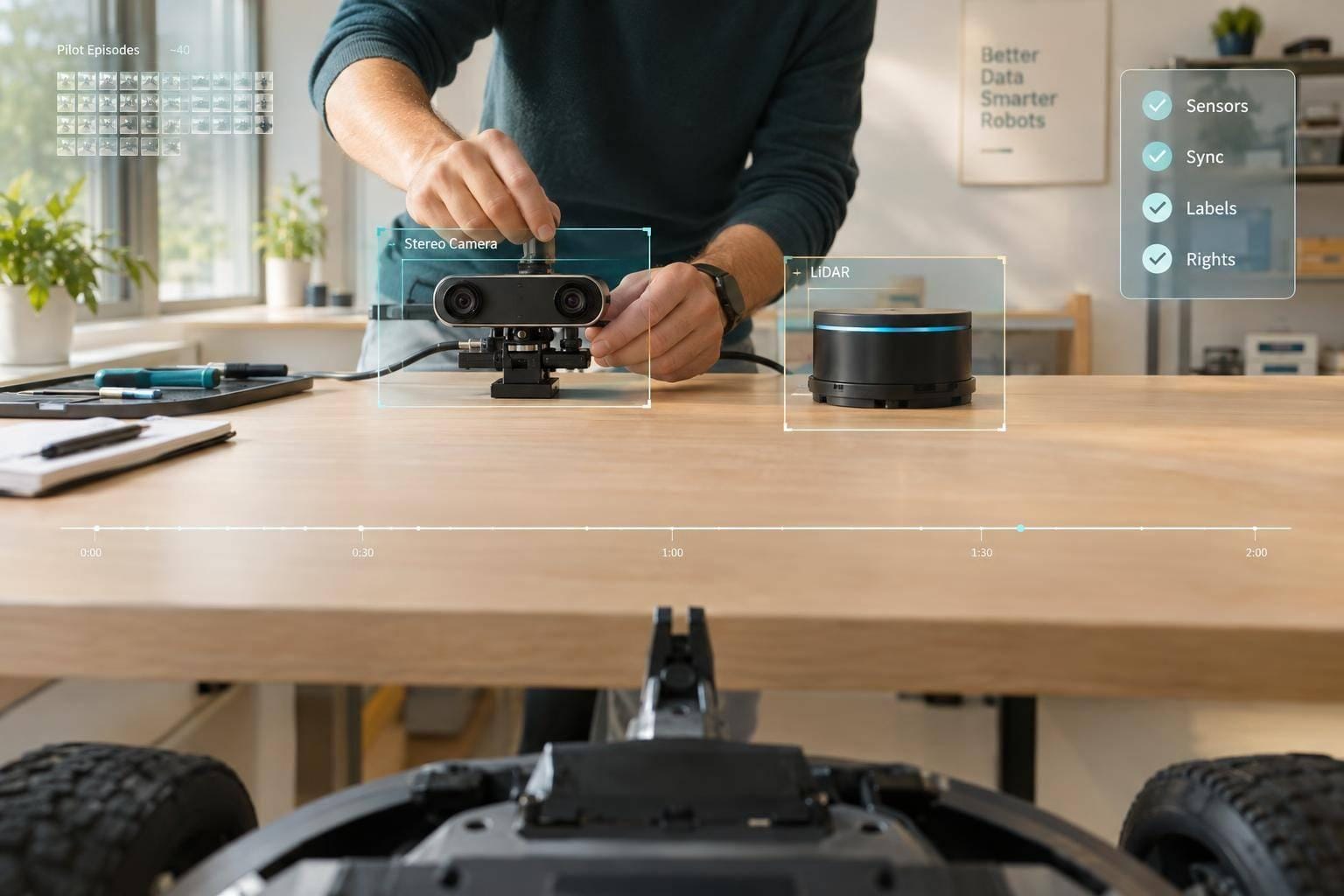
My advice: choose by training goal - not video hours - and test 30–50 episodes before buying at scale. Ready-made datasets can support perception pretraining. For robot-control training, I’d look for demonstrations with the required action commands, robot states, and sensor alignment.
I compare 11 options on task coverage, camera views, synchronization, labels, privacy, commercial rights, delivery, and total cost in U.S. dollars. The first check: <u>human hand motion is not robot-control data</u>.
Quick Comparison
| Provider or dataset | What I’d consider it for | Main check before use |
|---|---|---|
| Evlo.ai | Licensed data and custom collection | Confirm sensors, task coverage, and action labels |
| Appen | Commissioned multimodal demonstrations | Set timing, calibration, and label requirements |
| Unidata | Licensed datasets and custom robot demonstrations | Verify included streams and action formats |
| Digital Divide Data | Ready-made stereo workplace data | Check task range, calibration, and license scope |
| Roborax | Contact-rich task collection | Verify force measurements and stream alignment |
| Robgence | Dataset access and custom teleoperation collection | Confirm robot support and observation-action alignment |
| Meta Ego4D and Ego-Exo4D | Visual pretraining and cross-view learning | Check usage rights; robot-control targets are absent |
| EPIC-KITCHENS | Kitchen perception and action recognition | Obtain separate permission for commercial use |
| OpenEgo | Pretraining across six source datasets | Review each source’s license and available sensors |
| Open-AoE | Smartphone-based manipulation pretraining | Validate estimated motion and release terms |
| EgoLive | Stereo manipulation pretraining | Confirm access, calibration, labels, and rights |
There’s no single best choice for every team. I’d request a sample episode, load it into my training pipeline, and confirm written rights before committing. Then I’d compare cost per accepted episode, including licensing, processing, storage, and rework - not just the quoted recording rate.
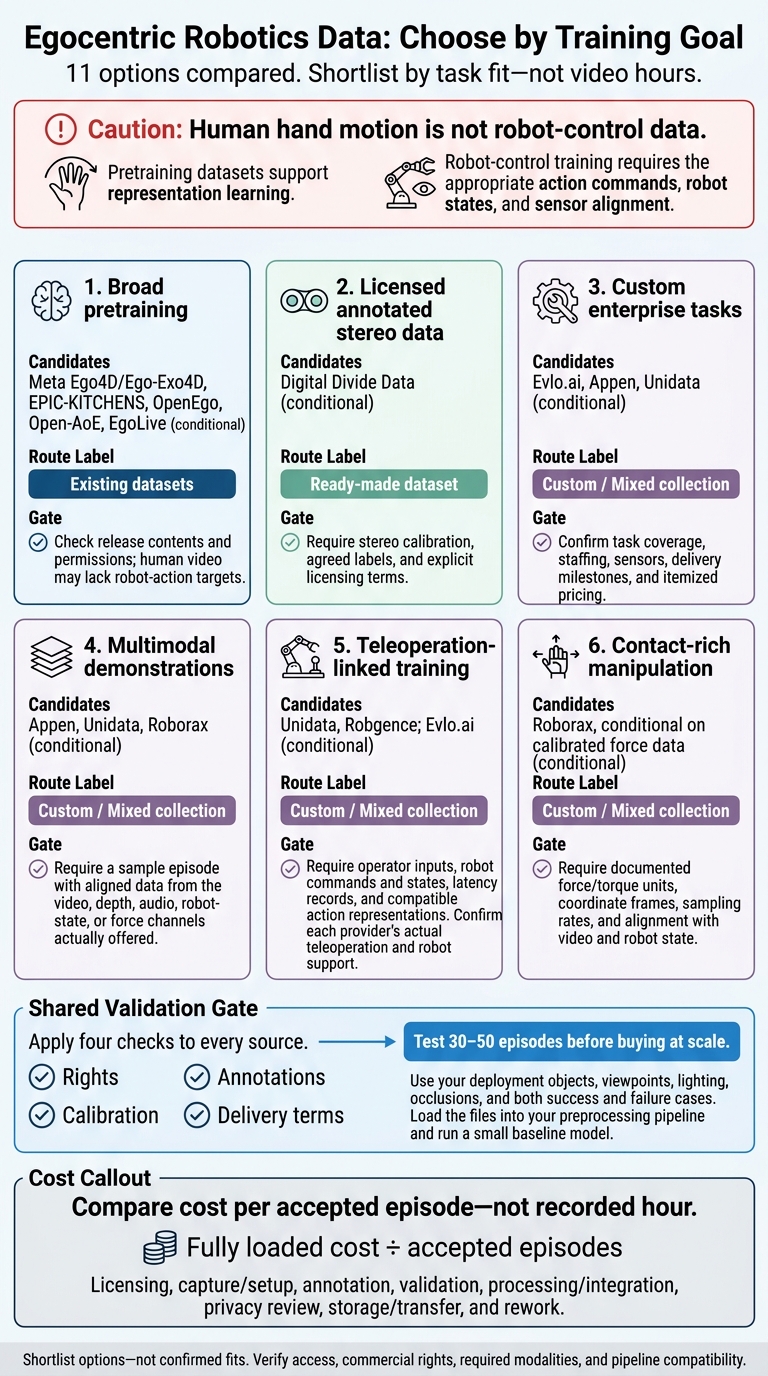
Egocentric Robotics Data: Choose by Training Goal
1. Evlo.ai
Capture Setup and Tasks
Evlo.ai offers ready-made collections and custom dataset services. For commissioned work, spell out the camera mount, tools, objects, and task variations in the statement of work. Public materials don’t specify capture hardware or manipulation-task coverage, so get those details in writing.
Synchronization and Labels
Next, check synchronization and annotation quality. The available materials describe synchronized multimodal inputs but don’t specify sensor-level synchronization guarantees for robotics demonstrations. Evlo.ai says a second expert reviews tasks before delivery. Confirm that this review covers both robotics demonstrations and temporal labels.
Privacy and Commercial Rights
Evlo.ai’s public terms place enterprise dataset licensing and custom data services under a Master Services Agreement. Separate engagement agreements govern contributor work. The terms also state that contributor-created intellectual property is assigned under the applicable engagement agreement, and no dataset license is granted without explicit written consent.
Negotiate consent, retention, withdrawal, model training, deployment, exclusivity, resale, and derivative-dataset rights.
Delivery and Total Cost
Once the technical fit is clear, procurement terms determine whether the project can scale. No public pricing is listed. Request itemized rates for capture, annotation, licensing, storage, and rework. Tie payments to accepted deliverables and pilot milestones.
2. Appen
Capture Setup and Tasks
Appen suits robotics teams that need commissioned egocentric collection with a defined sensor stack, rather than passive video alone. Its stereo first-person rigs use wrist-pose and gripper-state sensors, with extra streams available when needed.
The key check: can Appen support your exact manipulation task, sensors, and label detail? Ask for the camera baseline, resolution, frame rate, calibration files, and a task matrix that specifies each action. Also confirm whether the data is commissioned, licensed, or a mix of both. Appen describes human demonstrations in kitchen, assembly, and logistics settings, with labels for object states and hand trajectories.
Synchronization and Labels
Appen says its hardware-synchronized rigs record streams against a common clock, with sub-millisecond alignment metadata. One case study reports synchronization error within 0.1 second and annotation accuracy of at least 99.5%. Treat those figures as project-specific results, not guarantees.
Before approving production, request the synchronization specification, timestamp format, clock-drift limits, calibration records, dropped-frame reports, and a sample trajectory. For labels, ask for the schema, definitions, inter-annotator agreement, validation sampling rate, and correction policy.
Privacy and Commercial Rights
Appen’s enterprise materials describe encrypted transfer, isolated access, written retention and deletion terms, and defined licenses. They do not promise automatic ownership transfer.
Confirm that your agreement covers raw video, sensor streams, calibration files, annotations, and synchronized trajectories. For worksite collection, spell out requirements for participant consent, bystanders, location data, retention and deletion, and robot-training and deployment rights.
Delivery and Total Cost
Appen does not publish a standard robotics price list in the available materials. Custom projects are priced case by case. When comparing options, distinguish providers that handle managed collection from those better suited to dataset access alone.
Request a U.S.-dollar quote with separate fees for setup, capture, annotation, validation, storage, revisions, and delivery. Set dates for pilot approval, first delivery, final acceptance, and rework.
3. Unidata
Capture Setup and Tasks
Unidata sells licensable datasets and custom data collection through teleoperation, VR control, and kinesthetic teaching. Its egocentric offering reports stereo RGB, depth, 6-DoF motion, hand tracking, and full-body skeleton data. Custom robotics collection can add joint states, force-torque logs, and trajectories for picking, placing, assembling, and sorting. Confirm which streams and camera views your purchase includes.
One offering lists 15,000+ scenarios and approximately 200 hours. But those numbers need context: does “scenario” mean a task, clip, or attempt? Check how much footage is usable and annotated, and don’t combine catalog totals until you’ve confirmed their scope. These details help you judge whether the data fits your manipulation-learning needs.
Synchronization and Labels
Unidata reports synchronized streams with frame-level labels for object pose, grasp point, hand pose, actions, and objects. Check that these are complete for each episode. Request a sample with timestamps, coordinate transforms, calibration, and a measured synchronization tolerance.
Confirm that contact forces and robot actions line up with the video. For manipulation tasks, inspect trajectory continuity and ask which labels receive human review. Once you’ve checked the label schema, review the contract terms.
Privacy and Commercial Rights
Published materials describe consented collection, commercial licensing, and - for some custom projects - exclusive usage rights.
Check exactly what the license permits. Confirm rights for existing versus commissioned data, commercialization of trained models, sublicensing, and retention of raw video and sensor streams. Also review biometric and body-pose restrictions, plus how faces, voices, and bystanders are handled.
With those terms clear, compare licensing costs with the cost of new collection.
Delivery and Total Cost
No public pricing or turnaround time is posted. Price existing-data licensing separately from custom capture, equipment, operators, annotation, validation, data conversion, privacy redaction, storage, and reshoots. Ask for milestones and acceptance criteria.
For robot-specific imitation learning, start with a small pilot. Train and evaluate, then use the failures you observe to guide further collection rather than ordering hours alone.
4. Digital Divide Data
Capture Setup and Tasks
Digital Divide Data (DDD) is a dataset-first option for teams that need a fixed benchmark rather than commissioned capture. Its ready-made human egocentric dataset supports embodied AI and robotics, with rectified stereo video above 1080p at 60 fps.
Published examples include distributing notepads and pens, erasing and rewriting a whiteboard agenda, and arranging a water carafe and six glasses.
These examples cover a narrow set of workplace and tabletop tasks. Before training, request the full task inventory, scene and demonstrator counts, object taxonomy, and calibration files. Also confirm that the dataset includes both successful and failed demonstrations.
Synchronization and Labels
DDD reports per-frame 6-DoF head-pose estimates, a 21- to 26-joint skeleton for each hand, camera and world coordinates, and IMU data. Frame-to-pose synchronization is within 10 milliseconds at the 95th percentile.
Each episode includes a natural-language task description and 1- to 5-second subtask segments that identify the object and action. Delivery formats include stereo MP4, HDF5 pose, and LeRobot v2, with a 371-dimensional float32 observation state. Before training, check timestamp consistency, missing-data handling, and the risk of occlusion from the head-mounted setup.
Privacy and Commercial Rights
DDD states that PII is stripped at capture and advertises commercial use rights. Still, get written confirmation of participant consent, permitted robot-training and deployment uses, and redistribution limits. Confirm whether faces, voices, screens, documents, logos, home interiors, and bystanders are excluded or redacted.
Delivery and Total Cost
Request written dates for sample access, contract review, payment, secure transfer, and onboarding. Ask about minimum-order requirements and evaluation-access policies, too.
Get a quote that covers the full cost: licensing, support, storage or transfer, format conversion, annotation verification, and any custom splits or extra labels. If your team needs task-specific demonstrations, compare this dataset with the commissioned collection options in the next sections.
5. Roborax
Capture Setup and Tasks
Roborax serves teams training manipulation policies from human demonstrations. It offers commissioned data collection for grasping, pouring, assembling, and other contact-rich tasks. Its setup may include head-mounted RGB-D, eye tracking, IMUs, and force-sensing gloves, with egocentric video at 60 fps and hand-pose and grasp data at 40 Hz.
Start by defining the tasks and sensor scope. Confirm which stream the 60 fps rate applies to, and put dropped-frame limits in the statement of work.
Synchronization and Labels
Roborax says video, hand pose, gaze, and force streams share one timeline. Ask for sample recordings and a report showing maximum inter-stream skew and session drift. Also confirm whether the gloves measure force, pressure, or contact only.
Its annotation pipeline includes action segmentation, affordance masks, captions, and reward labels. During the pilot, check that contact events, force peaks, and action boundaries line up. Poor alignment makes the data less useful for imitation learning. Once timing and labels pass those checks, review how you can use the recordings.
Privacy and Commercial Rights
Roborax’s terms assign customer-program data, models, and derivatives to the customer. Roborax retains its pipeline, tooling, training methods, and quality processes.
Require explicit rights for commercial model training, evaluation, and deployment. The agreement should also cover demonstrator consent for gaze and motion capture, limits on provider reuse, and retention and deletion terms.
Delivery and Total Cost
Roborax delivers datasets as bag files or custom formats. Its four-week startup claim is not a delivery promise. Pricing and timelines are set in the statement of work; there’s no public rate card.
Request separate pilot and production quotes covering sensor setup, annotation, synchronization checks, and recapture. Compare cost per accepted episode, not per recorded hour. Use the pilot results to decide whether to scale, then compare this managed collection model with the next provider’s mix of dataset access and custom capture.
6. Robgence
Capture Setup and Tasks
Robgence is a commissioned data partner with a reported library of 500,000+ egocentric videos for imitation learning and multimodal policy training. Its REBOCAM system uses wearable, head-mounted rigs to record RGB, depth, audio, IMU, motion/pose, tactile or force-torque, and robot-state data. Tasks include grasping, pick-and-place, tool use, insertion, and failure recovery.
Public materials don’t give a definitive list of supported robot platforms. Before commissioning a task, confirm the robot model, end effector, control interface, workspace, safety limits, and camera placement in writing.
Synchronization and Labels
Robgence advertises RLDS, MCAP, ROS 2 bag, and custom exports, along with teleoperation datasets that link observations to operator actions. For a pilot, request timestamps, action commands, robot states, calibration files, episode boundaries, and success/failure labels.
Public materials don’t specify frame-rate guarantees, timestamp accuracy, calibration tolerances, label taxonomies, or annotator-review procedures. Put these requirements in the statement of work and check robot-state alignment. Once the export works with your pipeline, check who owns the resulting data and model outputs.
Privacy and Commercial Rights
Robgence describes enterprise privacy controls but doesn’t publish terms for licensing, ownership, retention, consent, biometrics, or geographic use. Treat library access and commissioned recordings as separate rights. Explicitly secure permission to train, fine-tune, evaluate, deploy, and commercialize models.
Delivery and Total Cost
Robgence doesn’t publish a rate card. Request an itemized quote covering setup, calibration, operators, teleoperation access, capture, annotation, QA, rework, storage, transfer, conversion, and licensing.
The company advertises delivery in under two weeks, but that’s a company claim - not a guarantee. Confirm the schedule against robot access, safety approval, task complexity, and sample-import acceptance.
For teams that need fixed benchmark data rather than collection services, the next sections cover dataset-first options.
Robot Learning by Understanding Egocentric Videos
7. Meta Ego4D and Ego-Exo4D
For teams that want ready-made first-person datasets rather than custom recording, these next two options provide datasets only.
Capture Setup and Tasks
Both resources are best suited to pretraining and benchmarking, not task-specific data collection. Ego4D includes about 3,670 hours of everyday first-person video from roughly 931 camera wearers across 74 locations in 9 countries. Use it for visual pretraining, activity recognition, and object-hand understanding.
Ego-Exo4D pairs Meta Aria glasses with four to five stationary GoPro cameras to support cross-view reasoning and human-motion analysis. Both datasets support pretraining, but neither provides data for direct robot control.
Synchronization and Labels
Ego-Exo4D’s views are time-aligned and mapped to a shared, gravity-aligned 3D frame. Its annotations include procedure steps, object segmentation tracks, and body and hand keypoints.
Human motion is not robot control data. Neither dataset includes robot joint trajectories, gripper states, or force/torque measurements. Use them for representation learning, then add demonstrations from your target robot. Scene calibration does not calibrate your robot camera.
Privacy and Commercial Rights
Access requires accepting each dataset’s applicable license. Before commercial use, check the current terms for permitted uses, attribution requirements, redistribution limits, and participant and bystander privacy rules.
Delivery and Total Cost
Approval typically takes about 48 hours. Ego-Exo4D access credentials expire after 14 days. Download only the clips and modalities you need. The next option moves from general human video to task-specific kitchen data.
8. EPIC-KITCHENS
Capture Setup and Tasks
EPIC-KITCHENS-100 is a fixed kitchen benchmark, not robot-control data. It contains about 100 hours of unscripted first-person video from 45 home kitchens, recorded with head-mounted cameras over multiple days.
Activities include food preparation, opening containers, pouring, and handling utensils. These recordings support perception pretraining and benchmark comparisons, but their viewpoint differs from robot-mounted or wrist-mounted cameras. They’re useful for kitchen-domain perception - not a replacement for robot demonstrations.
Synchronization and Labels
Participants reviewed recordings through a pause-and-narrate interface to create timestamped action segments. Four annotators marked each interval. Those boundaries don’t necessarily identify the exact moment of contact or release needed for robot learning.
RGB, audio, and extended-sequence inertial data support perception pretraining. Force signals, robot trajectories, and gripper states are absent.
Privacy and Commercial Rights
These home recordings require internal privacy review and controls for storage and sharing. The standard CC BY-NC 4.0 license excludes commercial use. For commercial training, obtain a separate commercial license from the University of Bristol and confirm which materials and uses it covers.
Delivery and Total Cost
Research resources are available for download, but the extended-sequence version is about 740 GB compressed, before extraction or additional training copies. Budget for storage, decoding, timestamp normalization, and privacy filtering. Teams that need broader manipulation coverage can move to the next dataset section.
9. OpenEgo
Capture Setup and Tasks
OpenEgo is a combined multimodal egocentric-manipulation dataset, not a commissioned collection service. It reports 1,107 hours of video, 290 manipulation tasks, and 600+ environments drawn from six public datasets: CaptainCook4D, HOI4D, HoloAssist, EgoDex, HOT3D, and HO-Cap. Tasks cover cooking, assembly, and everyday object handling. The source datasets differ, so check viewpoints, camera intrinsics, and calibration before selecting a task-specific subset.
Synchronization and Labels
OpenEgo standardizes hand annotations into a 21-joint MANO hand-pose representation in camera coordinates and adds timestamped, intention-aligned action primitives. These labels support preprocessing, cross-dataset training, hand-trajectory prediction, and language-conditioned imitation learning.
Before using them, verify joint conventions, left/right-hand handling, coordinate frames, and timestamp accuracy against the source video. Modalities also vary: don't assume all six datasets provide the same depth, audio, object tracks, or camera-pose coverage.
Privacy and Commercial Rights
The MIT license covers OpenEgo’s code - not the underlying recordings. Each source dataset keeps its original terms. Project materials list Apache 2.0 for CaptainCook4D, CC BY-NC 4.0 for HOI4D, CDLA v2 for HoloAssist, and CC BY-NC-ND 4.0 for EgoDex.
Check HOT3D and HO-Cap separately, too; each has its own licensing and attribution requirements. Keep source-level attribution and provenance, and verify consent, redistribution rights, and commercial-training permissions before using any subset. EgoDex may also require downloads from its official source and permission-based access to annotations.
Delivery and Total Cost
The cited materials specify no standard commercial price or delivery SLA. Access depends on release instructions and source-dataset conditions.
Budget for downloads, storage, preprocessing, label validation, legal review, and mapping human hand motion to robot controls. Free access doesn't mean unrestricted commercial use. OpenEgo is best suited to pretraining, benchmarking, and representation learning. Select a task-specific subset rather than treating the full corpus as ready for deployment.
10. Open-AoE
Capture Setup and Tasks
Open-AoE adds a larger, smartphone-native corpus to the dataset-only options. It’s an open egocentric manipulation dataset and toolchain - not a custom-collection service. The first release reports about 2,000 hours from 500+ contributors, 400+ smartphones, 400+ scenes, and 8,000+ tasks.
Video is typically 30 fps. A resolution of 1,280 × 720 is common, while some devices record at 1,920 × 1,080. Before use, check task coverage, two-hand visibility, and motion quality.
Synchronization and Labels
The release pairs these recordings with structured motion and action labels: synchronized first-person video, left- and right-hand MANO pose tracks, metric-scale 6-DoF camera paths, and time-stamped atomic-action labels. These are provided in hands.npz, camera_traj.npz, and ego_action_annotation.json. The reconstructed motion is estimated - not measured ground truth for robot control. Validate it under occlusion, blur, and fast motion.
Privacy and Commercial Rights
Project materials report contributor consent, local review, masking of sensitive regions, and bans on identity recognition, profiling, surveillance, and re-identification. These safeguards do not grant commercial-training rights. Review the current license files before use.
Delivery and Total Cost
Confirm current access before planning training. Budget for storage, preprocessing, quality review, and task-specific relabeling or retargeting. Open-AoE suits broad manipulation pretraining if you can handle the integration work; commissioned collection is the better fit when you need guaranteed task coverage or robot-specific demonstrations.
11. EgoLive
Capture Setup and Tasks
EgoLive is a ready-made dataset with 1,680 hours, 65,866 episodes, and 346 task categories. It covers manipulation tasks in home services, retail, pharmacies, and other workplaces. Request episode counts for each task, then check how the data was recorded and labeled.
Synchronization and Labels
The head-mounted JoyEgoCam rig records synchronized stereo RGB at 2,160 × 2,160 pixels per camera and 60 fps, alongside 200 Hz IMU measurements. Outputs include stereo-derived depth, 6-DoF camera pose, 3D hand keypoints, hand/object masks, scene reconstruction, subtask boundaries, and task instructions.
Confirm that the release you can access includes raw stereo RGB, calibration files, trigger-frame timestamps, and synchronized IMU data. Check timestamps, clock drift, calibration, coordinate frames, dropped frames, depth masks, and annotation granularity. Ask for benchmark protocols, error distributions, and sample data. Once these checks pass, review rights and delivery terms.
Privacy and Commercial Rights
Get written rights for training, deployment, redistribution, and trained weights, plus privacy terms covering faces, voices, bystanders, documents, and screens. Public descriptions do not establish these terms. Check whether raw video and annotations carry different rights, then weigh those rights against access speed and total cost.
Delivery and Total Cost
No public pricing, timeline, or SLA is posted. Before budgeting for stereo data processing, confirm access approval, which subset you can download, transfer size, fees, and support costs. Use EgoLive for perception pretraining and human-to-robot transfer - not as a replacement for robot-specific demonstrations. The next section compares those needs.
Comparing Data for Robot Learning
Capture Setup and Task Coverage
Compare usable training signals - not raw video hours. Start with how each source provides data and which tasks it supports.
| Source | Source type | Best use | Main limitation to verify |
|---|---|---|---|
| Evlo.ai | Licensed data and custom collection | Deployment-specific demonstrations | Confirm sensors, labels, and robot-action compatibility |
| Appen | Commissioned collection | Managed collection for defined tasks | Agree on robotics-specific acceptance criteria |
| Unidata | Licensed data and custom collection | Custom industrial tasks | Verify hardware and action representation |
| Digital Divide Data | Ready-made dataset | Workplace and tabletop benchmarks | Check task breadth and calibration |
| Roborax | Commissioned collection | Contact-rich manipulation demonstrations | Establish whether actions are recorded or inferred |
| Robgence | Library access and commissioned collection | Task-specific motion capture and teleoperation | Verify robot compatibility and calibration |
| Meta Ego4D and Ego-Exo4D | Ready-made datasets | Visual pretraining and cross-view learning | Human-to-robot mapping is still required. |
| EPIC-KITCHENS | Ready-made dataset | Kitchen perception and action recognition | Commercial use requires separate authorization. |
| OpenEgo | Combined public datasets | Cross-dataset manipulation pretraining | Modalities and permissions vary by source |
| Open-AoE | Ready-made dataset and toolchain | Broad manipulation pretraining | Reconstructed motion needs validation |
| EgoLive | Ready-made dataset | Perception pretraining and human-to-robot transfer | Verify accessible streams and annotation quality |
If a source doesn't disclose its sensor stack, verify it in the sample and statement of work. Not publicly specified means the source documents don't confirm it.
Next, check whether the streams are measured, synchronized, and usable for robot learning.
Sensor Synchronization and Label Quality
Human motion is not robot-control data. Measured timing, coordinate frames, and contact labels determine whether first-person data can support imitation learning.
Keep measured signals separate from derived labels. Sensor depth, stereo-reconstructed depth, and model-estimated depth each have different error sources. Head-mounted views may miss fingertip contact. Paired views can resolve occlusion, but they don't supply force or gripper state.
| Check | Evidence to request | Acceptance question |
|---|---|---|
| Timing and alignment | Timestamp source, frame rates, clock drift, dropped-frame logs, and inter-stream alignment | Are errors within the target task’s agreed tolerance? |
| Geometry and trajectories | Intrinsics, extrinsics, stereo baseline, coordinate frames, trajectories, and calibration files | Can the team reproduce transformations into the robot’s frame? |
| Labels and defects | Action/object schema, contact boundaries, measured vs. derived fields, reviewer agreement, double-label rate, and defect reports | Are occlusions, incomplete actions, and failures labeled consistently? |
Once the data fits the task, check whether its rights allow you to train on it, ship products, and deploy models.
Privacy and Commercial Rights
Assess rights to raw recordings, annotations, derived features, and trained models separately.
| Sources | Procurement question |
|---|---|
| Evlo.ai; Appen; Unidata; Digital Divide Data; Roborax; Robgence | Does the signed agreement establish ownership and permit commercial training, deployment, and required sublicensing? |
| Meta Ego4D and Ego-Exo4D | Do the gated agreements permit the intended training, deployment, redistribution, and derived-data reuse? |
| EPIC-KITCHENS | Does separate commercial authorization cover the product and training workflow excluded by the standard CC BY-NC 4.0 license? |
| OpenEgo; Open-AoE; EgoLive | Do all applicable release and source licenses permit the intended use of recordings, annotations, and trained weights? |
Compare costs only after you've defined scope, label quality, and rights.
Delivery Options and Total Cost
Request USD per accepted episode or accepted hour, along with a fully loaded total. Include hardware, annotation, privacy review, storage, transfer, integration, project management, and rework. Compare a 30–50-episode pilot before scaling.
Tie acceptance to usable episodes, calibration, timestamp alignment, and deployment rights. Set accepted-data throughput, batch milestones, revision windows, and replacement obligations. Treat technical access and legal approval as separate milestones.
| Sources / delivery model | Price status | Proof to request |
|---|---|---|
| Evlo.ai: licensed data and custom projects | Quote-based | Available inventory, pilot scope, raw and processed sample episodes, schemas, and acceptance terms |
| Appen; Unidata; Roborax; Robgence: licensed or commissioned data, as offered | Quote-based | Minimum scope, accepted-episode schedule, calibration and timestamps, QA results, and recapture obligations |
| Digital Divide Data: ready-made dataset | Quote-based | Task inventory, sample-import results, transfer schedule, and included support |
| Meta Ego4D and Ego-Exo4D: gated access | Access-dependent | Approval requirements, usable subsets, formats, and transfer volume |
| EPIC-KITCHENS: dataset download | Separate commercial authorization | Commercial quote, authorization scope, and annotation compatibility |
| OpenEgo; Open-AoE; EgoLive: access depends on the release terms | Commercial terms vary by release | Exact release, access approval, manifests, conversion tools, and legal clearance |
Strengths, Limits, and Best Fits
Choose based on what you need to train. Pretraining datasets support representation learning. Commissioned collection is a better fit when robot tasks, sensors, and viewpoints need to match deployment.
Apply four checks to every source: rights, calibration, annotations, and delivery terms.
| Source | Main strength | Main limitation | Conditional best fit | Required checks |
|---|---|---|---|---|
| Evlo.ai | Collection can target specific tasks and environments. | Custom scope adds procurement work. | Deployment-specific demonstrations | Confirm available capabilities, task coverage, action fields, and re-collection costs. |
| Appen | Can deliver synchronized multimodal demonstrations. | The sensor mix varies by project. | Managed multimodal collection | Require a sensor manifest and measured spatial and temporal alignment. |
| Robgence | A large operator network supports geographic variation. | Network size alone does not establish recording consistency. | Collection across locations and environments | Audit operator qualifications, hardware consistency, location coverage, and consent. |
| Meta Ego4D and Ego-Exo4D | Support human-activity pretraining; Ego-Exo4D also supports cross-view learning. | Human recordings do not provide robot-control targets. | Visual pretraining or cross-view learning | Verify release rights, calibration, modalities, and how human motion can be retargeted to robot actions. |
| EPIC-KITCHENS | Provides dense kitchen action labeling. | Covers a narrow set of environments and has restrictive commercial terms. | Kitchen-object perception and action recognition | Check permission for commercial use, action boundaries, camera viewpoint mismatch, and missing control signals. |
| EgoLive | Offers a large stereo manipulation corpus. | Scale alone does not prove label or calibration quality. | Stereo-based manipulation pretraining | Verify available streams, stereo calibration, episode validity, and robot-state availability. |
Use these tradeoffs to narrow the shortlist by training need.
Budget for usable episodes - not just access. Public releases often need filtering, conversion, and relabeling. Custom projects add recruitment, hardware, supervision, and re-collection costs. Use the shortlist below to rank options by task fit, rights, and integration effort.
Final Shortlist by Training Need
These are shortlist options, not confirmed fits. Each depends on access, commercial rights, required modalities, and compatibility with your training pipeline.
| Training need | Shortlist | Route and gate |
|---|---|---|
| Broad pretraining | Meta Ego4D/Ego-Exo4D, EPIC-KITCHENS, OpenEgo, Open-AoE, EgoLive | Existing datasets. Check release contents and permissions; human video may lack robot-action targets. |
| Licensed annotated stereo data | Digital Divide Data | Ready-made dataset. Require stereo calibration, agreed labels, and explicit licensing terms. |
| Custom enterprise tasks | Evlo.ai, Appen, Unidata | Confirm task coverage, staffing, sensors, delivery milestones, and itemized pricing. |
| Multimodal demonstrations | Appen, Unidata, Roborax | Require a sample episode with aligned data from the video, depth, audio, robot-state, or force channels actually offered. |
| Teleoperation-linked training | Unidata, Robgence; Evlo.ai | Require operator inputs, robot commands and states, latency records, and compatible action representations. |
| Contact-rich manipulation | Roborax, conditional on calibrated force data | Require documented force/torque units, coordinate frames, sampling rates, and alignment with video and robot state. |
Narrow your candidates, then test them with a pilot on your actual task. Use your deployment objects, viewpoints, lighting, occlusions, and both success and failure cases. Assess manipulation coverage, synchronization, privacy records, delivery capacity, and total cost - including rework.
Load the files into your preprocessing pipeline and run a small baseline model. Choose a provider or dataset only after confirming rights, calibration, labels, and pipeline fit.
FAQs
How can I measure whether egocentric data improves my robot’s performance?
Start with a baseline for your target deployment tasks using existing data. In held-out physical tests, track task success, recovery success, operator interventions, and completion time. Then add egocentric data and repeat the tests. Check whether it fixes the failures you measured in contact details, hand-object interactions, and gaze.
Verify synchronization, calibration to your robot’s kinematics and workspace, and semantic accuracy. If results don’t improve, review how well the data covers lighting, layouts, and edge cases - not just how much data you have.
When should I combine human demonstrations with robot-collected data?
Combine human demonstrations and robot data when you need to connect visual task understanding with physical execution. Human demonstrations teach task structure, workflows, and object interaction. But they lack the robot-specific commands, contact forces, and kinematic alignment needed for direct control.
To teach execution, pair human data with teleoperation logs that contain synchronized robot states, commands, and outcomes. Keep every data stream time-synced so mismatched timing doesn’t corrupt the training signal.
How can I prevent data leakage between training and evaluation?
Assign train/validation/test splits before collection. Keep repeated objects, layouts, trajectories, seeds, and near-duplicate demonstrations in the same split to prevent overlap. Where possible, use contributor IDs to keep each contributor’s data in a single split.
Track each split with provenance records, versioned datasets, and episode-level manifests that include IDs, timestamps, calibration and synchronization details, and success criteria. These records let you audit and reproduce each split. Before packaging evaluation data, check for timestamp drift, dropped frames, and incomplete actions.